Hindu sentiments outraged: Muslim men slaughter several cows on Bakrid in Mhow, Madhya Pradesh
 Mau, Madhya Pradesh, India
  1 June, 2026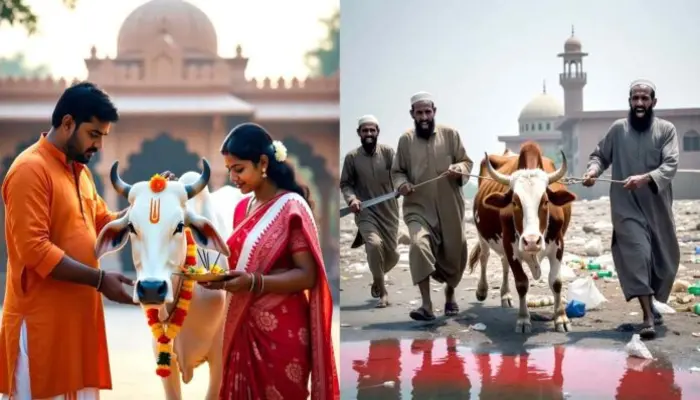
Case Summary
Hindu sentiments were outraged after a case of organised cow slaughter came to light in Banda Basti, Mhow, Madhya Pradesh, where a group of Muslim men led by Imran Khatkhat was involved in the illegal slaughter of multiple cows on the day of Bakrid (Eid al-Adha). The incident gained attention at the time of Bakrid when the Muslim perpetrators slaughtered more than eight cows at a location in Mhow. Upon receiving information about the activity, local activists associated with Bajrang Dal, a Hindu organisation, reached the spot, following which the Muslim perpetrators fled the area. Police subsequently launched an investigation and arrested a number of individuals linked to the operation, while the mastermind, Imran Khatkhat, remained absconding for several days. Following sustained efforts to locate him, police received information on 2 June 2026 that Imran Khatkhat, a 38-year-old resident of Banda Basti, had been seen near Choral Dam. Acting on the tip-off, a police team surrounded the area in an attempt to apprehend him. Upon noticing the police presence, Imran attempted to escape and ran towards a nearby culvert. Taking advantage of the darkness, he jumped from the structure in an effort to evade arrest. Police personnel pursued him and later found him injured beneath the culvert. He sustained serious injuries to both legs as a result of the jump and was taken to the hospital for medical treatment before being formally arrested. During interrogation, the accused identified himself as Imran, son of Anwar Khatkhat. Authorities stated that he had been carrying a reward of ₹5,000 due to his continued absconding. After his arrest, he was produced before a court, which remanded him to judicial custody. A case had been registered against him under Sections 4, 5 and 9 of the Madhya Pradesh Prohibition of Cow Slaughter Act, 2004, along with Section 25(1)(B) of the Arms Act. Police investigations linked him and his associates to the slaughter of numerous cows in the Mhow area, leading to legal action against members of the network involved in the operation.
Why it is Hate Crime ?
This case has been added to the tracker under the primary category of - Attack on Hindu religious representations. Within it, the sub-category selected is - Desecration of Hindu religious symbol. Icons and symbols or a religious representation of a spiritual ideal are widely revered in Hinduism. Iconography is of vital significance in the Hindu milieu. It helps connect people’s spiritual beliefs with the real world. Iconography within the Hindu faith takes several shapes and forms. Murtis are of most significance to Hindus, to which daily rituals, prayers and offerings are done. Besides the murtis, there are several other symbols which have deep significance in the Hindu faith – the Om and Swastika for example. Since these Hindu religious symbols hold paramount importance in Hinduism, any desecration of symbols, icons, murtis, religious representations and manifestations, is driven by animosity towards the faith itself which manifests itself through these murtis, icons and symbols. Therefore, any desecration of these Hindu religious symbols and representations is considered religiously motivated hate crimes under this category. This case has been included in the tracker because it involved the slaughter of multiple cows by a group of Muslim men around the time of the Islamic festival of Bakrid (Eid al-Adha). To understand why cow slaughter evokes such profound anguish within Hindu society, one must first understand what the cow represents within Hindu civilisation. The cow is not merely an animal. It is revered as Gau Mata, a symbol of motherhood, nurturing, sacrifice, compassion, and life-giving abundance. Hindu civilisation has for millennia accorded a uniquely elevated position to the feminine through the worship of goddesses such as Durga, Lakshmi, Saraswati, Kali, and countless local manifestations of the Divine Mother. The cow occupies a sacred place within this civilisational framework because it is seen as an embodiment of maternal care and feminine divinity. The sacred status of the cow is rooted in centuries of Hindu belief and practice. Vedic literature refers to the cow as "Aghnya", meaning one that should not be harmed or killed. Cow-derived products play an important role in numerous Hindu rituals, ceremonies, and religious observances. This sacred status of cows in Hinduism is precisely why radical Muslims repeatedly target cows, be it cow slaughter or the force-feeding of cow meat of Hindu women; these acts by Islamists are essentially meant to mock and humiliate Hindus and violate the sanctity of Hindu femininity. Their objective is not simply to sacrifice an animal but to desecrate a symbol that Hindus revere. Since the cow embodies motherhood, feminine divinity, and values that occupy a central place in Hindu civilisation, its slaughter inflicts far greater religious and psychological injury than the slaughter of any ordinary animal. The act derives its significance from its sacredness. In this way, cow slaughter becomes not merely an act of animal sacrifice but a symbolic assault on Hindu faith itself. What makes this incident even more egregious is the timing of the incident, which is relevant for understanding its impact on the Hindu community. Eid al-Adha commemorates Prophet Ibrahim's willingness to sacrifice his son in obedience to God, and Islamic tradition permits the sacrifice of various animals, including goats, sheep, buffaloes, camels, etc. The sacrifice of a cow is not a mandatory or indispensable requirement of the festival. Indian courts, including the Supreme Court, have repeatedly observed that cow sacrifice does not constitute an essential religious practice under Islam. Multiple alternative animals may be lawfully and religiously sacrificed for Eid al-Adha. Despite this, Muslims have repeatedly slaughtered cows during Bakrid. The repeated insistence on cow slaughter, therefore, cannot be understood solely through the lens of religious obligation. If the purpose were merely to fulfil the ritual requirements of the festival, any of the permissible animals would suffice. The deliberate preference for cows is significant because of what cows represent to Hindus. The act derives its impact precisely from the fact that it wounds Hindu religious sentiments in a way that the sacrifice of other animals does not. This explanation becomes even clearer when viewed alongside the numerous cases where Hindu women have been forced to eat beef or cow meat against their wishes. The purpose of such acts is not food or nutrition. The humiliation comes from forcing a Hindu to violate something she considers sacred. The act derives its impact precisely because the cow holds a revered place in Hindu belief. The same logic applies to cow slaughter. The power of the act lies in the fact that it targets a symbol that Hindus deeply revere. The more sacred the symbol, the greater the hurt caused by its violation. This is why the repeated targeting of cows, despite the availability of several other permissible animals for sacrifice, cannot be viewed merely as a religious necessity. The significance lies in the cow's unique place in the Hindu faith and religious life. Viewed as a whole, the pattern suggests that the cow is targeted not because it is the only animal that can be sacrificed, but because it is sacred to Hindus. The act, therefore, goes beyond animal sacrifice. It becomes an attack on a symbol that represents Hindu faith, sacred motherhood, and feminine divinity, causing the deepest possible religious and emotional injury to the Hindu community that reveres it. Disclaimer: It is important to clarify that none of the media sources covering this case has specified the exact date when the victim's ordeal began. The earliest date mentioned is 2 June 2026, when the accused was seen near Choral Dham. Since the Hinduphobia Tracker records incidents based on when the victim’s ordeal began, not when it was reported, we have considered the date of the incident to be 2 July 2026. Disclaimer: The Hinduphobia Tracker acknowledges that multiple individuals were involved in the cow-slaughter operation led by Imran Khatkhat. However, the available reports explicitly identify only Imran Khatkhat by name, while the remaining participants are referred to generally as members of his gang or accomplices. Since the identities and exact number of the other accused individuals were not disclosed in the source material, the perpetrator count has been conservatively recorded as 1.


Case Status
Arrested


Perpetrators Details
Perpetrators
Muslim Extremists
Perpetrators Range
One Person
Perpetrators Gender
male
 Sources




