Hindu man’s home broken into, husband brutally beaten and wife left bloodied by Muslim mob in Bangladesh for refusing extortion demand
 Jessore District, Bangladesh
  8 June, 2026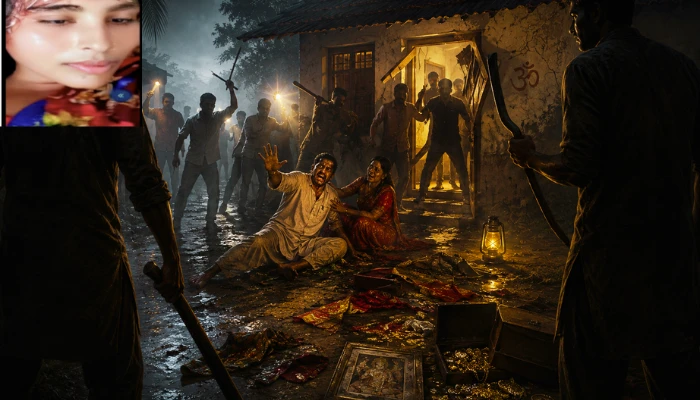
Case Summary
In Bahadurpur village, Khanpur Union, Monirampur upazila, Jashore district, Bangladesh, the home of a Hindu resident was attacked by a mob in the early hours of 8 June 2026. Shubh Biswas had repeatedly refused extortion demands made by Mahbub Mordal and Matiar Rahman Mordal of Machna village, after which a group of 10 to 12 men broke into his home, assaulted his family, and looted cash and jewellery. For an extended period before the attack, Mahbub Mordal and Matiar Rahman Mordal of Machna village in Khanpur Union had been demanding five lakh taka in extortion money from Shubh Biswas. Shubh Biswas refused to comply with the demand. According to the family, this refusal provoked the accused. In the early morning hours of 8 June 2026, a group of 10 to 12 men, led by Mahbub Mordal and Matiar Rahman Mordal, descended on Shubh Biswas's home in Bahadurpur village. The group broke down the door of the house, forced entry, and began looting the premises. When they turned on Shubh Biswas, his wife, Suchitra Biswas, moved to place herself between her husband and the attackers. The mob beat her severely. She was struck on the head, sustained serious injuries, and collapsed on the ground in a bloodied state. Suchitra Biswas was subsequently rescued and transported to a private hospital in Jashore town. Medical staff confirmed she required multiple stitches to her head, and she remained hospitalised at the time this report was prepared. The attackers looted two lakh taka in cash that had been kept at the home for Shubh Biswas's business purposes. They also seized a gold chain from Suchitra Biswas's neck during the assault. Following the attack, fear and anger spread through the Bahadurpur village and the surrounding areas. Residents called for a thorough investigation, the swift arrest of those responsible, and exemplary legal consequences. The victim's family stated they were in the process of filing a formal complaint and initiating legal proceedings. At the time this report was written, no FIR status or police statement was available from the relevant authorities. The attack on Shubh Biswas and family took place against the backdrop of sustained and escalating violence against Hindus in Bangladesh, which unfolded in three distinct phases. The first phase followed the ouster of Sheikh Hasina’s government in August 2024. Multiple reports documented attacks on Hindu homes, temples, and religious institutions, alongside arson, mob assaults, and organised intimidation of minority neighbourhoods. The Hinduphobia Tracker recorded 336 such incidents during this period. The second phase followed the death of Sharif Osman Bin Hadi, a Muslim political activist known for anti‑Hindu rhetoric, who died in Dhaka on 18th December 2025 during clashes. In the aftermath, Hindu communities were blamed and subjected to retaliatory violence. Hindu homes were set ablaze, and families were displaced. A Hindu man named Dipu Chandra Das was lynched and his body set ablaze by a mob on false blasphemy allegations. Posters and written materials calling for the extermination of Hindus appeared in public spaces. The Hinduphobia Tracker documented 51 incidents of anti‑Hindu violence in this period alone. The third phase erupted after the 13th National Parliamentary Election in 2026. Within days of the results, Hindu families in Noakhali, Rangpur, Nilphamari, Sylhet, Thakurgaon, and Dinajpur reported coordinated attacks involving arson, looting, assault, and vandalisation of temples and homes. Hindu residences were selectively targeted, and families received threats of displacement. The stabbing of Bipin Kumar Mondal in Kaliganj formed part of a wider pattern in which Hindu men and women across Bangladesh faced violence, extortion, and intimidation, a pattern sustained by the persistent failure of authorities to respond with the consistency and urgency that the protection of a besieged religious minority demanded.
Why it is Hate Crime ?
The primary category for this case is "Attack not resulting in death". The sub-category for this case is "Attacked for Hindu identity". In several cases, Hindus are attacked merely for their Hindu identity without any perceived provocation. A classic example of this category of religiously motivated hate crime is a murder in 2016. 7 ISIS terrorists were convicted for shooting a school principal in Kanpur because they got ‘triggered’ seeing the Kalava on his wrist and the tilak that he had put. In this, the Hindu victim had offered no provocation except for his Hindu religious identity. The motivation for the murder was purely religious, driven by religious supremacy. Such cases where Hindus are targeted merely for their religious identity would be documented as a hate crime under this category. The other sub-category selected is "Attacked for opposing radicals or trying to save a victim" In several cases, Hindus are attacked for opposing religiously motivated crimes being committed against a fellow Hindu or simply for voicing an opinion opposing radical elements, who either have in the past or continue to persecute Hindus. In such cases, the initial attack against the victim, against which the Hindu was trying to defend the victim, would also need to be classified as a religiously motivated hate crime. Since the initial crime itself was religiously motivated and the subsequent crime of attempting to save the victim or speaking against the radical elements ends up inviting a violent attack, it would also be classified as a religiously motivated hate crime under this category. This case was included in the Hinduphobia Tracker because it occurred within a documented environment in which Hindu minorities in Bangladesh had repeatedly faced violence, intimidation, economic coercion, and organised hostility. Consequently, the incident was not assessed in isolation but within the broader context of sustained anti-Hindu persecution that had affected Hindu communities across the country. At its core, the case raised concerns because the violence appeared to be the culmination of a process of coercion directed against a Hindu family living within that persecution environment. The significance of the incident did not lie solely in the violence itself but in the manner in which pressure was imposed and subsequently enforced. In contexts where religious minorities are repeatedly subjected to intimidation and coercion, such conduct often serves a wider purpose than personal enrichment. It reinforces fear, demonstrates vulnerability, and establishes dominance over individuals perceived to have limited ability to resist or secure protection. The incident was not treated as an ordinary assault because it took place in a broader environment where Hindus in Bangladesh had repeatedly faced attacks, intimidation, violence, and other forms of persecution. Since the victims belonged to a Hindu family living amid this documented pattern of anti-Hindu hostility, their religious identity was a relevant factor when assessing the motive and nature of the attack. Had a similar robbery or assault occurred in most parts of India or in another setting where no comparable pattern of systematic persecution against Hindus existed, it would ordinarily have been treated as a conventional criminal offence rather than a hate crime. However, in Bangladesh, where Hindus have faced sustained and documented targeting, such incidents cannot be viewed in isolation from the wider context in which they occur. The violence was not limited to Shubh Biswas alone. Suchitra Biswas was attacked when she stepped forward to protect her husband from the assailants. Her injuries were not the result of a separate dispute. She was targeted because she intervened during the attack and attempted to shield another victim from harm. Her victimisation, therefore, formed part of the same chain of events and demonstrated how violence against one member of a Hindu family could quickly extend to others who resisted or tried to provide protection. Furthermore, the broader context remained highly significant. During periods of sustained persecution, patterns themselves acquire evidentiary value. While the available facts did not contain an explicit declaration of religious motive, the identity of the victims, the nature of the coercion, the targeting of a Hindu household, and the consistency of the incident with documented forms of anti-Hindu intimidation were all relevant considerations. The absence of an express statement did not eliminate the need to assess the incident within the environment in which it occurred. Viewed in its entirety, the case reflected more than an isolated act of criminal violence. It illustrated how coercion, intimidation, and violence could operate against members of a vulnerable religious minority within a broader atmosphere of hostility. For that reason, the incident was recorded as a likely anti-Hindu hate crime, subject to review should future evidence establish a different motive. Disclaimer: The media report stated that a mob of approximately 10 to 12 men participated in the attack. For documentation purposes, the perpetrator count has been recorded as 12 to capture the maximum number of assailants mentioned in the source. This figure should therefore be understood as an estimate based on the reported range rather than a confirmed count of identified perpetrators.
Victim Details
Total Victim
2
Deceased
0
Gender
- Male 1
- Female 1
- Third Gender 0
- Unknown 0
Caste
- SC/ST 0
- OBC 0
- General 0
- Unknown 2
Age Group
- Minor 0
- Adult 2
- Senior Citizen 0
- Unknown 0


Case Status
Unknown


Perpetrators Details
Perpetrators
Muslim Extremists
Perpetrators Range
From 10 to 100
Perpetrators Gender
male
 Sources




