Minor Hindu girl driven to suicide after facing sexual exploitation, blackmail, forced conversion, and pressure to wear a burqa by Muslim man
 Dharwad, Karnataka, India
  7 May, 2026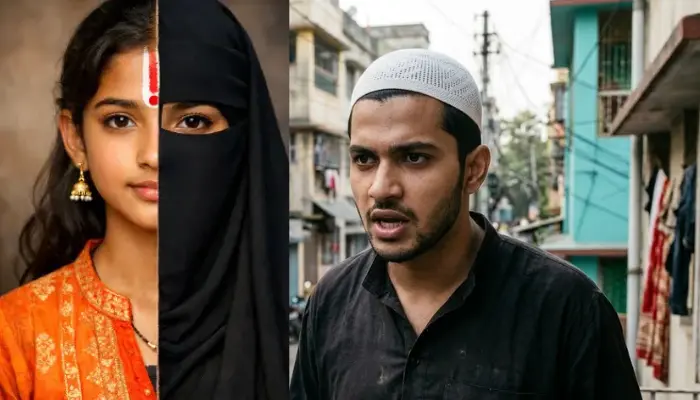
Case Summary
A minor Dalit Hindu girl from Garag village in Dharwad district, Karnataka, was driven to suicide after being subjected to sexual exploitation and mental harassment by a Muslim youth, Nayeem Baig of Hanumankoppa. The accused blackmailed the girl with her obscene photos and videos and was also pressuring her to convert to Islam and wear a burqa. According to media reports, the girl was lured into a relationship by the accused, Nayeem Baig. He began grooming her and then subjected her to sexual exploitation and mental harassment. He also pressured her to convert to Islam and wear a burqa. When the victim's family found out about this, they opposed the relationship and counselled the girl to stay away from the accused. Following this, both the accused and the girl were disconnected for some period of time, but later they came into contact as Nayeem gave her a phone to secretly talk with him. Subsequently, Nayeem posted all the obscene photos and videos of her on his social media that he had clicked with her. This caused the girl severe mental distress, leading to her suicide. The victim attempted suicide on 8 May 2026 after consuming insecticide. She was later admitted to the Karnataka Medical College and Research Institute (KMCRI), where she died on 9 May 2026 despite treatment. Following the investigation, police arrested two accused in the case, 25-year-old Nayeem Baig Jorammanavar of Hanumanakoppa village and 22-year-old Sohail Mulla of Uppinabetageri village. Nayeem Baig was arrested in Shirahatti in Gadag district by a team led by Garag Sub-Inspector Praveen Gangol, and later his associate Sohail Mulla was also taken into custody. Police recovered photographs and explicit videos from the mobile phones of the accused, Nayeem and Sohail, confirming the sexual exploitation of the minor girl. Following this, Hindu organisations expressed outrage over the matter, calling it a case of ''Love Jihad''. Sri Rama Sene chief Pramod Mutalik visited Garag village and questioned the delay in the police response, while also meeting the victim’s family. Meanwhile, Hindu organisations including the Bajrang Dal and the Vishwa Hindu Parishad announced plans to stage protests in Garag village, demanding strict punishment for the accused and others involved in the case. Dalit Sangharsh Samiti (DSS) leader Hemavati T stated that the accused had entered into a relationship with the girl and later harassed her, leading to her suicide. She also highlighted delays in police action. Hemavati stated: “The police have also acted in favour of the youth in this case. As a result, an FIR was registered only 15 days after the girl’s death, following the directions of the Superintendent of Police.” She said that the girl’s uneducated parents were being sidelined and the police were attempting to hush up the case. She further demanded an immediate, thorough investigation and strict action against the guilty. Otherwise, she warned them that they (Dalit Sangharsh Samiti office-bearers) along with the victim’s parents would launch a dharna (sit-in protest), seeking justice.
Why it is Hate Crime ?
The first primary category selected in this case is: Predatory Proselytisation. The subcategory selected is: Proselytisation by grooming, brainwashing, manipulation or subtle indoctrination. The tertiary categories selected are: Rape and sexual assault/harassment, Conversion of Minor, and Family/Friends of deceased victim says she was brainwashed/groomed. Religious brainwashing essentially means the often subtle and forcible indoctrination to induce someone to give up their religious beliefs to accept contrasting regimented ideas. Religious grooming or brainwashing also involves propaganda and manipulation. It involves the systematic effort, driven by religious malice and indoctrination, to persuade “non-believers’ to accept allegiance, command, or doctrine to and of a contrasting faith. Cases of such grooming or brainwashing are far more nuanced than direct threats, coercion, inducement and violence. In such cases, it is often seen that there is repeated, subtle and continual manipulation of the victim to induce disaffection towards their own faith and acceptance of the contrasting faith of the perpetrator. While subtle indoctrination is widely acknowledged as predatory, an element which is often understated in such conversions or the attempts of such conversion is the role of loyalty and trust which might develop between the perpetrator and the victim. Fiduciary relationships are often abused to affect such religious conversion. For example, an educator transmitting religious doctrine of a competing faith to a Hindu student. The Hindu student is likely to accept what the teacher is transmitting owing to existence of the fiduciary relationship. The exploitation of the fiduciary relationship to religiously indoctrinate victims would also be included in this category. Since the underlying animosity towards the victim’s faith forms the basis of predatory proselytization, such cases are considered religiously motivated hate crimes. The other subcategory selected is: Harassment, threats, coercion for conversion. Harassment covers a wide range of behaviours of an offensive nature. It is commonly understood as behaviour that demeans, humiliates, and intimidates a person, including threats and coercion. Harassment and threats, in this case, find their root on discriminatory grounds which has the effect of nullifying a person’s rights or infringing upon his freedom to exercise his right specifically owing to the victim’s religious identity. Verbal and physical threats and psychological or physical harassment are often used against Hindu victims because they choose to practice their professed religion. Religious harassment also includes forced and involuntary conversions by harassment, threats or coercion. Coercion includes intimidatory tactics like force-feeding a Hindu victim beef to convert to another religion, forceful circumcision etc. In several cases documented, non-Hindu perpetrators or those who harbour specific animosity towards Hinduism, harass victims simply based on their religious identity. Such cases often also include harassment to ensure the Hindu victim abandons his/her professed religion and adopts the religion of the perpetrator. Such cases where Hindu victims are harassed to convert to the perpetrator’s religion are rooted in animosity towards the victim’s religious identity and are therefore documented as religiously motivated hate crimes. The other subcategory selected is: Suicide after pressure to convert. When there is pressure, threat or coercion employed upon the Hindu victim to convert to a different religion, in several cases, owing to the humiliation or pressure/threat, the victim commits suicide. In such cases, the pressure/threat/intimidation/coercion/violence itself is driven by animosity towards the victim’s Hindu faith. The pressure/threat that is employed leads to the Hindu victim taking his own life. Since the victim’s faith is at the heart of the pressure to convert and the ensuing suicide by the victim, such cases are considered religiously motivated hate crimes. The second primary category selected in this case is: Crimes against women in relationships and other sexual crimes. The subcategory selected is: Brainwashed and/or Groomed. The tertiary categories selected are: Rape and sexual assault/harassment, Conversion of Minor, and Family/Friends of deceased victim says she was brainwashed/groomed. In our database, we have not added incidents where women have converted to another religion of their free will and no allegations of forced/involuntary conversion have been made. However, there are certain cases of conversion where the consent itself is a result of the brainwashing or grooming of a minor by the non-Hindu perpetrator trying to victimise a woman for her Hindu religious identity. The phenomenon of grooming points to non-Hindu perpetrators identifying their Hindu victims’ vulnerabilities and exploiting them over months and sometimes years, to extract the supposed ‘consent’ in order to convert their religion. In most cases of grooming, the victims are minors or the grooming started when the victim was a minor. In other cases of grooming, the non-Hindu perpetrator brainwashes and grooms a minor victim to extract their trust and then proceeds to rape them repeatedly with the intent of converting them to their faith. It is pertinent to understand here that when the victim is a minor, the ‘consent’ to convert or enter into a romantic relationship with an adult itself is redundant – addressed by POCSO. While every case of conversion of a minor and incidents of establishing a physical relationship with a minor by an adult is a crime, for the purpose of this database, a case would be considered a hate crime only if there is a distinct religious angle to the grooming. For example, in the UK, if a Hindu minor is targeted by Pakistani grooming gangs, it would be considered a hate crime because the victims are specifically targeted owing to their non-Muslim religious identity with the perpetrators being Muslim. In other cases, if a Hindu minor is brainwashed into entering a physical relationship with the non-Hindu adult perpetrator and the family alleges grooming/brainwashing of the minor to convert her religion, it would form a part of this database. If the victim is a Hindu adult, the case would form a part of this database only if the victim herself says that she was brainwashed/groomed to convert her religion. However, if the victim is deceased (murdered or otherwise), the case would form a part of this database if her family/friends provided testimony that the victim was brainwashed/groomed to convert her religion. Since these crimes have a distinct religious angle where the victim is being targeted owing to her Hindu religious identity, these cases are considered a hate crime. The other subcategory selected is: Blackmailed to convert. When Hindu women are in a relationship with non-Hindu men, there are cases where the woman is blackmailed to convert her religion, owing to her religious identity of being a Hindu. Such relationships may be consensual with the religious identity of the non-Hindu man known to the victim, however, there could be cases where the relationship is not consensual and the non-Hindu man starts blackmailing a Hindu woman to convert her religion. In these cases, it is often seen that the Hindu woman is blackmailed with intimate photos and/or videos, threats of harm to her or her family, threats of violence etc. Such cases are driven by specific religious motivations and against the religious identity of the victim and are therefore qualified as hate crimes. The case involving the minor Dalit Hindu girl from Garag village serves as a clear example of a religiously motivated hate crime. The sequence of events, whereby a minor Hindu girl was lured into a relationship, subsequently groomed, sexually exploited, and systematically pressured to convert to Islam and wear a burqa by the Muslim accused, demonstrates a targeted religious agenda. The accused later escalated the harassment by posting explicit photographs and videos of the victim on social media, intentionally inflicting severe public humiliation and psychological trauma. This sustained, identity-based persecution ultimately crushed her spirit, driving her to end her life. The presence of these explicit religious demands and targeting makes the entire trajectory of this crime undeniably rooted in religious animosity. To fully understand the gravity of this crime, it is vital to recognise that the victim, due to her age, was in a position of extreme vulnerability. Since she was a minor, the element of genuine consent and a true change of conscience was entirely missing ab initio. Minors possess a natural vulnerability that makes them easily susceptible to manipulation, grooming, and coercion. They lack the emotional and psychological maturity to comprehend the lifelong implications of engaging in sexual activities with an adult, entering complex relationships, or altering their religious faith. The perpetrator deliberately and calculatedly exploited this age vulnerability, using it as a tool to dismantle her religious autonomy and force her into conversion and the adoption of the burqa, highlighting a clear intent to strip a minor Hindu girl of her faith. Furthermore, the sexual exploitation inflicted upon the victim cannot be viewed in isolation; it was directly tied to the overarching objective of religious conversion. The systematic grooming and violation of the girl reveal that this sexual violence was not committed merely for physical gratification. Given the persistent demands for conversion that followed, the sexual exploitation was used as a weapon to target a Hindu girl specifically because of her religious identity. By violating her sexually, the perpetrator sought to increase her emotional dependence, induce trauma, and break down her psychological resistance. This represents a distinct form of religiously motivated sexual exploitation, where sexual violence serves as a mechanism to assert dominance over a victim's religious identity. The act of blackmailing the victim with intimate media to force her conversion to Islam highlights the deep religious hostility underpinning the case. Subjecting a Hindu individual to forced conversion is a direct violation of religious autonomy and fundamental human rights. A person's faith is an intrinsic part of their identity, and using coercion, terror, intimidation, and social ruin to compel them to abandon it is an act of ideological aggression. In this case, the demand to convert was not an afterthought but the primary objective, using emotional and social destruction to erase the victim's Hindu faith. Such systematic coercion aimed at destroying an individual's religious identity constitutes a core marker of an identity-based hate crime. Similarly, the demand that the victim wear a burqa represents a calculated attempt at cultural erasure and religious imposition. Forcing a Hindu girl to adopt attire deeply tied to Islamic religious practice is an aggressive form of grooming designed to sever her ties with her own community, heritage, and family. It marks a physical manifestation of dominance, where the victim is forced to outwardly project an identity that has been violently thrust upon her. In the context of ongoing harassment, this imposition functions as a tool of total submission, making it an act of hate aimed at erasing her visible connection to her Hindu heritage. Finally, the immense mental harassment that drove the victim to suicide underscores the absolute severity of the hostility she faced. The psychological torture of balancing severe community stigma with relentless demands to convert and alter her entire life created an unendurable environment of despair. Driving a young girl to consume insecticide to escape this torment reveals the lethal nature of the coercion. When a victim is cornered into taking her own life because she refused to yield her faith, it demonstrates that the harassment was absolute and unyielding. This fatal outcome is the direct consequence of a campaign of terror rooted in deep religious animosity. Since this case meets the parameters of a hate-driven offence, it is being added to the hate crime database of the Hinduphobia Tracker. Disclaimer: The Hinduphobia Tracker records incident dates based on when the victim's ordeal begins rather than when it is reported by the media. In the present case, media reports do not specify the exact date on which the victim's suffering began. They only mention that she attempted suicide on 8 May 2026, which is the earliest date available in the public domain. Hence, 8 May 2026 has been recorded as the indicative incident date for documentation purposes only. Although Naeem Baig is identified as the main accused in this case, the police also arrested his accomplice, Sohail Mullah, for possessing obscene photographs of the victim. Accordingly, both individuals have been considered perpetrators, and the perpetrator count has been recorded as two. This classification is made for documentation purposes only.
Victim Details
Total Victim
1
Deceased
1
Gender
- Male 0
- Female 1
- Third Gender 0
- Unknown 0
Caste
- SC/ST 1
- OBC 0
- General 0
- Unknown 0
Age Group
- Minor 1
- Adult 0
- Senior Citizen 0
- Unknown 0


Case Status
Arrested


Perpetrators Details
Perpetrators
Muslim Extremists
Perpetrators Range
From 2 To 5
Perpetrators Gender
male
 Sources




