Hindu temple and idols desecrated; Maulvi pays Muslim youths to attack temples, calls Hindus 'Kafirs' and incites violence against them
 Baddi, Himachal Pradesh, India
  2 June, 2026
Case Summary
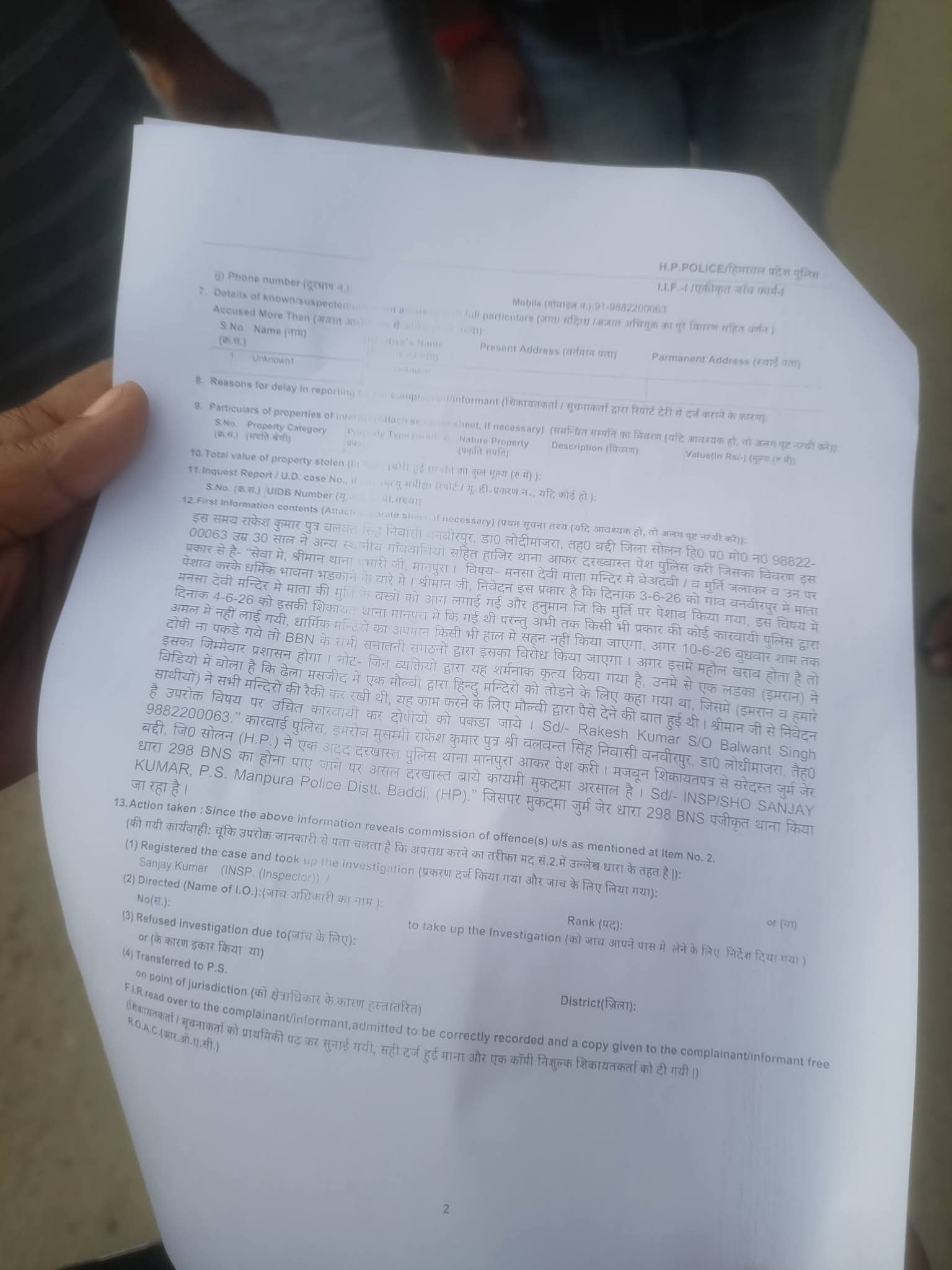
A Hindu temple in Vanveerpur village of Baddi, Himachal Pradesh, was subjected to religious desecration after Muslim perpetrators targeted Hindu religious symbols and places of worship as part of a wider anti-Hindu conspiracy. The Hindu temple was targeted, with its consecrated idols being defiled and temple property burnt by Muslims perpetrators. The incident involved a Muslim boy named Imran, who stated in a video that he had been instructed and financially incentivised by a Maulvi associated with the Dhela Mosque to carry out attacks on Hindu temples. The case involved the burning of sacred objects associated with Hindu deities, the defilement of a Hindu idol, and discussions about expanding similar attacks to other temples across Himachal Pradesh. According to the complaint submitted by Rakesh Kumar, a resident of Vanveerpur village, the incident occurred on 3 June 2026 at the Mansa Devi Mata Temple. The clothes adorning the idol of the Goddess were set on fire, while an idol of Lord Hanuman was urinated upon by Muslim perpetrators. The complainant stated that a report regarding the incident had initially been made to Manpura Police Station on 4 June 2026, but that no action had been taken at that stage. The complaint further stated that the desecration of Hindu temples and religious symbols had deeply offended the religious sentiments of local Hindus and generated widespread anger within the community. The matter gained further significance after a video of one of the perpetrators, Imran, surfaced online. In the video, he stated that a Maulvi from the Dhela Mosque had instructed him and his associates to demolish Hindu temples and had offered them money to carry out such acts. Imran further stated that the Maulvi had described Hindus as "kafirs" (infidels) and told them that Hindus should be killed and their temples burned. He also stated that he and his associates had conducted reconnaissance of temples in the area and discussed plans to target them for desecration and destruction. Information emerging from the incident indicated that a girl and another boy were also involved in the conspiracy. The group also discussed plans to expand similar attacks to Hindu temples across Himachal Pradesh and spoke about challenging the administration with armed individuals. Imran additionally expressed support for the destruction of Hindu temples and advocated violence against Hindus. These statements demonstrated that the attack on the Mansa Devi Mata Temple was not an isolated act of vandalism but formed part of a broader plan directed against Hindu religious institutions and the Hindu community. Following the submission of the formal complaint, Inspector and Station House Officer Sanjay Kumar of Police Station Manpura examined the matter and concluded that the contents of the complaint prima facie disclosed the commission of an offence under Section 298 of the Bharatiya Nyaya Sanhita (BNS). Consequently, a First Information Report (FIR) was registered at Manpura Police Station. The police initiated legal proceedings and forwarded the complaint for investigation into the desecration of the temple, the burning and defilement of Hindu idols, the involvement of additional conspirators, and the role of the Maulvi named in the complaint.
Case Images
Why it is Hate Crime ?
This case has been added to the tracker under the primary category of - Attack on Hindu religious representations. Within it, the sub-category selected is - Attack on temples. In Hinduism, a temple is the abode of the Deity. The Deity in the Temple is consecrated, thereby, making it a real, breathing entity. Hindus believe that not just the Deity but the temple premises itself are sacred to Hindus since Hindus hold the faith that the entire Temple space is an amalgamation of the divine energy of the deity. Given the central significance of Temples in Hindu Dharma, any attack against a Hindu Temple or its peripheral premises is an attack on the faith itself and is born out of animosity towards the faith, of which, the Temple is a central tenet. Any manner of attack against a Temple and/or its premises would therefore be considered a religiously motivated hate crime. The other sub-category selected here is - Desecration of Hindu religious symbol. Icons and symbols or a religious representation of a spiritual ideal are widely revered in Hinduism. Iconography is of vital significance in the Hindu milieu. It helps connect people’s spiritual beliefs with the real world. Iconography within the Hindu faith takes several shapes and forms. Murtis are of most significance to Hindus, to which daily rituals, prayers and offerings are done. Besides the murtis, there are several other symbols which have deep significance in the Hindu faith – the Om and Swastika for example. Since these Hindu religious symbols hold paramount importance in Hinduism, any desecration of symbols, icons, murtis, religious representations and manifestations, is driven by animosity towards the faith itself which manifests itself through these murtis, icons and symbols. Therefore, any desecration of these Hindu religious symbols and representations is considered religiously motivated hate crimes under this category. The other sub-category selected here is - Hate speech against Hindus. Within it, the sub-category selected is - Anti-Hindu slurs, mocking faith. Anti-Hindu slurs and the deliberate mocking of the Hindu faith owing to religious animosity involve the usage of derogatory terms, stereotypes, or offensive references to religious practices, symbols, or figures. One of the common anti-Hindu slurs used against Hindus is “cow-worshipper” and “cow piss drinker”. The intention of using this term is to demean and mock Hindus as a group and their religious beliefs since Hindus consider the cow holy. Additionally, some symbols and the slurs attached to them have a historical context that exacerbates the insult, hate, stereotyping, dehumanisation and oppression against Hindus. Cow worship has been used for centuries to denigrate Hindus, insult their faith and oppress Hindus specifically as a religious group. There has been overwhelming documentation about how cow slaughter has been used to persecute Hindus with cow meat being thrown in temples and places of worship. There has also been overwhelming documentation where cow meat (beef) has been force-fed to Hindus to either forcefully convert them to Islam or denigrate their faith. Apart from cow worship, the Swastika – which holds deep religious significance for the Hindus – has also been misinterpreted and distorted to use as a slur against Hindus. Similarly, the worship of the Shivling has been used by supremacist ideologies and religions to denigrate Hindus owing to religious animosity. Such slurs and denigration stem out of inherent animosity and hate towards Hindus and their faith, therefore, it is categorised as hate speech targeted at Hindus specifically owing to their religious identity. The other sub-category selected is - Violent threats. Violent threats, explicit, implicit or implied, is the most dangerous form of hate speech since it goes beyond discriminatory and prejudicial language to express the intent of causing harm to an individual or a group of people based on their religious identity and faith. There could be several different kinds of threats that are issued to Hindus based on religious animosity. An explicit threat would mean the direct threat of violence towards an individual Hindu, a group of Hindus or Hindus at large. Physical violence, death threats, threats of destruction of property belonging to Hindus and threats of genocide would mean explicit threats against Hindus for their religious identity. Implicit threats may not be a direct threat but implied through the use of symbols of actions – for example – in the Nupur Sharma case, other than explicit threats, there were also implicit threats when Islamists took to the streets to burn and beat her effigies. It implies that they want to do the same to Nupur Sharma – thereby is considered an implicit threat. Violent threats can be delivered in person, through letters, phone calls, graffiti, or increasingly through social media and other online platforms. It would be important to understand that a threat – explicit or implicit, online or offline – to an individual who happens to be a Hindu does not qualify as a religiously motivated threat. Such a threat, while vile and dangerous, could be owing to non-religious reasons and/or personal animosity. To qualify as a religiously motivated threat, it would need to exhibit an indication that the individual is being targeted for religious reasons and/or owing to his/her religious identity as a Hindu. This case has been added to the tracker because the Muslim perpetrators specifically targeted a Hindu place of worship and Hindu religious symbols as part of a broader plan directed against Hindu religious institutions. The incident was not limited to ordinary vandalism or property damage but involved the desecration of sacred Hindu idols, the defilement of a Hindu temple, and statements advocating violence against Hindus and the destruction of Hindu places of worship. The nature of the acts committed, the choice of target, and the statements attributed to those involved collectively reveals hostility directed towards the Hindu faith and its adherents. The available evidence proves that the objective extended beyond causing physical damage and included the desecration, humiliation, and intimidation of a religious community through attacks on objects and sites held sacred by Hindus. A significant indicator of anti-Hindu animus was the deliberate targeting of the Mansa Devi Mata Temple. According to the complaint, the clothes adorning the idol of the Goddess were set on fire. The burning of items adorned on the Hindu deity cannot be viewed as accidental damage or ordinary mischief. Hindu idols and objects used in worship possess profound religious significance for devotees, and the deliberate destruction of such sacred items constitutes an attack on the sanctity of the temple itself. The perpetrators did not target a random structure; they selected a Hindu place of worship, demonstrating that the offence was directed not merely against property but against a symbol of Hindu religious identity. Such conduct was inherently capable of causing fear, distress, and a sense of vulnerability among Hindu worshippers by signalling that their places of worship could be deliberately targeted and desecrated. The desecration of the idol of Lord Hanuman further reinforces the hate-driven nature of the incident. The idol of Lord Hanuman was urinated upon, an act that carries a clear element of contempt, degradation, and religious insult. Urinating on a sacred idol is not merely an act of damage; it is a symbolic act intended to dishonour and defile an object of worship. Lord Hanuman is one of the most widely revered deities in Hinduism, and the deliberate defilement of his idol would be understood by any reasonable person as deeply offensive to Hindu religious sentiments. The nature of this act demonstrates a conscious intention to insult and humiliate Hindu beliefs and traditions. Such conduct reflects hostility towards the religion represented by the idol and strengthens the conclusion that the temple was targeted because of its Hindu character and religious significance. The statements given by Imran in the video provide further evidence of religious animosity towards Hindus. Imran stated that a Maulvi from the Dhela Mosque had instructed him and his associates to demolish Hindu temples and had discussed providing money in exchange for carrying out such acts. He further stated that the Maulvi described Hindus as "kafirs" (infidels), advocated violence against them, and called for Hindu temples to be burned. These statements were significant because they reveal that the attack was not directed at a particular individual or property for personal reasons; rather, Hindu temples were identified as targets because they were Hindu institutions. The discussion of surveying multiple temples, planning further attacks, and expressing hostility towards Hindus demonstrates that the animus was directed towards Hindu religious sites and the Hindu community as a whole. The statements therefore, prove an ideological motive rooted in prejudice against the Hindu faith and an intention to intimidate, insult, and undermine the religious identity of Hindus. Furthermore, the Maulvi described Hindus as "kafirs" (infidels) while advocating violence against them and calling for the destruction of their temples. It was a way to dehumanise Hindus in the eyes of Muslims so as to justify violence against them and desecrate their places of worship. Hindus were identified and singled out on the basis of their religious identity, and the term was used while discussing plans to attack Hindu temples and harm members of the Hindu community. The reference to Hindus as "kafirs", coupled with calls for their killing and the burning of their places of worship, reflects a process of religious othering and dehumanisation that sought to portray Hindus as legitimate targets of hostility. Taken together, the burning of items associated with a Hindu deity, the desecration of a Hanuman idol through urination, and the statements expressing hostility towards Hindus and Hindu temples establish a clear nexus between the offence and the religious identity of the victims and the targeted institution. The evidence indicates that the temple was attacked precisely because it was a Hindu place of worship and that the acts committed were designed to insult, degrade, and provoke Hindus on account of their faith. For these reasons, the incident meets the criteria for classification as a hate crime targeting Hindus and their religious institutions. Disclaimer: The Hinduphobia Tracker acknowledges that multiple individuals were involved in the incident and the broader conspiracy to target Hindu temples. However, the available information explicitly identifies only four individuals: Imran, the Maulvi named in the complaint, one girl, and another boy who were reported to have participated in the conspiracy. Since no further individuals have been specifically identified in the available records, the perpetrator count has been recorded as four for documentation purposes. The actual number of individuals involved may be higher and remains subject to further investigation and disclosure by the authorities.


Case Status
Complaint registered


Perpetrators Details
Perpetrators
Muslim Extremists
Perpetrators Range
From 2 To 5
Perpetrators Gender
both
 Sources




