400 year-old Hindu temple demolished by unidentified miscreants in Gopalganj, Bangladesh
 Gopalganj District, Bangladesh
  7 June, 2026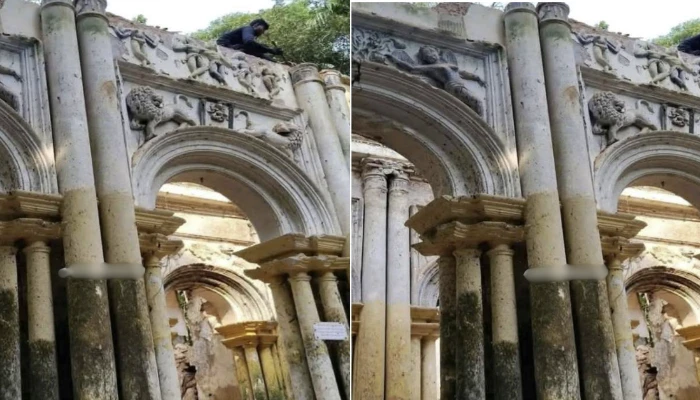
Case Summary
In Chhoto Banagram village of Muktarpur Upazila, Gopalganj District, the historic Saraswati temple, an approximately 400-year-old intricately ornamented Hindu religious structure, was demolished by unknown miscreants. The Saraswati temple of Chhoto Banagram had stood for roughly four centuries as a recognised heritage site of the region. According to local sources and oral tradition, the temple was constructed around the mid-seventeenth century. It was constructed by the local zamindar, Rajat Daulat Bhaumik, and was subsequently named after the Hindu goddess of learning and the arts, Devi Saraswati. A descendant of his family bears the name. The structure was noted for its traditional architectural style and decorative craftsmanship, which distinguished it as a landmark of local history, culture, and religious life. After the reports of the temple's demolition emerged on social media, widespread condemnation followed from the Hindu community online. Numerous Hindu netizens expressed strong protest and called for the preservation of centuries-old religious and historical structures. They held that such heritage sites formed an inseparable part of the country's history and cultural identity, and that their protection was a matter of institutional responsibility, not discretion. At the time of reporting, no formal or official information had been made available regarding the reasons for the demolition, the identity of those responsible, or whether any authorisation from the relevant authorities had been sought or granted. The escalation of violence against Hindus in Bangladesh has unfolded in three distinct phases: first, following the ouster of Sheikh Hasina’s government in August 2024; second, after the death of Sharif Osman Bin Hadi in December 2025; and third, in the immediate aftermath of the 13th National Parliamentary Election 2026. Following the ouster of Sheikh Hasina, multiple reports documented attacks on Hindu homes, temples, and religious institutions, alongside intimidation campaigns, arson, and mob assaults targeting minority neighbourhoods. The Hinduphobia Tracker has recorded 336 such incidents against the Hindu minority, underscoring the scale and persistence of anti-Hindu violence during this period. A further escalation occurred following the death of Sharif Osman Bin Hadi, a Muslim political activist and student leader known for his anti-Hindu and anti-India rhetoric. Hadi had been involved in political unrest after the fall of the Hasina government and was killed in Dhaka on 18th December 2025 during clashes. In the aftermath of his death, Hindu communities were blamed and subsequently targeted in retaliatory violence. Hindu homes were selectively set ablaze in multiple localities, forcing families to flee and leaving many displaced. The attacks appeared patterned rather than sporadic, with Muslim mobs focusing on Hindu neighbourhoods, properties, and religious symbols. Among the victims was Dipu Chandra Das, who was lynched to death and his body was set ablaze by a Muslim mob over false blasphemy allegations. The Hinduphobia Tracker documented 51 incidents of anti-Hindu violence in the period following Hadi’s death alone. Such incidents underscored the vulnerability of the Hindu minority amid rising communal hostility and the weaponisation of religious accusations. Reports further indicated that posters and written materials calling for the extermination of Hindus were displayed in public spaces, signalling an alarming normalisation of genocidal rhetoric. When combined with acts of arson, vandalism, assault, and targeted intimidation, these developments suggested a coordinated environment of hostility aimed at terrorising the Hindu community and reinforcing majoritarian dominance. The third phase of violence was unleashed after the 13th National Parliamentary Election 2026. Within days of the announcement of results, Hindu families in districts such as Noakhali, Rangpur, Nilphamari, Sylhet, Thakurgaon, and Dinajpur reported coordinated attacks involving arson, looting, assault, and vandalism of temples and homes. In several instances, Hindu homes were selectively targeted, looted, and families were threatened with displacement.
Why it is Hate Crime ?
This incident has been added to the tracker under the category- Attack on Hindu religious representations. Under this, the first subcategory selected is- Attack on Temples. In Hinduism, a temple is the abode of the Deity. The Deity in the Temple is consecrated, thereby making it a real, breathing entity. Hindus believe that not just the Deity but the temple premises itself are sacred to Hindus since Hindus hold the faith that the entire Temple space is an amalgamation of the divine energy of the deity. Given the central significance of Temples in Hindu Dharma, any attack against a Hindu Temple or its peripheral premises is an attack on the faith itself and is born out of animosity towards the faith, of which the Temple is a central tenet. Any manner of attack against a Temple and/or its premises would therefore be considered a religiously motivated hate crime. The other subcategory selected is- Desecration of Hindu religious symbol. Icons and symbols or a religious representation of a spiritual ideal are widely revered in Hinduism. Iconography is of vital significance in the Hindu milieu. It helps connect people’s spiritual beliefs with the real world. Iconography within the Hindu faith takes several shapes and forms. Murtis are of most significance to Hindus, to which daily rituals, prayers and offerings are done. Besides the murtis, there are several other symbols which have deep significance in the Hindu faith – the Om and Swastika for example. Since these Hindu religious symbols hold paramount importance in Hinduism, any desecration of symbols, icons, murtis, religious representations and manifestations, is driven by animosity towards the faith itself which manifests itself through these murtis, icons and symbols. Therefore, any desecration of these Hindu religious symbols and representations is considered religiously motivated hate crimes under this category. This case was included in the Hinduphobia Tracker because what was targeted was not merely a physical structure but a consecrated Hindu temple dedicated to Devi Saraswati. At the outset, it was important to recognise that the religious identity of the target was central to understanding the nature of the incident. The structure that was demolished served as a place of worship for Hindus and stood as a visible symbol of Hindu faith, continuity, and presence in the region. The fact that the target was a Hindu temple was not incidental; it was the defining feature of the case. At the core of the incident lay a simple question: why was a centuries-old Hindu temple chosen for destruction? The temple had survived generations of political transitions, social change, and historical upheaval. It had neither fallen into neglect nor been lost to the passage of time. Its destruction resulted from deliberate human action. When a structure of such religious significance was singled out for demolition, the choice of target itself became highly relevant. The act was directed at a sacred Hindu institution and, by extension, at the community that revered it. In Hinduism, a temple is regarded as the abode of the deity and occupies a central place in religious life. Consequently, an attack on a temple is not merely damage to property but an attack on a sacred religious representation. Beyond its spiritual significance, this temple also embodied centuries of Hindu history and cultural continuity. Its demolition therefore carried implications far beyond the loss of a building. The destruction removed a visible symbol of Hindu faith from the landscape and erased a site that had borne witness to generations of Hindu religious life in the region. Such attacks on Hindu temples are basically an attack on the entire Hindu faith itself, and it amounts to desecration of a sacred Hindu symbol. Such attacks are rooted in hatred for Hinduism and its adherents, making it a religiously driven hate crime. The broader context further heightened the seriousness of the incident. The demolition occurred in Bangladesh during a period when Hindu minorities had repeatedly faced attacks on temples, idols, homes, businesses, and other religious institutions. Against this backdrop, the destruction of a historic Hindu shrine could not reasonably be viewed in isolation. Rather, it aligned with a wider pattern in which Hindu religious symbols and institutions had increasingly become targets. The destruction of such a longstanding place of worship conveyed that even sites that had endured for centuries were not beyond attack. Equally significant was the absence of any publicly stated justification, accountability, or legal explanation for the demolition. No official reason was provided, no responsible individuals were identified, and no action was publicly announced against those involved. The result was the destruction of a centuries-old Hindu religious site without any corresponding accountability. Such impunity reinforced fears within the Hindu community that attacks on their religious heritage could occur without consequence. The impact of the incident extended well beyond the temple itself. The destruction of a historic place of worship affected not only those who prayed there but also the wider Hindu community that viewed the site as part of its shared religious and cultural inheritance. Incidents of this nature created insecurity among minority communities by demonstrating that even their most longstanding and historically significant religious institutions remained vulnerable. They also deepened concerns regarding the preservation of Hindu heritage in an environment already marked by documented anti-Hindu hostility. For these reasons, the incident was recorded as an attack on a Hindu religious representation. The deliberate demolition of a centuries-old Hindu temple struck at a sacred institution, erased an important symbol of Hindu continuity, and contributed to a broader climate of fear and vulnerability faced by Hindus in Bangladesh. At the time of reporting, although the identities of the perpetrators remained unknown, the nature of the act was rooted in hostility towards Hindus, their faith, and their religious sites. Accordingly, this incident is being added to the hate crime database of the Hinduphobia Tracker. Disclaimer: The Hinduphobia Tracker records incident dates based on when the crime occurred rather than when it was reported by the media. However, in this case, media reports did not specify the exact date of the incident. Therefore, the date on which the incident was first published by the media, 8 June 2026, has been selected as the indicative incident date. This has been recorded for documentation purposes only.


Case Status
Unknown


Perpetrators Details
Perpetrators
Unknown
Perpetrators Range
Unknown
Perpetrators Gender
unknown
 Sources




