Minor Hindu girl was deceived, sexually exploited and blackmailed by Muslim man feigning Hindu identity
 Purnia, Bihar, India
  9 June, 2026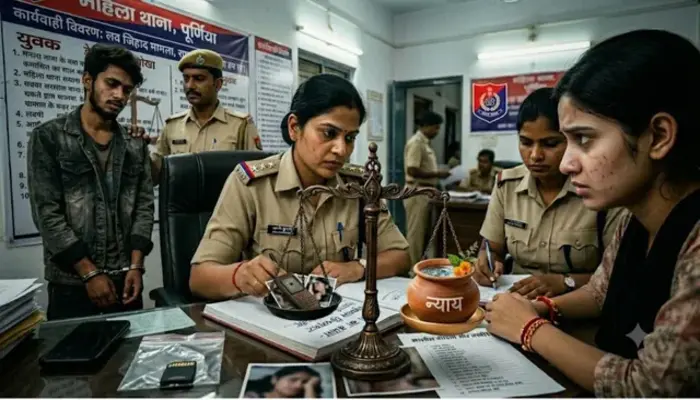
Case Summary
In the Purnia district, Bihar, a minor Hindu girl was deceived, sexually exploited and blackmailed by a Muslim man named Raja Khan, who pretended to be Hindu The accused, Raja Khan, a Muslim man from Narayanpur in Bhagalpur district, had lured the minor Hindu girl into a relationship approximately one and a half years after introducing himself as "Raja" and concealing his religious identity. The victim believed him to be Hindu and remained unaware of his real name and background throughout the period of their association. According to the information that emerged during the investigation, Raja Khan had previously resided in the Purnia area, where he first came into contact with the minor girl. He later moved to Delhi, where he continued his studies and worked in a private capacity, but remained in regular communication with the girl. On 10 June 2026, he travelled from Delhi to Purnia specifically to meet her. After arriving at Purnia Junction railway station, he met the girl and took her to the Kala Bhavan complex in Purnia city. While the two were present at the complex, residents became suspicious and questioned the accused about his identity. During the questioning, he appeared nervous and was asked to produce identification documents. The scrutiny revealed that the individual known to the girl as "Raja" was, in fact, Raja Khan. The disclosure of his concealed identity caused a commotion at the location, and members of the public apprehended him before police intervened and took him into custody. The revelation came as a severe shock to the minor victim, who discovered that the person she had trusted and believed to be Hindu had concealed both his real name and religious identity. During the incident, bystanders examined Raja Khan's mobile phone and found numerous obscene photographs and videos connected to the victim. Further enquiries revealed that the accused had secretly provided the victim with a mobile phone, despite her family being unaware that she possessed one. The phone was used to maintain constant communication with her and to facilitate his continued influence over her. The victim's family reached the scene and informed the police that they had never purchased a mobile phone for their daughter and had no knowledge of her possession of one. Information gathered during the investigation indicated that the accused had used the device to remain in continuous contact with the minor and had placed her in a vulnerable position through manipulation and blackmail. The discovery of objectionable material on the accused's phone further intensified concerns regarding the nature of his interactions with the girl. Following reports of the disturbance and rising tensions at the Kala Bhavan complex, police personnel from Kehat Police Station and the Women's Police Station arrived at the scene and brought the situation under control. Raja Khan was taken into custody, while the victim was escorted to the Women's Police Station for further proceedings. Her parents and relatives subsequently arrived at the police station and sought strict legal action against the accused. Women's Police Station head Aarti Kumari stated that Raja Khan had been taken into police custody and was being interrogated. She said that the matter involved the deception of a minor girl through concealment of identity, harassment, and the possession of obscene material. Police initiated a detailed investigation into all aspects of the case and began the process of recording statements and receiving a written complaint from the victim's family. As the girl was a minor, police stated that an FIR would be registered under relevant provisions relating to offences against children, including the Protection of Children from Sexual Offences (POCSO) Act, along with charges connected to fraud, blackmail, and identity concealment. The accused remained in police custody while the investigation continued.
Why it is Hate Crime ?
The primary category for the case is "Crimes against women in relationships and other sexual crimes". The sub-category for this case is "Man pretends to be Hindu". The tertiary categories here are "Name changed." When a non-Hindu man pretends to be a Hindu to deceive a Hindu woman into a relationship, the act is seen as triggered by malicious intentions. In some cases, the woman eventually accepts the man’s original religious identity and converts after the man’s identity is revealed. These cases could be argued as cases of religious brainwashing and a result of the pressure a woman feels after getting into a relationship with a man. The woman, it can be argued, also changed her religious identity because of the stigma she believes she might face if she chooses to walk out of a deceptive relationship. However, for the purpose of documenting hate crimes, the cases in this subcategory are limited to those where there is explicit violence aimed at religious conversion against the wishes of the victim (force-feeding beef, blackmailing with intimate videos, rape on refusal to convert, etc), or if the woman herself complains of the man’s religious deception. In such cases, it is established that the deception of the non-Hindu man had a specific aim of religious conversion or targeting of the victim due to her Hindu religious identity, therefore, making it a religiously motivated hate crime. This case has been added to the tracker because a minor Hindu girl was deceived, groomed, sexually exploited, and blackmailed by a Muslim man named Raja Khan, who concealed his religious identity and posed as a Hindu in order to gain her trust and establish a relationship with her. The case involves the targeting of a Hindu minor through religious identity concealment, prolonged deception, sexual exploitation, and coercive control. Firstly, it is important to note here that the victim was a minor, which means the element of consent and genuine change of conscience was missing ab initio. Minors, due to their young age and lack of maturity, are particularly vulnerable to manipulation and coercion. They may not have the ability to fully understand the implications of getting into relationship or consenting to sex or elopement, and the Muslim perpetrator purposely targeted and exploited this vulnerability of the victim. Furthermore, any supposed consent given for such a relationship is already considered invalid under the POCSO Act. Secondly, the accused deliberately concealed his religious identity to initiate and sustain a relationship with a minor Hindu girl. This itself is a clear manifestation of bias and malicious intent towards the victim's religion. By concealing his true identity, he exploited her trust, targeting her under false pretences. This indicates a premeditated intent to manipulate her based on her religious background. In cases like these, the tactic of adopting a false Hindu identity to manipulate and "ensnare" a Hindu individual is not just an act of personal betrayal but can also be interpreted as an expression of disdain or disregard for Hinduism and its customs that reflects a deeper animosity towards Hindus and their beliefs. In such instances, identity concealment is not merely a personal deception, but a calculated strategy rooted in religious targeting and profiling. The accused was aware that the victim, being Hindu, may not have consented to the relationship had she known his real identity from the outset. He therefore circumvented her ability to exercise informed choice by deliberately lying about his name and religious background. This demonstrated a premeditated effort to exploit the victim specifically on the basis of her religious identity. Thirdly, the facts of the case reveal a pattern of manipulation and control extending beyond identity concealment. The possession of intimate material involving a minor significantly aggravated the nature of the offence because such material was used to blackmail, threaten, and control the minor Hindu girl. The combination of deception, sexual exploitation, and blackmail demonstrates that the accused exercised influence over the victim through coercive means rather than through an honest and transparent relationship. These exploitations were not random acts of crime; rather, they functioned as religiously motivated tools aimed at humiliating and dominating a Hindu girl because of her faith. The target was not the victim as an individual, but her Hindu identity. The specific focus on her Hindu identity in the commission of these acts highlights the religious hatred underlying the crime, making it a religiously motivated offence. Taken together, the prolonged concealment of religious identity, the discovery of obscene material, and the use of blackmail and exploitation demonstrate a sustained pattern of deception and coercion directed at a Hindu minor. For these reasons, the case has been documented in the tracker as an instance of religiously targeted deception, grooming, sexual exploitation, and coercive control against a Hindu victim. Disclaimer: It is important to clarify that none of the media sources covering this case has specified the exact date when the victim's ordeal began. The earliest date mentioned is 10 June 2026, when the accused travelled to Purnia to meet the victim. Since Hinduphobia Tracker records the incident based on when the victim’s ordeal began and not when it was reported, we have considered the date of the incident as 10 June 2026.
Victim Details
Total Victim
1
Deceased
0
Gender
- Male 0
- Female 1
- Third Gender 0
- Unknown 0
Caste
- SC/ST 0
- OBC 0
- General 0
- Unknown 1
Age Group
- Minor 1
- Adult 0
- Senior Citizen 0
- Unknown 0


Case Status
Arrested


Perpetrators Details
Perpetrators
Muslim Extremists
Perpetrators Range
One Person
Perpetrators Gender
male
 Sources




