Hindu man brutally killed, his wife assaulted by Muslim neighbours in Bangladesh amidst ongoing persecution of Hindu minorities
 Nilphamari District, Bangladesh
  30 May, 2026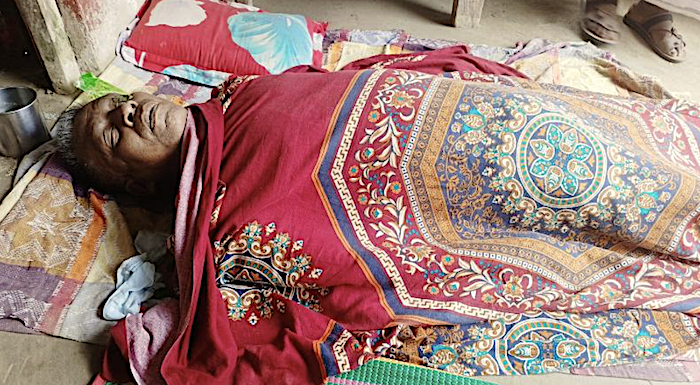
Case Summary
In Nilphamari district's Domar Upazila in Bangladesh, a Hindu man, Sudhir Chandra Roy, died after being subjected to a violent assault by his Muslim neighbours. The attack left him seriously injured and ultimately resulted in his death several days later. The incident occurred amidst continuing anti-Hindu violence across Bangladesh, where members of the Hindu minority community had faced repeated attacks on their lives, homes, property, and personal security. Sudhir Chandra Roy, aged 54, was a resident of the Bhogaripara area under Ketkibari Union in Domar Upazila. The attack centred on a dispute involving a goat that had been tied on neighbouring land. What began as an argument escalated into physical violence directed at the Hindu victim. The assault left Sudhir Chandra Roy severely injured and also caused injuries to his wife, Radhika Rani. According to the victim's family members and local sources, on 31st May 2026, Fatema Begum, the wife of Muslim neighbour Moshiur Rahman, tied a goat on a piece of land adjacent to the Roy family's property. When Sudhir Chandra Roy's second wife, Radhika Rani, objected, an altercation developed between the two sides. As tensions escalated, Sudhir Chandra Roy arrived at the scene and attempted to resolve the dispute. During the confrontation, Moshiur Rahman's son, Fahim, physically attacked him, causing him to collapse to the ground. Following the initial assault, local residents rescued Sudhir Chandra Roy and took him home. As his condition deteriorated, family members arranged to transport him to the Domar Upazila Health Complex for medical treatment. However, while he was being taken for treatment, a group consisting of Moshiur Rahman, his relatives, and approximately twenty to twenty-five associates intercepted the vehicle carrying the injured Hindu man near Gosanihat Bazaar. The group stopped the vehicle and launched a second assault on Sudhir Chandra Roy. He was beaten again while already suffering from injuries sustained during the earlier attack. During this assault, his wife, Radhika Rani, was also injured. The repeated attacks significantly worsened Sudhir Chandra Roy's condition, and he was subsequently admitted to the Upazila Health Complex for treatment. Sudhir Chandra Roy remained under medical care for three days. According to his family, he experienced persistent chest pain following the assault, and his condition did not improve after returning home from hospital. On the night of 6th June 2026, as his chest pain intensified, family members attempted to take him back to hospital. He died on the way. Following news of his death, police from Domar Police Station arrived at the scene and recovered the body. The body was sent for post-mortem examination. Police officials stated that an assault involving neighbours had taken place several days earlier and that the post-mortem examination would assist in determining the precise cause of death. Family members maintained that the injuries inflicted during the assault directly led to Sudhir Chandra Roy's death and demanded justice against those responsible. This escalation of violence against Hindus in Bangladesh has unfolded in three distinct phases: first, following the ouster of Sheikh Hasina's government in August 2024; second, after the death of Sharif Osman Bin Hadi in December 2025; and third, in the immediate aftermath of the 13th National Parliamentary Election 2026. Following the ouster of Sheikh Hasina, multiple reports documented attacks on Hindu homes, temples, and religious institutions, alongside intimidation campaigns, arson, and mob assaults targeting minority neighbourhoods. The Hinduphobia Tracker has recorded 336 such incidents against the Hindu minority, underscoring the scale and persistence of anti-Hindu violence during this period. A further escalation occurred following the death of Sharif Osman Bin Hadi, a Muslim political activist and student leader known for anti-Hindu and anti-India rhetoric. Hadi had been involved in political unrest after the fall of the Hasina government and was killed in Dhaka on 18th December 25 during clashes. In the aftermath of his death, Hindu communities were blamed and subsequently targeted in retaliatory violence. Hindu homes were selectively set ablaze in multiple localities, forcing families to flee and leaving many displaced. The attacks appeared patterned rather than sporadic, with Muslim mobs focusing on Hindu neighbourhoods, properties, and religious symbols. Among the victims was Dipu Chandra Das, who was lynched to death and his body was set ablaze by a Muslim mob over false blasphemy allegations. The Hinduphobia Tracker documented 51 incidents of anti-Hindu violence in the period following Hadi's death alone. Such incidents underscored the vulnerability of the Hindu minority amid rising communal hostility and the weaponisation of religious accusations. Reports further indicated that posters and written materials calling for the extermination of Hindus were displayed in public spaces, signalling an alarming normalisation of genocidal rhetoric. When combined with acts of arson, vandalism, assault, and targeted intimidation, these developments reflected a coordinated environment of hostility aimed at terrorising the Hindu community and reinforcing majoritarian dominance. The third phase of violence unfolded after the 13th National Parliamentary Election 2026. Within days of the announcement of results, Hindu families in districts such as Noakhali, Rangpur, Nilphamari, Sylhet, Thakurgaon, and Dinajpur reported coordinated attacks involving arson, looting, assault, and vandalism of temples and homes. In several instances, Hindu homes were selectively targeted, looted, and families were threatened with displacement.
Why it is Hate Crime ?
This case was added to the tracker under the primary category - Attack resulting in death. The subcategory selected was - Attacked for Hindu identity. In several cases, Hindus are attacked merely for their Hindu identity without any perceived provocation. A classic example of this category of religiously motivated hate crime is a murder in 2016. 7 ISIS terrorists were convicted for shooting a school principal in Kanpur because they got ‘triggered’ seeing the Kalava on his wrist and tilak that he had put. In this, the Hindu victim had offered no provocation except for his Hindu religious identity. The motivation for the murder was purely religious, driven by religious supremacy. Such cases where Hindus are targeted merely for their religious identity would be documented as a hate crime. Under this category, cases where the attack led to the death of the Hindu victim/s would be documented. The other subcategory selected in this case is- Attacked for opposing radicals or trying to save victim. In several cases, Hindus are attacked for opposing religiously motivated crimes being committed against a fellow Hindu or simply for voicing an opinion opposing radical elements, who either have in the past or continue to persecute Hindus. In such cases, the initial attack against the victim, against which the Hindu was trying to defend the victim, would also need to be classified as a religiously motivated hate crime. Since the initial crime itself was religiously motivated and the subsequent crime of attempting to save the victim or speaking against the radical elements ends up inviting a violent attack, it would also be classified as a religiously motivated hate crime. Under this category, cases where the attack led to the death of the Hindu victim/s would be documented. In this case, a Hindu man, Sudhir Chandra Roy, died after being subjected to repeated violent assaults by his Muslim neighbours in Bangladesh. The attacks left him seriously injured, and he succumbed to his injuries several days later. His wife, Radhika Rani, was also injured during the second assault. In the prevailing environment of anti-Hindu hostility in Bangladesh, the incident aligns with the broader pattern of insecurity, violence, and targeting experienced by the vulnerable Hindu minority community. While some may argue that the immediate trigger for the violence was a dispute over a goat tied on neighbouring land, the broader context of anti-Hindu hostility, persecution, and insecurity in Bangladesh remains relevant for classification. During periods marked by sustained violence, intimidation, and targeting of Hindus based on their religious identity, the Hinduphobia Tracker applies a contextual presumption that attacks on Hindu victims may be faith-targeted, even when immediate reports attribute the violence to personal disagreements, property disputes, or other local circumstances. In such situations, the vulnerability of Hindu communities and the normalisation of hostility towards religious minorities can contribute to attacks occurring without perpetrators openly expressing a religious motive. For the purpose of documenting the 2024 to 2026 ethnic cleansing of Hindus in Bangladesh and the subsequent persecution following the political exile of Sheikh Hasina, the death of Sharif Osman Hadi, and the 13th National Parliamentary Election 2026, the Hinduphobia Tracker records such incidents as likely religiously motivated at the point of entry. If any case is later established through credible investigation or court findings to have arisen from motivations other than religious hostility, it will be revised or removed from the hate crime database. The death of Sudhir Chandra Roy and the injuries sustained by his wife generated concern among local Hindus because the victims belonged to a vulnerable religious minority community. Although the immediate trigger appeared to be a neighbourhood dispute over the tying of a goat, the violence escalated into repeated assaults, including an attack on the vehicle transporting the injured victim for medical treatment. The incident reinforced existing fears among Hindus living in an environment already characterised by recurring incidents of anti-Hindu hostility, intimidation, and violence. This incident must also be viewed within Bangladesh's broader anti-Hindu environment, where Hindu minorities frequently face insecurity, intimidation, land-related conflicts, social pressure, and violence. Attacks on Hindus are often attributed to ostensibly non-religious causes such as personal disputes, criminal activities, property disagreements, or other local conflicts, thereby obscuring the possibility of underlying religious hostility. In many instances, such explanations can divert attention from the broader pattern of discrimination and violence faced by Hindu minorities. In the present case, the dispute originated over a seemingly minor issue involving a goat tied on adjacent land, yet it escalated into a brutal assault that was followed by a second attack while the injured Hindu victim was being transported for medical treatment. The participation of multiple members of the neighbouring Muslim family and a group of approximately twenty to twenty-five associates transformed a local disagreement into a coordinated act of violence against a Hindu household. Set against the backdrop of an ongoing environment in which Hindus constitute a vulnerable minority and have faced recurring incidents of intimidation and violence, the possibility that the victim was targeted within this broader pattern of religious persecution cannot be conclusively ruled out on the basis of the information presently available. The death of Sudhir Chandra Roy and the assault on Radhika Rani contributed to feelings of insecurity within the local Hindu community and reinforced the reality of their vulnerability, irrespective of whether the perpetrators explicitly articulated a religious motive. Given the prevailing anti-Hindu persecution environment in Bangladesh and the continuing pattern of violence affecting vulnerable Hindu minorities, this case meets the threshold for inclusion in the Hinduphobia Tracker's hate crime database.
Victim Details
Total Victim
2
Deceased
1
Gender
- Male 1
- Female 1
- Third Gender 0
- Unknown 0
Caste
- SC/ST 0
- OBC 0
- General 0
- Unknown 2
Age Group
- Minor 0
- Adult 2
- Senior Citizen 0
- Unknown 0


Case Status
Complaint filed


Perpetrators Details
Perpetrators
Muslim Extremists
Perpetrators Range
From 10 to 100
Perpetrators Gender
both
 Sources




