Hindu mother and her two daughters found dead inside government guesthouse in Bangladesh amidst ongoing persecution of Hindu minorities
 Barguna District, Bangladesh
  2 June, 2026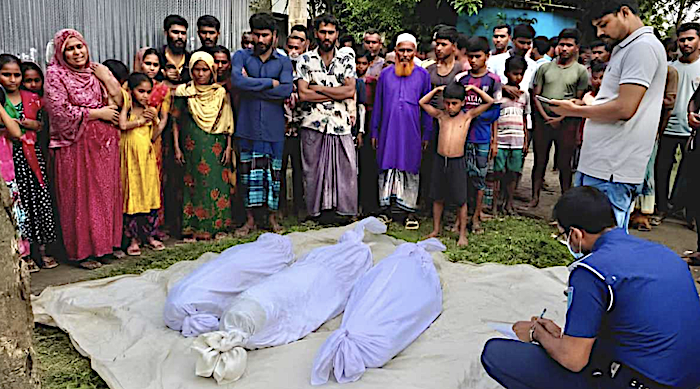
Case Summary
Hindu woman Smriti Rani and her two young daughters were found dead inside rooms on the third floor of the Barguna District Council Dak Bungalow in Barguna, Bangladesh. The deaths of the Hindu mother and her children shocked the local Hindu community and immediately raised serious concerns about the circumstances in which they lost their lives. Questions emerged after the bodies were recovered from separate rooms inside a government facility, while conflicting accounts surfaced regarding the cause of death. The victims were identified as Smriti Rani, the wife of Dulal Roy, and her two minor daughters. Smriti Rani had been working as a temporary cleaner at the Barguna District Council Dak Bungalow. The family belonged to Bangladesh's Hindu minority community. Their deaths occurred at a time when Hindus across Bangladesh continued to face heightened insecurity, targeted violence, and growing concerns over their safety amid an increasingly hostile environment for religious minorities. On 3rd June 2026, at approximately 4:30 pm, police recovered the bodies from two separate rooms on the third floor of the government guesthouse. One of the minor girls, estimated to be around six years old, was found lying on a bed in Room 303. Smriti Rani and her younger daughter, estimated to be around two years old, were subsequently found inside the adjacent Room 304 after the door was opened. Police personnel, district administration officials, and investigators arrived at the scene and began an inquiry into the deaths. Initial information indicated that sleeping pills and a bottle of water were recovered from one of the rooms. Police stated that preliminary findings pointed towards a possible suicide scenario and launched an investigation to determine the exact cause of death. The bodies were sent for further examination while investigators collected evidence from the rooms and the surrounding premises. The deaths quickly became the subject of public scrutiny after portions of CCTV footage from the guesthouse circulated online on 05/06/26. The footage showed several individuals moving around the third floor before the bodies were discovered. One man was seen approaching and knocking on a door before entering a nearby room. He later returned to the area multiple times. Another individual subsequently arrived, and both men were seen moving around the floor where the Hindu mother and her daughters were later found dead. The released footage also raised questions about the operation of the surveillance system within the government facility. Observers noted inconsistencies in the displayed date and time stamps. Questions were raised regarding whether the CCTV system had been configured correctly and whether all available footage had been made public. Public discussion intensified after only selected portions of surveillance footage were released despite confirmation that investigators had collected several hours of recordings from the guesthouse. Further questions emerged regarding a black handbag seen in the footage. CCTV images showed Smriti Rani entering Room 303 carrying the bag. Family members later stated that the same bag was recovered from Room 304, where one of the victims was found. The movement of the bag between rooms became another point of discussion surrounding the sequence of events that unfolded inside the building before the deaths were discovered. Members of the victims' families rejected suggestions that the deaths resulted from suicide. Dulal Roy stated that he observed marks on the necks of his daughters and maintained that they had been killed. He demanded a full investigation and sought accountability for those responsible. The deaths prompted demonstrations and public gatherings in Barguna, where residents called for the disclosure of all available CCTV footage and demanded a transparent investigation into the circumstances surrounding the deaths. Police authorities continued to investigate the incident and stated that no final determination had been reached. Barguna Superintendent of Police Muhammad Kudrat-e-Khuda stated that investigators were examining all available evidence and had formed an additional investigation team led by the Detective Branch. Police also confirmed that approximately six hours of CCTV footage had been collected from the guesthouse for examination. The deaths of Smriti Rani and her two daughters occurred against the backdrop of sustained anti-Hindu hostility and violence in Bangladesh. As members of the Hindu minority community, the victims belonged to a population that has faced repeated incidents of intimidation, displacement, assault, vandalism, and targeted attacks in recent years. Their deaths, therefore, attracted particular attention among minority rights advocates and local residents, who emphasised the need for a thorough investigation capable of determining whether the family was specifically targeted and whether all possible motives had been fully examined. This escalation of violence against Hindus in Bangladesh unfolded in three distinct phases. The first followed the ouster of Sheikh Hasina's government in August 2024. During this period, attacks on Hindu homes, temples, and religious institutions were documented across multiple districts. Hindu neighbourhoods faced intimidation campaigns, arson attacks, mob violence, and destruction of property. The Hinduphobia Tracker documented 336 incidents targeting Hindus during this period, highlighting the scale of violence faced by the minority community. A second phase emerged following the death of Sharif Osman Bin Hadi on 18th December 2025. Hadi, a Muslim political activist known for anti-Hindu and anti-India rhetoric, was killed during clashes in Dhaka. Following his death, Hindu communities were subjected to retaliatory attacks in several areas. Hindu homes were set on fire, families were displaced, and Hindu neighbourhoods faced organised violence. The Hinduphobia Tracker documented 51 incidents of anti-Hindu violence during this period alone. Among the victims was Dipu Chandra Das, who was lynched and his body burned following false blasphemy accusations. Reports from this period also documented public displays of material calling for the extermination of Hindus. Combined with incidents of arson, vandalism, assault, intimidation, and attacks on religious sites, these developments reflected a broader environment of hostility directed towards Bangladesh's Hindu minority. A third phase of violence emerged following the 13th National Parliamentary Election 2026. In the aftermath of the election results, Hindu families in districts including Noakhali, Rangpur, Nilphamari, Sylhet, Thakurgaon, and Dinajpur reported attacks involving looting, arson, assault, vandalism of homes, and destruction of temples. Hindu properties were selectively targeted, and families faced threats of displacement. These incidents further reinforced concerns regarding the security of Hindu communities across the country.
Why it is Hate Crime ?
This case was added to the tracker under the primary category - Attack resulting in death. The subcategory selected was - Attacked for Hindu identity. In several cases, Hindus are attacked merely for their Hindu identity without any perceived provocation. A classic example of this category of religiously motivated hate crime is a murder in 2016. 7 ISIS terrorists were convicted for shooting a school principal in Kanpur because they got ‘triggered’ seeing the Kalava on his wrist and tilak that he had put. In this, the Hindu victim had offered no provocation except for his Hindu religious identity. The motivation for the murder was purely religious, driven by religious supremacy. Such cases where Hindus are targeted merely for their religious identity would be documented as a hate crime. Under this category, cases where the attack led to the death of the Hindu victim/s would be documented. In this case, Hindu woman Smriti Rani and her two minor daughters were found dead inside a government guesthouse in Barguna, Bangladesh. The deaths of a Hindu mother and her young children must be viewed within the wider reality faced by Hindus in Bangladesh, where members of the minority community have experienced sustained violence, intimidation, displacement, and insecurity. The loss of an entire Hindu family unit carries significance beyond the immediate victims and creates fear throughout the wider Hindu community. The targeting of a Hindu mother together with her children represents one of the most devastating forms of violence that can be inflicted upon a vulnerable minority population. While the available information does not contain an explicit statement of religious motive, the broader anti Hindu persecution environment in Bangladesh remains highly relevant. The Hinduphobia Tracker documents incidents occurring during a period marked by repeated attacks on Hindu homes, temples, businesses, and families. During such periods of widespread hostility, perpetrators do not need to openly declare anti Hindu motives for religious targeting to occur. The normalisation of hostility towards Hindus can influence victim selection even where a direct religious statement is absent. As a result, incidents involving Hindu victims must be assessed within the wider context of anti Hindu violence rather than in isolation. For the purpose of documenting the 2024 to 2026 persecution of Hindus in Bangladesh following the political upheaval after Sheikh Hasina's removal, the violence that followed the death of Sharif Osman Bin Hadi, and the attacks that emerged after the 13th National Parliamentary Election 2026, the Hinduphobia Tracker applies a contextual framework when assessing attacks against Hindu victims. Under this framework, serious violence or deaths involving members of the Hindu minority are evaluated against the documented pattern of anti Hindu persecution occurring across the country. If future evidence conclusively establishes a different motive, the classification can be revised accordingly. The deaths of Smriti Rani and her daughters are particularly concerning because the victims belonged to a Hindu family living within a climate of sustained anti Hindu hostility. This was not an incident affecting a single victim but one that wiped out a Hindu mother and her children together. Across Bangladesh, anti Hindu violence has frequently extended beyond individuals and targeted entire families, households, and communities. Such incidents deepen insecurity among Hindus by reinforcing the perception that neither family life, childhood, nor ordinary daily existence provides protection from harm. The impact therefore extends beyond the immediate victims and contributes to fear throughout the wider Hindu minority community. This case must also be viewed within Bangladesh's documented anti Hindu ecosystem, where Hindu identity has increasingly corresponded with heightened vulnerability to violence. The deaths of a Hindu mother and her two daughters occurred during a period in which Hindu communities faced repeated attacks, threats, displacement, and intimidation. The vulnerability of the victims, the destruction of an entire Hindu family unit, and the broader pattern of anti Hindu hostility support the conclusion that this case constitutes probable religious targeting and warrants documentation within the wider record of persecution faced by Hindus in Bangladesh. Given Bangladesh's sustained anti-Hindu persecution environment, this case meets all thresholds for inclusion in the Hinduphobia Tracker's hate crime database.
Victim Details
Total Victim
3
Deceased
3
Gender
- Male 0
- Female 3
- Third Gender 0
- Unknown 0
Caste
- SC/ST 0
- OBC 0
- General 0
- Unknown 3
Age Group
- Minor 2
- Adult 1
- Senior Citizen 0
- Unknown 0


Case Status
Unknown


Perpetrators Details
Perpetrators
Unknown
Perpetrators Range
Unknown
Perpetrators Gender
unknown
 Sources




