Hindu indigenous tribal villagers lured to convert and attacked for resisting religious conversion by Christian pastor and associates in Bastar, Chhattisgarh
 Bastar, Chhattisgarh, India
  7 June, 2026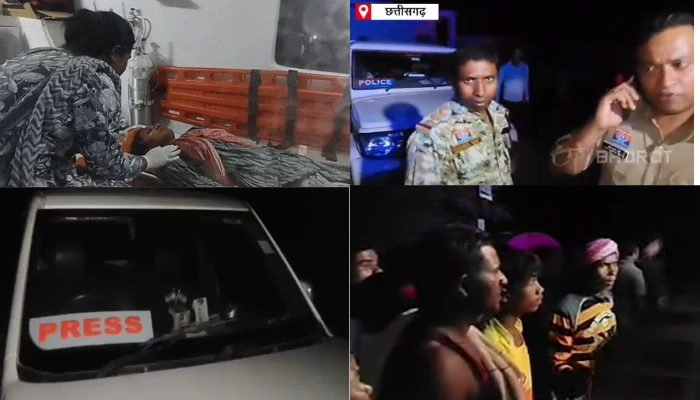
Case Summary
In Bharanda village, Bastar, Chhattisgarh, the indigenous Hindu tribal community were targeted and lured to convert to Christianity by a Christian pastor and his associates. When villagers came to know of the activities and opposed them, a clash broke out in which a woman and other villagers sustained serious injuries. On the evening of 8th June 2026, a Christian pastor, along with two to three other individuals, arrived in Bharanda village under the Bharanda police station area of Narayanpur district, Chhattisgarh. The vehicle in which they arrived bore the word "Press" on it. According to villagers, the group entered a private residence in the village and conducted religious activities there. The villagers stated that they attempted to persuade members of the indigenous tribal community to abandon their Hindu faith and adopt Christianity. When information about the activities spread through the village, a large number of Hindu villagers gathered at the location and raised strong objections. A dispute broke out between the villagers and members of the converted community who were present. The verbal confrontation quickly escalated into a physical altercation. Two to three people, including a woman, sustained injuries in the clash. The injured were transported to the hospital by ambulance for medical treatment. On receiving information about the disturbance, the police reached the spot. The situation was brought under control with some effort. The pastor and two to three other individuals were taken to the police station for questioning. Aggrieved villagers staged a sit-in protest on the road following the incident. They stated that the pastor and his associates had arrived in a vehicle marked "Press", and expressed concern that the use of a press-marked vehicle tarnished the image of journalism. They demanded strict action against the pastor and all others involved and raised objections to the manner in which the religious activities had been conducted in the village. Upon receiving information about the dispute, senior police and administrative officials reached the scene. An additional police force was deployed in the village and surrounding areas to maintain order. Police held discussions with both sides in an effort to keep the situation calm. The entire matter was under investigation at the time of writing the report.
Why it is Hate Crime ?
The primary category for this case is "Attack not resulting in death", and within this, the subcategory selected is "Attacked for opposing radicals or trying to save a victim" In several cases, Hindus are attacked for opposing religiously motivated crimes being committed against a fellow Hindu or simply for voicing an opinion opposing radical elements, who either have in the past or continue to persecute Hindus. In such cases, the initial attack against the victim, against which the Hindu was trying to defend the victim, would also need to be classified as a religiously motivated hate crime. Since the initial crime itself was religiously motivated and the subsequent crime of attempting to save the victim or speaking against the radical elements ends up inviting a violent attack, it would also be classified as a religiously motivated hate crime under this category. The other primary category selected in the case is "Predatory Proselytisation". Within this, the subcategory selected is - "Conversion/attempts to convert by inducements". Predatory Proselytisation is not just limited to threat, harassment, force and violence, but it also has contours of stealth. In several cases, the Hindu victim is exploited to convert, with non-Hindus taking advantage of their poverty. In such cases, the Hindu victim who is suffering financially is offered monetary benefits, including lucrative offers for jobs, health treatment, education, etc, to induce the victim into changing his/her religion. In such cases, the religious identity of the victim and the aim to disenfranchise him from his faith form the heart of the crime. Also, taking advantage of and exploiting an individual’s economic vulnerabilities is widely acknowledged as exploitation, forms of which are often penalised by law. Such cases, therefore, are considered religiously motivated hate crimes since the victim’s religious identity forms the very heart of the crime itself. This case was included in the Hinduphobia Tracker because it involved two distinct but connected acts of religious hostility, both directed at the Hindu tribal community of Bharanda village. At the outset, the attempt to lure Hindu tribal villagers away from their ancestral faith through inducements served as the first act of religious hostility. The targets were not chosen arbitrarily. The Hindu tribal villagers were carefully selected because they were innocent, economically vulnerable, and socially isolated from mainstream institutional support. Their circumstances made them susceptible to false promises of miraculous healings, financial assistance, better livelihoods, and prospects of social upliftment. These were not spiritual offerings but calculated baits, designed to exploit the gap between what a vulnerable person needed and what a missionary was willing to promise in exchange for the abandonment of their faith. The inducements were not offered as unconditional welfare. They were tied to the acceptance of Christianity and the abandonment of Hindu belief and practice. The objective was not coexistence; it was replacement. Hindu tribal identity was treated as something to be discarded, and material incentives were the instrument deployed to achieve that. The second act was the violence that followed when Hindu villagers resisted. The villagers did not initiate aggression; they only objected. They exercised the basic right to oppose activities they believed targeted their community and undermined their faith. That act of opposition invited a physical assault in which a woman and other villagers sustained serious injuries. The violence was the direct consequence of Hindu resistance to conversion activity. It functioned as both punishment for that resistance and a warning against future opposition. Taken together, these two acts revealed a single religious motive. Hindu tribal identity was first identified as the target for conversion, then defended by those who bore it, and punished for that defence. The inducements sought to weaken the community’s attachment to Hinduism from within. The violence sought to silence those who refused to allow it. Both served the same end. Accordingly, this case was included in the Hinduphobia Tracker. Disclaimer: The available source reported that one woman and two to three other villagers sustained injuries in the incident. As the exact number of injured persons was not specified beyond this range, the victim count has been recorded as four (4) for documentation purposes only. The actual number of victims may be higher. Further, the report mentioned only one pastor by designation, without naming him or specifying the exact number of associates present. The perpetrator count has accordingly been recorded as one (1) for documentation purposes. The actual number of perpetrators involved may be higher.
Victim Details
Total Victim
4
Deceased
0
Gender
- Male 3
- Female 1
- Third Gender 0
- Unknown 0
Caste
- SC/ST 0
- OBC 0
- General 0
- Unknown 4
Age Group
- Minor 0
- Adult 1
- Senior Citizen 0
- Unknown 3


Case Status
Complaint filed


Perpetrators Details
Perpetrators
Christian Extremists
Perpetrators Range
One Person
Perpetrators Gender
male
 Sources




