"You are a Hindu, we will kill you": Armed Muslim men brutally attack Hindu youth while making derogatory remarks against Hinduism
 Hapur, Uttar Pradesh, India
  4 June, 2026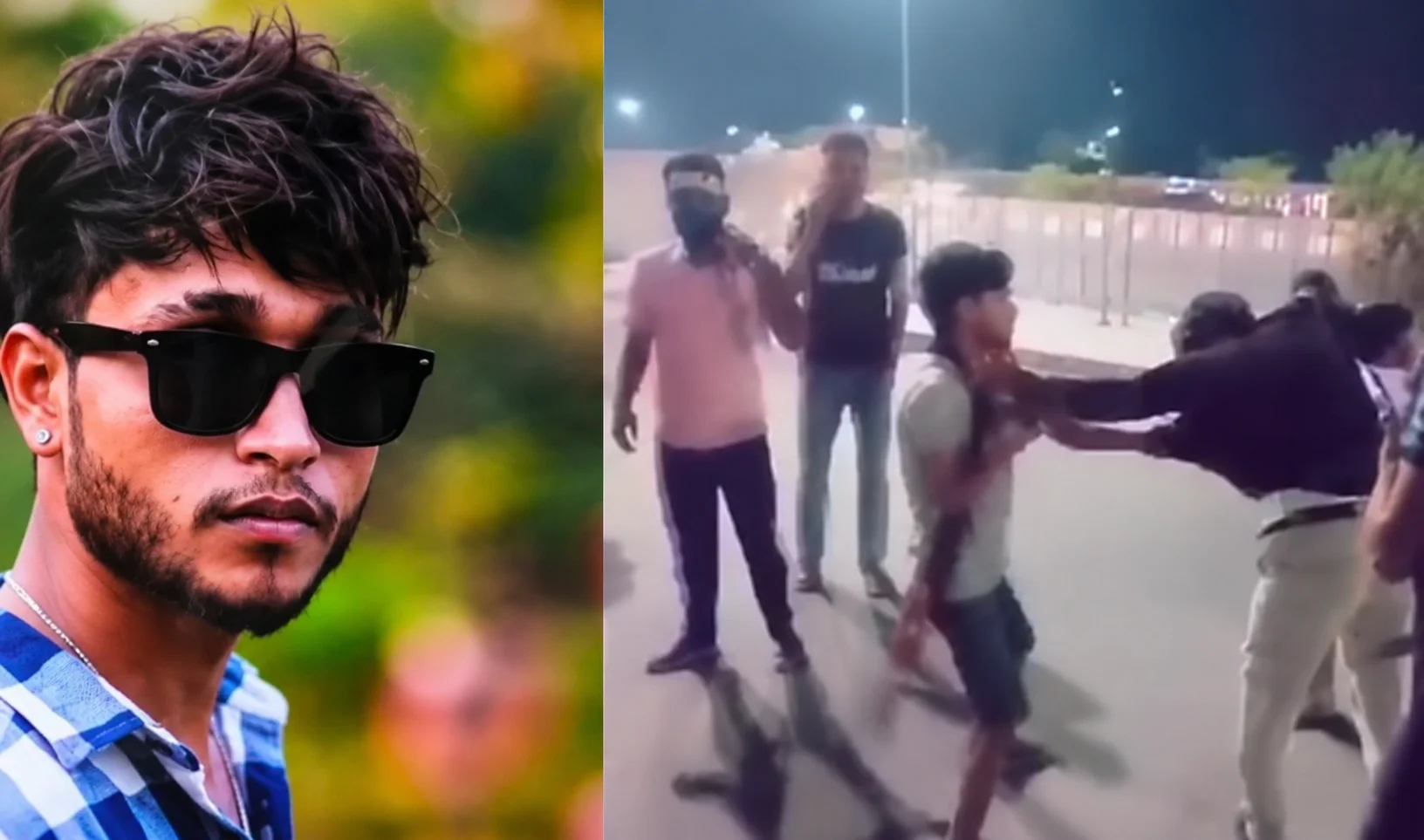
Case Summary
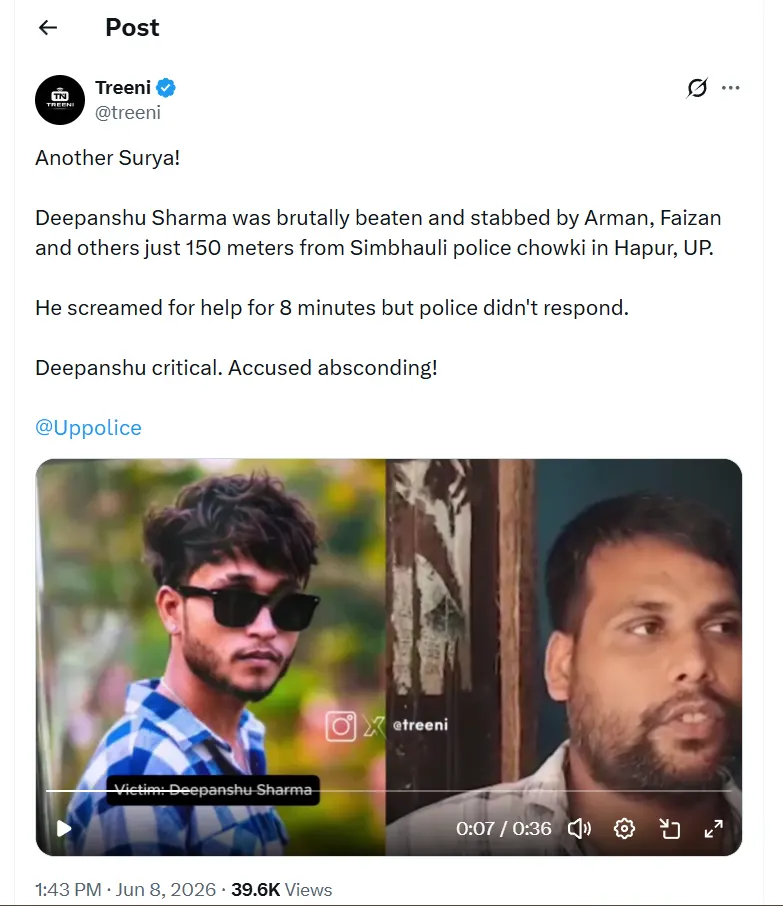
In Buxar village of Hapur, Uttar Pradesh, a Hindu youth named Deepanshu Sharma alias Pashu was brutally attacked by armed Muslim men after being identified as a Hindu. The accused first threatened him for being a Hindu before launching a violent assault. They also made derogatory remarks against Hinduism in front of the victim. According to reports, the attack took place on 5 June 2026. The accused first asked Deepanshu his name and, upon hearing his Hindu name, became determined to kill him. The victim's brother, Lalit, stated that the accused, Faizan and Arman, made objectionable remarks against Hinduism and attacked Deepanshu with the intention of killing him. Lalit said that his brother worked at the shop of a Muslim man named Sahil. Sahil had a dispute with Faizan and Aamir during Eid, which created tension between the two sides. Deepanshu was also present at the scene during that earlier incident and had intervened in the dispute, because of which the accused held a grudge against him. Late on the night of 5 June 2026, Deepanshu was returning home from work with his Muslim friend Shajim when the accused, Faizan, Arman and their four to five Muslim accomplices stopped them on the way. The accused first asked for their names and, after hearing Deepanshu's name, said, "You live with Sahil and are Hindu, and we will kill you today." Faizan and Arman then attacked Deepanshu with a knife and a scooter key. According to the victim's family, two of Deepanshu's friends later informed Lalit that the accused became even more aggressive after hearing his Hindu name, intensifying the assault. Lalit stated that the attackers chased away Shajim, who was accompanying Deepanshu, saying, "You are Muslim, nothing will happen to you; he will be killed today." The Hindu victim sustained serious injuries to his face and head in the assault, and the attackers fled after assuming that he was dead. He was initially taken to a local hospital before being referred to Meerut Medical College due to his critical condition. The victim's brother, Lalit, said that while being transported to the hospital, his injured brother narrated the entire incident himself and identified the Muslim perpetrators by name. According to the victim, the attack was premeditated, and he was targeted solely because of his religion. The incident led to tensions in the area. Reports also confirmed that even after undergoing two head surgeries, Deepanshu's condition remained critical. The victim's family demanded strict action against the accused and demanded the invocation of the National Security Act (NSA). Family members and Hindu organisations also demanded an encounter of the main accused. Deepanshu's brother Gurjeet Sharma stated that if the attackers were not killed in an encounter, the family would be forced to leave the area as they feared the accused would not allow them to live there. The police seized CCTV footage from the earlier incident (fight during Eid) as well as footage of the attack and used it to identify the accused. Gurjeet Singh, a resident of Buxar village, filed a complaint at the police station stating that his brother Deepanshu was attacked with a knife by Faizan, a resident of the same village, along with Arman and five other associates. During the investigation, police arrested Faizan, son of Firoz Khan, from the Nawada canal track and recovered his scooter. The police believed that the scooter key was used in the attack. During this time, the other perpetrator, Arman, remained absconding. The police then claimed that Deepanshu was attacked with the scooter key rather than a knife. The search for the remaining accused continued, with multiple police teams and the Special Operations Group deployed after the accused fled towards the Saharanpur area and switched off their mobile phones. The police investigation further revealed that Arman's brother-in-law had earlier been attacked and injured by his cousins, Sahil and Aamir, while Deepanshu was present with them at the scene, although he did not participate in the fight. The relevant footage was also seized by the police. According to the police, the individuals seen assaulting Deepanshu had been identified from the footage and would be arrested soon. Police also found that the male members of the accused's families had gone underground, while only the women remained at their homes and were unwilling to cooperate with the investigation. Their mobile phones had been switched off, making it difficult for the police to obtain leads. The accused had also installed CCTV cameras around their houses, an uncommon feature in the village, which further complicated efforts to trace their whereabouts. The investigation also revealed that when the initial information about the assault reached the police, the victim was identified only by his nickname "Pashu", leading officers to believe that both groups involved in the clash were Muslim. It was only after the injured youth reached Meerut Medical College and his family identified him as Deepanshu Sharma, a Hindu, that the police realised the communal nature of the attack. By that time, the attackers had already fled.
Case Images
Why it is Hate Crime ?
The case is being added to the Hinduphobia Tracker under the primary category: Attack not resulting in death. The subcategory selected is: Attacked for Hindu identity. In several cases, Hindus are attacked merely for their Hindu identity without any perceived provocation. A classic example of this category of religiously motivated hate crime is a murder in 2016. 7 ISIS terrorists were convicted for shooting a school principal in Kanpur because they got ‘triggered’ seeing the Kalava on his wrist and tilak that he had put. In this, the Hindu victim had offered no provocation except for his Hindu religious identity. The motivation for the murder was purely religious, driven by religious supremacy. Such cases where Hindus are targeted merely for their religious identity would be documented as a hate crime under this category. The case is also being added under another primary category: Hate speech against Hindus. The subcategory selected is: Anti-Hindu slurs, mocking faith. Anti-Hindu slurs and the deliberate mocking of the Hindu faith owing to religious animosity involve the usage of derogatory terms, stereotypes, or offensive references to religious practices, symbols, or figures. One of the common anti-Hindu slurs used against Hindus is “cow-worshipper” and “cow piss drinker”. The intention of using this term is to demean and mock Hindus as a group and their religious beliefs since Hindus consider the cow holy. Additionally, some symbols and the slurs attached to them have a historical context that exacerbates the insult, hate, stereotyping, dehumanisation and oppression against Hindus. Cow worship has been used for centuries to denigrate Hindus, insult their faith and oppress Hindus specifically as a religious group. There has been overwhelming documentation about how cow slaughter has been used to persecute Hindus with cow meat being thrown in temples and places of worship. There has also been overwhelming documentation where cow meat (beef) has been force-fed to Hindus to either forcefully convert them to Islam or denigrate their faith. Apart from cow worship, the Swastika – which holds deep religious significance for the Hindus – has also been misinterpreted and distorted to use as a slur against Hindus. Similarly, the worship of the Shivling has been used by supremacist ideologies and religions to denigrate Hindus owing to religious animosity. Such slurs and denigration stem out of inherent animosity and hate towards Hindus and their faith, therefore, it is categorised as hate speech targeted at Hindus specifically owing to their religious identity. This case is a clear example of a religiously motivated hate crime because a Hindu youth was profiled on the basis of his Hindu identity. After his name confirmed that he was a Hindu, he was brutally assaulted by the Muslim perpetrators solely because of his religious identity. During the attack, the accused also made derogatory remarks against Hinduism in the victim's presence, demonstrating that the violence was accompanied by explicit religious hostility. The selection of the victim on the basis of his faith, coupled with anti-Hindu remarks and the brutal nature of the assault, makes this incident a clear example of a religiously motivated hate crime. It is first important to clarify that some may argue that the initial trigger for the incident was a non-religious dispute between Muslim youths on Eid in which the Hindu victim, Deepanshu, was present and that this resulted in a personal grudge between the Muslim perpetrators and the victim. However, any personal dispute ceased to be the defining feature of the incident the moment the perpetrators profiled Deepanshu on the basis of his religious identity and singled him out because he was a Hindu. The attack was no longer directed at an individual because of an earlier disagreement but was transformed into an act of violence motivated by the victim's Hindu identity, making the victim's faith the central reason for the assault. This itself is the first and most significant religious marker in the case. On 5 June 2026, the perpetrators did not attack Deepanshu merely because he had been present during an earlier dispute on the day of Eid. Instead, they first established his identity by asking his name and, after confirming that he was a Hindu, declared that he would be killed because he was a Hindu. The explicit reference to his religion before launching the assault demonstrates that his Hindu identity became the trigger for the violence. The severity of the attack further reflects the depth of hostility directed towards the victim on account of his faith. By identifying, isolating and violently attacking him as a Hindu, the perpetrators demonstrated animosity that extended beyond any personal disagreement and entered the realm of religious hatred. Such targeted violence against an individual solely because he belongs to the Hindu community is a clear manifestation of a religiously motivated hate crime. Another important religious marker is the manner in which the perpetrators treated Deepanshu's Muslim companion. While carrying out the assault, they chased away his Muslim friend, stating that nothing would happen to him because he was Muslim and that only the Hindu victim would be killed. This statement is of immense significance because it clearly distinguishes between the two individuals solely on the basis of religion. The Muslim companion was spared and permitted to leave unharmed, while the Hindu youth was isolated and subjected to brutal violence. This selective targeting removes any doubt regarding the motive behind the attack and demonstrates that the perpetrators consciously differentiated between individuals based on religious identity. The deliberate separation of the Hindu victim from his Muslim friend and the decision to inflict violence only upon the Hindu youth reveal the depth of religious hostility that motivated the crime and make it a clear case of a religiously motivated hate crime. The perpetrators also made derogatory remarks against Hinduism while carrying out the assault. Hinduism is one of the world's oldest living religions and holds profound spiritual, cultural and emotional significance for millions of devotees. For practising Hindus, their faith forms an integral part of their identity and worldview and commands deep reverence. Mocking or denigrating Hinduism while attacking a Hindu individual is therefore not merely abusive language but an expression of contempt towards a sacred belief system that is cherished by the entire Hindu community. Such remarks inflict deep emotional hurt upon Hindus and reinforce an atmosphere of hostility and intimidation directed against their religious identity. The fact that the perpetrators denigrated Hinduism while simultaneously attacking Deepanshu for being Hindu further demonstrates the depth of their religious hostility. The use of anti-Hindu remarks alongside physical violence reflects an attempt to humiliate, intimidate and dominate the victim because of his faith. The assault was not confined to causing bodily harm but extended to attacking the victim's religious identity and dignity. The combination of targeted violence and the denigration of Hinduism reveals an intention to suppress and degrade the victim for belonging to the Hindu community. This convergence of physical assault and religious contempt makes the communal motive unmistakable and firmly establishes the incident as a religiously motivated hate crime. Taken together, the deliberate profiling of the victim on the basis of his Hindu identity, the explicit declaration that he would be killed because he was Hindu, the decision to spare his Muslim companion while attacking only the Hindu youth, and the derogatory remarks directed against Hinduism collectively demonstrate a pattern of targeted religious hostility rather than an ordinary act of violence. The victim's faith was central to the selection, execution and nature of the attack. Since the incident exhibits clear indicators of religiously motivated violence and anti-Hindu hostility, it is being added to the hate crime database of the Hinduphobia Tracker.
Victim Details
Total Victim
1
Deceased
0
Gender
- Male 1
- Female 0
- Third Gender 0
- Unknown 0
Caste
- SC/ST 0
- OBC 0
- General 1
- Unknown 0
Age Group
- Minor 0
- Adult 1
- Senior Citizen 0
- Unknown 0


Case Status
Case sub-judice


Perpetrators Details
Perpetrators
Muslim Extremists
Perpetrators Range
From 5 to 10
Perpetrators Gender
male
 Sources




