Hindu headmaster assaulted outside school after months of threats, says was targeted because of his religiosu identity
 Dhaka Division, Bangladesh
  6 June, 2026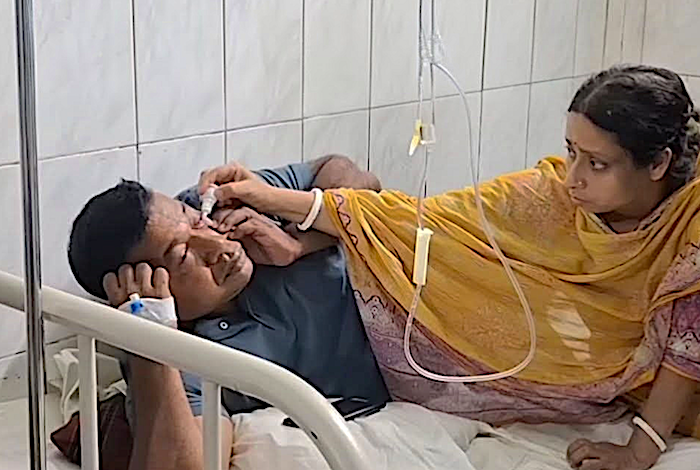
Case Summary
In Shariatpur district of Bangladesh, Hindu school headmaster Sujit Karmakar was physically assaulted outside the main gate of Damudya Pilot Girls’ High School. The incident occurred when he tried to return to work after a prolonged absence due to months of threats, public accusations, and pressure directed at him. Speaking about the attack, the Hindu teacher stated that he had been targeted because of his religious identity. He added that he had repeatedly raised concerns about his safety with local authorities. On 7th June 2026, Sujit Karmakar arrived at Damudya Pilot Girls’ High School to resume his duties as headmaster. Karmakar had served as headmaster of the institution since 2013 and had been away from the school for an extended period due to security concerns stemming from a prolonged campaign against him. Prior to returning, he informed both the Upazila Nirbahi Officer and the Officer-in-Charge of Damudya Police Station of his planned arrival and the risks associated with his return. As Karmakar approached the school premises in an auto-rickshaw, a group of young men intercepted him near the school entrance and prevented him from entering the campus. He was then physically assaulted near the main gate of the school. The assailants then pulled him into an auto-rickshaw, where he was subjected to further assault. Videos capturing portions of the assault circulated widely on social media, drawing public attention to the incident. Following the attack, Karmakar was admitted to the Damudya Upazila Health Complex before being transferred to Shariatpur Sadar Hospital due to concerns regarding his safety. Medical examinations revealed injuries across several parts of his body, including visible swelling and bruising to the face. He remained under medical treatment following the assault. The attack occurred after a prolonged period of hostility directed towards Karmakar. Approximately two years earlier, tensions had emerged between him and a local group that subsequently initiated a campaign of accusations against him, including allegations involving female students. Karmakar consistently rejected the allegations and maintained that they had been fabricated as part of a coordinated campaign against him because of his religious identity. Following the political changes in Bangladesh in 2024, additional complaints were submitted against him before local authorities. During this period, Karmakar stated that the pressure campaign intensified and that concerns for his personal safety prevented him from attending the school regularly. He further stated that he faced repeated threats and intimidation and that his identity as a Hindu made him particularly vulnerable amid local tensions. According to Karmakar, influential local individuals subjected him to various forms of pressure and threats after 2024. He informed administrative and law enforcement authorities about the risks he faced before deciding to return to work. Despite notifying authorities in advance, he was assaulted immediately upon arriving at the school premises. The Officer-in-Charge of Damudya Police Station confirmed that information regarding the assault had been received. Local administrative officials and members of the school management committee also confirmed that Karmakar had informed them about the attack after arriving at the school. Police were deployed to the area following notification of the incident. The assault on Sujit Karmakar occurred within a broader environment of hostility faced by Hindus in Bangladesh, where members of the Hindu minority community have increasingly reported intimidation, threats, social exclusion, violence, and pressure campaigns. In this case, the victim stated that his Hindu identity contributed to his vulnerability and formed part of the hostility directed against him. The attack targeted a Hindu educator attempting to resume his professional duties after a prolonged period of threats and intimidation. This escalation of violence against Hindus in Bangladesh has unfolded in three distinct phases: first, following the ouster of Sheikh Hasina’s government in August 2024; second, after the death of Sharif Osman Bin Hadi in December 2025; and third, in the immediate aftermath of the 13th National Parliamentary Election 2026. Following the ouster of Sheikh Hasina, multiple reports documented attacks on Hindu homes, temples, and religious institutions, alongside intimidation campaigns, arson, and mob assaults targeting minority neighbourhoods. The Hinduphobia Tracker has recorded 336 such incidents against the Hindu minority, underscoring the scale and persistence of anti-Hindu violence during this period. A further escalation occurred following the death of Sharif Osman Bin Hadi, a Muslim political activist and student leader known for his anti-Hindu and anti-India rhetoric. Hadi had been involved in political unrest after the fall of the Hasina government and was killed in Dhaka on 18th December 2025 during clashes. In the aftermath of his death, Hindu communities were blamed and subsequently targeted in retaliatory violence. Hindu homes were selectively set ablaze in multiple localities, forcing families to flee and leaving many displaced. The attacks appeared patterned rather than sporadic, with Muslim mobs focusing on Hindu neighbourhoods, properties, and religious symbols. Among the victims was Dipu Chandra Das, who was lynched to death and his body was set ablaze by a Muslim mob over false blasphemy allegations. The Hinduphobia Tracker documented 51 incidents of anti-Hindu violence in the period following Hadi’s death alone. Such incidents underscored the vulnerability of the Hindu minority amid rising communal hostility and the weaponisation of religious accusations. Reports further indicated that posters and written materials calling for the extermination of Hindus were displayed in public spaces, signalling an alarming normalisation of genocidal rhetoric. When combined with acts of arson, vandalism, assault, and targeted intimidation, these developments suggested a coordinated environment of hostility aimed at terrorising the Hindu community and reinforcing majoritarian dominance. The third phase of violence was unleashed after the 13th National Parliamentary Election 2026. Within days of the announcement of results, Hindu families in districts such as Noakhali, Rangpur, Nilphamari, Sylhet, Thakurgaon, and Dinajpur reported coordinated attacks involving arson, looting, assault, and vandalism of temples and homes. In several instances, Hindu homes were selectively targeted, looted, and families were threatened with displacement.
Why it is Hate Crime ?
This case was added to the tracker under the primary category, Attack not resulting in death. The subcategory selected was, Attacked for Hindu identity. In several cases, Hindus are attacked merely for their Hindu identity without any perceived provocation. A classic example of this category of religiously motivated hate crime is a murder in 2016. 7 ISIS terrorists were convicted for shooting a school principal in Kanpur because they got ‘triggered’ seeing the Kalava on his wrist and tilak that he had put. In this, the Hindu victim had offered no provocation except for his Hindu religious identity. The motivation for the murder was purely religious, driven by religious supremacy. Such cases where Hindus are targeted merely for their religious identity would be documented as a hate crime under this category. This case has been included in the tracker because a Hindu school headmaster was targeted, threatened, and ultimately assaulted on account of his religious identity. The victim had been facing a prolonged campaign of intimidation, public accusations, and pressure that, according to his account, stemmed from his identity as a Hindu. The hostility eventually culminated in a physical assault when he attempted to return to his workplace. The religious dimension of the case is particularly important because the victim repeatedly stated that his Hindu identity lay at the centre of the hostility directed against him. The pressure campaign against him unfolded in an environment where Hindus in Bangladesh have increasingly faced threats, exclusion, violence, and intimidation because of their religious identity. As a member of a vulnerable minority community, the victim's concerns cannot be viewed in isolation from the broader realities confronting Hindus across the country. The attack also reflects a wider pattern that has been repeatedly documented in Bangladesh. Over the years, Hindu teachers, community leaders, religious figures, business owners, and ordinary citizens have faced harassment, violence, false accusations, social boycotts, land-grabbing attempts, attacks on temples, and campaigns designed to force them out of public life. Hindu identity has often functioned as a marker of vulnerability, particularly during periods of political instability and communal tension. In many documented cases, hostility towards individual Hindus has extended beyond personal disputes and taken the form of efforts to intimidate, marginalise, or remove them from positions of visibility and influence. The deterioration in conditions for Hindus since 2024 further reinforces the significance of this incident. Following the political upheaval that year, numerous reports documented attacks on Hindu homes, temples, businesses, and community institutions. Hindu neighbourhoods were subjected to intimidation, arson, vandalism, looting, and physical violence. The Hinduphobia Tracker has documented hundreds of such incidents, illustrating that anti-Hindu hostility has not been confined to isolated local disputes but has emerged as a recurring feature of the environment faced by Bangladesh's Hindu minority. The situation worsened further following subsequent periods of unrest, during which Hindu communities were repeatedly subjected to retaliatory violence, threats, and organised intimidation. In several documented cases, Hindu homes and places of worship were selectively targeted, Hindu families were displaced, and Hindu individuals were assaulted or killed. Public displays of anti-Hindu hostility, including calls for violence and exclusion, have further contributed to an atmosphere of fear and insecurity among Hindus. Against this backdrop, attacks on individual Hindus acquire a significance that extends beyond the immediate victim because they occur within a broader environment of sustained religious hostility. The targeting of Sujit Karmakar, therefore, cannot be separated from the larger pattern of anti-Hindu persecution that has affected Bangladesh's Hindu minority. The prolonged campaign of intimidation, the victim's repeated identification of his Hindu identity as a factor in the hostility directed against him, the assault that followed his attempt to return to work, and the broader pattern of anti-Hindu persecution in Bangladesh together demonstrate that the religious dimension of the attack was central rather than incidental.
Victim Details
Total Victim
1
Deceased
0
Gender
- Male 1
- Female 0
- Third Gender 0
- Unknown 0
Caste
- SC/ST 0
- OBC 0
- General 1
- Unknown 0
Age Group
- Minor 0
- Adult 1
- Senior Citizen 0
- Unknown 0


Case Status
Complaint not filed


Perpetrators Details
Perpetrators
Unknown
Perpetrators Range
Unknown
Perpetrators Gender
unknown
 Sources




