Hindu faith mocked; Cockroach Janata Party supporter makes derogatory remarks against revered Hindu deity
 New Delhi, Delhi, India
  5 June, 2026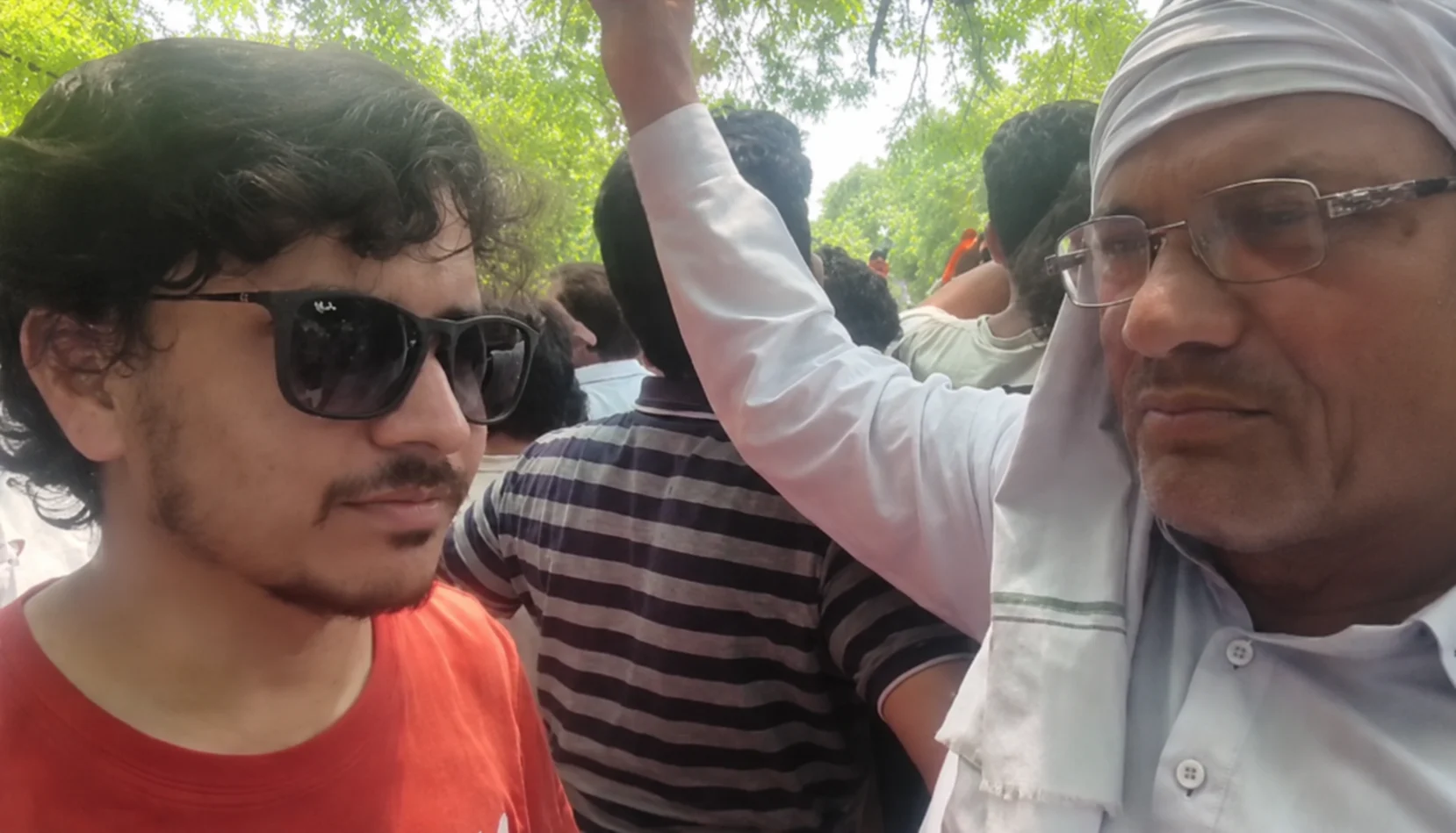
Case Summary
At Delhi’s Jantar Mantar, Hindu sentiments were outraged when a Cockroach Janata Party (CJP) supporter mockingly made derogatory remarks about Lord Ram, a revered Hindu deity. This occurred during a protest launched by CJP on 6 June 2026. In conversation with the media, the protester denied the existence of Lord Ram. Notably, the Cockroach Janata Party (CJP) emerged in mid-May 2026 as a satirical, youth-led online movement that rapidly transformed into a mass mobilisation platform for students and unemployed graduates, driven by social media engagement. It was founded by Abhijeet Dipke, an Aam Aadmi Party (AAP) member, who repurposed a controversial public remark comparing unemployed youth to "cockroaches" as a symbol of collective identity and protest. While Dipke initially portrayed the movement as a genuine, non-partisan, and constitutionally aligned initiative addressing youth unemployment and examination irregularities (such as the NEET and CBSE controversies), it quickly swayed from its original claimed narrative of criticising government policy failures. Rather than maintaining its focus on systemic educational reforms, the movement shifted toward targeted ideological opposition, marked by anti-Hindu remarks from its co-founders and participants. By the time it culminated in its first major street-level protest at Jantar Mantar on 6 June 2026, the movement's focus had drifted from neutral advocacy for students' rights into overt hostility against the Hindu community, Hindu organisations, activists, and what it termed a 'Hindutva-led government', exposing the initiative as an ideologically driven, anti-Hindu platform rather than a neutral student advocacy group. According to media reports, in this current case, a video clip of a Cockroach Janata Party protester went viral on social media, where he was seen denying the existence of Lord Ram and making derogatory comments against the revered Hindu deity. The accused was an elderly man who first claimed that he was opposing corruption and the NEET examination paper leaks that occurred, but soon began mocking Lord Ram and Hindu deities. He was heard saying, “Pandavas never existed, and all this is nonsense.” He further mockingly said, “Leave aside Ram. Don’t go there. Ram does not kill Modi. He looted the entire country and did not kill Modi. He swallowed so much money in the name of the Ram temple; he does not kill Adani and Ambani.” After this, when the reporter questioned why he dragged Lord Ram into political discourse, he mockingly replied that Lord Ram never existed and he was only used by the Bharatiya Janata Party to scare people. He further mocked Lord Ram by saying, “Ram does not kill those who eat cow. Why?”
Why it is Hate Crime ?
The primary category selected in this case is: Hate Speech against Hindus. The subcategory selected in this case is: Anti-Hindu slurs, mocking faith. Anti-Hindu slurs and the deliberate mocking of the Hindu faith owing to religious animosity involve the usage of derogatory terms, stereotypes, or offensive references to religious practices, symbols, or figures. One of the common anti-Hindu slurs used against Hindus is “cow-worshipper” and “cow piss drinker”. The intention of using this term is to demean and mock Hindus as a group and their religious beliefs since Hindus consider the cow holy. Additionally, some symbols and the slurs attached to them have a historical context that exacerbates the insult, hate, stereotyping, dehumanisation and oppression against Hindus. Cow worship has been used for centuries to denigrate Hindus, insult their faith and oppress Hindus specifically as a religious group. There has been overwhelming documentation about how cow slaughter has been used to persecute Hindus with cow meat being thrown in temples and places of worship. There has also been overwhelming documentation where cow meat (beef) has been force-fed to Hindus to either forcefully convert them to Islam or denigrate their faith. Apart from cow worship, the Swastika – which holds deep religious significance for the Hindus – has also been misinterpreted and distorted to use as a slur against Hindus. Similarly, the worship of the Shivling has been used by supremacist ideologies and religions to denigrate Hindus owing to religious animosity. Such slurs and denigration stem out of inherent animosity and hate towards Hindus and their faith, therefore, it is categorised as hate speech targeted at Hindus specifically owing to their religious identity. This incident constitutes a clear and explicit example of religiously motivated hate speech, where sacred Hindu symbols, beliefs, and figures were directly targeted within the setting of a public political demonstration. During a protest held at Jantar Mantar in Delhi, an individual associated with the Cockroach Janata Party made overtly mocking, dismissive, and derogatory remarks directed at Lord Ram as well as foundational Hindu religious beliefs. The utilisation of a high-visibility public protest platform to ridicule a revered religious figure demonstrates a clear shift from political expression into targeted religious denigration. The content, tone, and framing of the statements functioned to normalise contempt towards Hindu sacred traditions in a public forum, thereby amplifying hostility and reinforcing prejudice against the religious identity of Hindus. To properly assess the seriousness of the offence, it is necessary to recognise the central theological and cultural position occupied by these figures within Hinduism. Lord Ram is one of the most widely worshipped and culturally significant deities in Hindu tradition. He is venerated as “Maryada Purushottam,” meaning the supreme embodiment of righteousness, moral discipline, and ideal conduct in personal, social, and political life. He is worshipped as an incarnation (avatar) of Lord Vishnu, and his life narrative is treated as a guiding framework for dharmic living across generations. In parallel, the Mahabharata is not merely a literary epic but a foundational text of Hindu civilisation, encompassing philosophy, ethics, governance, and metaphysical inquiry. It contains the Bhagavad Gita, which is regarded as one of the most authoritative spiritual discourses in Hindu thought. Against this deeply embedded religious backdrop, statements that deny the existence of Lord Ram or dismiss the Mahabharata as “nonsense” constitute direct and deliberate disparagement of core sacred Hindu beliefs. Such remarks are an attack on the religious identity of millions of Hindus, as they seek to invalidate foundational beliefs that structure their spiritual and cultural life. The nature of the hostility is further demonstrated through the speaker’s attempt to reduce divinity to a mechanism of political violence and selective punishment. The remarks mockingly question why Lord Ram does not intervene to “kill” political figures such as Narendra Modi, Gautam Adani, or Mukesh Ambani if he exists. This rhetorical framing is not a neutral inquiry but a deliberate distortion of theological concepts, reducing the idea of divinity to a crude instrument of political retribution. It seeks to impose a literal and sensational expectation on spiritual belief systems in order to ridicule and discredit them in a public setting. By doing so, the speaker attempts to trivialise the entire basis of worship, devotion, and divine agency in Hinduism. The selective focus on Hindu belief structures in such a derogatory manner, particularly in a public protest environment, reflects a pattern of rhetorical hostility that weaponises political discourse to legitimise religious ridicule. The hostility is further escalated through the invocation of cow meat consumption, again used in a mocking and provocative religious context. In Hinduism, the cow holds a highly sacred status and is widely regarded as a symbol of non-violence (Ahimsa), sustenance, and maternal reverence. This reverence is not symbolic alone but is deeply embedded in religious ethics, cultural practice, and spiritual sentiment across large sections of the Hindu community. In this context, the speaker’s rhetorical question, asking why Lord Ram does not punish those who consume cow meat, constitutes a deliberate attempt to insult and provoke by targeting a sensitive religious boundary. It reduces a complex ethical and spiritual framework into a caricature intended to ridicule Hindu belief, thereby intensifying the emotional and religious offence caused to adherents of Hinduism. Had the intent of the protest been confined to legitimate political critique, the appropriate avenue would have been criticism of government policies, administrative decisions, economic structures, or elected representatives. Such critique is a recognised and constitutionally protected aspect of democratic engagement. However, the deliberate and repeated shift from political commentary to direct denigration of sacred religious figures demonstrates that the content of the speech extended beyond political dissent. The focus on mocking divine figures, questioning their existence, and ridiculing Hindu religious beliefs confirms that the nature of the expression was not limited to governance criticism but was directed at Hindu religious identity itself. This transition clearly establishes that the remarks operated within the framework of religious hostility rather than political argumentation. Given the nature, content, and public dissemination of these statements, and their direct targeting of core Hindu religious figures and beliefs, this incident meets the defined parameters of a hate-motivated religious offence. Accordingly, it is being formally documented and recorded in the Hinduphobia Tracker's hate crime database for structured classification and analysis.


Case Status
Unknown


Perpetrators Details
Perpetrators
Unknown
Perpetrators Range
One Person
Perpetrators Gender
male
 Sources




