Sacred temple norms at Jejuri temple violated as visitors enter premises with footwear, beat up priest for opposing
 Pune, Maharashtra, India
  8 June, 2026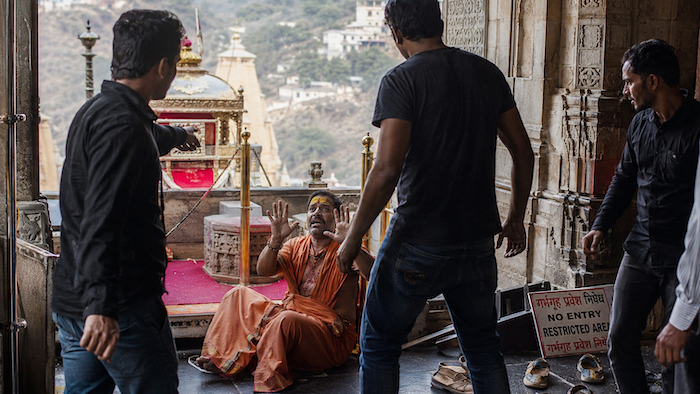
Case Summary
The sacred temple at Jejuri Fort in Pune, Maharashtra, was defiled as some visitors entered the premises wearing slippers. A Hindu priest who opposed this reckless behaviour was assaulted and suffered injuries. What began as an objection raised by the priest regarding a breach of temple norms quickly escalated into violence, leaving the Hindu priest injured and requiring medical treatment. The incident took place on a Sunday afternoon, 7th June 2026, at Jejuri Fort, a prominent Hindu religious site visited by devotees year-round. While on duty, the Hindu priest noticed a group of unknown individuals approaching the palanquin area wearing slippers. As the area was considered a sacred section of the temple complex where footwear was not permitted, the priest questioned them and asked why they had entered the vicinity wearing slippers. Following this interaction, an argument broke out between the priest and the unknown individuals. The dispute intensified after the priest challenged their presence in the sacred area while they were wearing footwear. During the confrontation, a group of three to four unidentified individuals verbally abused the priest and physically assaulted him within the temple premises. The attack was directed at the priest while he was carrying out his religious responsibilities and attempting to uphold the customs associated with the temple. The Hindu priest sustained injuries during the assault. The violence occurred inside a prominent Hindu place of worship and centred on the enforcement of temple rules relating to the sanctity of the religious premises. The priest was targeted immediately after objecting to conduct that violated established religious norms within the sacred area of the temple complex. Following the assault, the injured Hindu priest was admitted to a private hospital for treatment. The incident generated concern among devotees and local residents due to the attack taking place inside a major Hindu pilgrimage site. A complaint was filed with the Jejuri Police regarding the assault. Police initiated an investigation into the incident and began examining the circumstances surrounding the attack. The identities of the three to four unknown miscreants had not been publicly disclosed, and further investigation remained ongoing.
Why it is Hate Crime ?
This case has been added to the tracker under the primary category - Attack on Hindu religious representation, and within this, the subcategory selected is- Defiling religious customs. Sanatan Dharma is not a religion of one book, which is to say that while it has religious scriptures that form the central tenets of the faith, there are several traditions followed through thousands of years, mostly passed from generation to generation orally. There are several such customs and traditions that are followed by various Hindus and Hindu sects. Defiling of these traditions and customs is a breach of an individual or group’s religious practices. Such practices can range from dietary restrictions like not eating non-vegetarian food for a certain period of the year, not eating non-vegetarian food at all, not eating beef since the cow is considered holy in Hinduism, the sanctity of religious customs followed in the house (like many ISCKON devotees), etc. Any malicious action leading to the breach of such traditions or defilement of these traditions owing to animosity towards the faith or for the sake of activism stems not only from the lack of faith in the religion itself but also from disregard for the faith of the devotees who follow the customs/traditions and implicit bias against the faith, the tradition itself. Since these specific traditions are central to the faith of the devotees of that specific sect of Hindus, any non-compliance with these traditional rules would be considered a religiously motivated hate crime. The other subcategory selected is- Breaking rules of places of worship. Sanatan Dharma is not a religion of one book, which is to say that while it has religious scriptures that form the central tenets of the faith, there are several traditions followed through thousands of years, mostly passed from generation to generation orally. One of these oral traditions or written traditions is the rules of specific temples. Certain temples have rules which are traditional rules, dependent on the worship of the presiding deities. These rules and traditions have been followed for thousands of years whether they find scriptural mention or not. Such traditions are based on the nature and rules of worship of the presiding deity of that temple. Any non-compliance of these traditions owing to animosity towards the faith or for the sake of activism stems not only from the lack of faith in the presiding deity but also disregard for the faith of the devotees of that deity/temple and implicit bias against the faith, the tradition and the deity itself. Since these specific traditions are central to the faith of the devotees of that specific temple and presiding deity, any non-compliance with these traditional rules would be considered a religiously motivated hate crime. The other category selected here is- Attack not resulting in death. Within this, the subcategory selected is - Attacked for opposing radicals or trying to save victim. In several cases, Hindus are attacked for opposing religiously motivated crimes being committed against a fellow Hindu or simply for voicing an opinion opposing radical elements, who either have in the past or continue to persecute Hindus. In such cases, the initial attack against the victim, against which the Hindu was trying to defend the victim, would also need to be classified as a religiously motivated hate crime. Since the initial crime itself was religiously motivated and the subsequent crime of attempting to save the victim or speaking against the radical elements ends up inviting a violent attack, it would also be classified as a religiously motivated hate crime under this category. The incident carries clear religious markers because it involved the violation of long-established Hindu norms of reverence and purity within a sacred Hindu temple space. The Jejuri Fort is not merely a tourist monument or archaeological structure. It is a sacred site dedicated to Hindu deities and remains deeply significant to Hindu devotees as a living symbol of worship, faith, and civilisational heritage. Entering such spaces wearing footwear is widely regarded in Hindu tradition as disrespectful because footwear is associated with impurity and is removed as a mark of humility and devotion before the divine. A key religious marker in this case was the blatant disregard shown towards Hindu religious customs after the act was questioned. The Hindu priest objected specifically because Hindu tradition requires removing footwear before entering sacred temple premises. Instead of acknowledging or respecting this sentiment, the response was violence, reflecting open disregard for the customs and sensitivities associated with a Hindu place of worship. This was not merely a disagreement over site protocol, but a rejection of the expectation that Hindu religious practices deserve respect within a Hindu sacred space. The conduct also reflected a broader pattern in which Hindu religious sensitivities are often trivialised or treated casually in ways that would likely be considered unacceptable in relation to other religious communities. For Hindu devotees, the refusal to follow even the most basic norm of temple reverence inside a sacred Hindu shrine amounts to blatant disrespect towards the Hindu faith and the sanctity attached to temple spaces. Another significant religious marker was the physical assault on the Hindu priest because the violence arose directly from his attempt to uphold the sanctity, customs, and religious norms of a Hindu place of worship. Hindu priests serve as custodians of temple traditions and sacred spaces, and in this case, the priest was carrying out that responsibility when he objected to conduct that violated established temple practices. The subsequent assault turned a matter of religious observance into an act of violence against a Hindu religious functionary performing his duties. The priest was assaulted after opposing conduct that he viewed as inconsistent with the religious norms of the temple. Although the identities of the perpetrators remain unknown, the available facts show that the violence was directed at the priest immediately after he challenged behaviour that violated temple customs. Rather than respecting the sanctity of the premises or resolving the disagreement peacefully, the perpetrators responded with physical force against the individual responsible for safeguarding the site's religious character. The incident demonstrated disregard for Hindu religious institutions and the authority of those entrusted with maintaining them. The attack did not occur in a setting unrelated to the priest's religious role; it occurred while he was acting in his capacity as a Hindu priest and enforcing temple norms within a revered Hindu shrine. The violence was therefore directed at a Hindu religious representative because he sought to protect the sanctity of a Hindu place of worship. Therefore, the assault on the Hindu priest, the location of the attack within temple premises, and its direct connection to his efforts to uphold Hindu religious customs establish the religiously aggravating nature of the incident. The priest became the victim while defending the sanctity of a Hindu sacred space, making the case appropriate for inclusion in the Hinduphobia Tracker. Disclaimer: The exact date on which the assault on the Hindu priest occurred at Jejuri Fort Temple was not specified in the available sources. However, the incident became publicly known through reports published on 8th June 2026. Accordingly, the Hinduphobia Tracker has recorded the respective date as the incident date for documentation purposes only.
Victim Details
Total Victim
1
Deceased
0
Gender
- Male 1
- Female 0
- Third Gender 0
- Unknown 0
Caste
- SC/ST 0
- OBC 0
- General 0
- Unknown 1
Age Group
- Minor 0
- Adult 1
- Senior Citizen 0
- Unknown 0


Case Status
Complaint filed


Perpetrators Details
Perpetrators
Unknown
Perpetrators Range
From 2 To 5
Perpetrators Gender
unknown
 Sources




