Hindu villagers targeted for conversion with inducements during Christian prayer meeting in Hardoi
 Hardoi, Uttar Pradesh, India
  7 June, 2026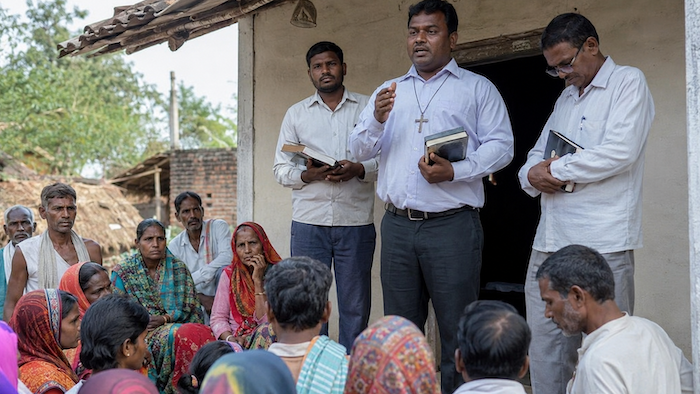
Case Summary
A group of Hindu villagers from Hardoi district, Uttar Pradesh, found themselves at the centre of a religious conversion programme being conducted in Mahdapur village under the Tadiawan police station area. What began as a visit to a prayer gathering soon raised concerns among the Hindu attendees regarding efforts to persuade them to abandon their faith. The gathering became contentious when objections were raised and attempts were made to document the activities taking place there. On 8th June 2026, Hindu resident Alkesh Singh of Paniha village visited the residence of Rajesh Pal in Mahdapur village along with several other local Hindu villagers. At the location, a prayer meeting was being conducted by Christian pastor Satyapal along with his associates Ram Singh and Ram Pravesh. Hindu men and women who attended the gathering were exposed to messages encouraging them to leave Hinduism and adopt Christianity. During the course of the programme, inducements were offered to Hindu attendees to persuade them to abandon their faith. The gathering focused specifically on Hindu individuals, and efforts were directed towards motivating them to convert to Christianity. The programme was conducted in a manner intended to influence the religious beliefs of those present and encourage a change in faith. As the events unfolded, some Hindu attendees attempted to record videos of the activities taking place at the gathering. Their efforts were met with resistance from the programme's organisers and participants. Verbal confrontations followed when the recording attempts continued. Threats to life were issued against the Hindu villagers who sought to document the proceedings. The Hindu attendees further stated that such activities had been taking place for a prolonged period and involved repeated efforts to influence individuals through various forms of inducements and assurances. Concerns were also raised regarding remarks made against Hindu deities during the programme. The comments targeted Hindu religious beliefs and caused distress among the Hindu villagers present at the gathering. Following the incident, a written complaint was submitted to the police. Based on the complaint, a case was registered against Rajesh Pal, Christian pastor Satyapal, Ram Singh, and Ram Pravesh. The police initiated an investigation into the matter and began collecting evidence and witness statements. Station House Officer Ishtiyaq Hussain stated that the investigation was underway and that further action would be taken based on the evidence collected during the inquiry. The police stated that the allegations would be verified through the ongoing investigation and subsequent proceedings.
Why it is Hate Crime ?
This case has been added to the tracker under the primary category- Predatory Proselytisation. Within this, the subcategory selected is - Conversion/attempts to convert by inducements. Predatory Proselytisation is not just limited to threat, harassment, force and violence, but it also has contours of stealth. In several cases, the Hindu victim is exploited to convert, with non-Hindus taking advantage of their poverty. In such cases, the Hindu victim who is suffering financially is offered monetary benefits, including lucrative offers for jobs, health treatment, education, etc, to induce the victim into changing his/her religion. In such cases, the religious identity of the victim and the aim to disenfranchise him from his faith form the heart of the crime. Also, taking advantage of and exploiting an individual’s economic vulnerabilities is widely acknowledged as exploitation, forms of which are often penalised by law. Such cases therefore are considered religiously motivated hate crimes since the victim’s religious identity forms the very heart of the crime itself. This case has been included in the tracker because it involved efforts to persuade Hindus to abandon their existing faith and adopt Christianity through inducements. The conduct was directed specifically at members of the Hindu community and was aimed at securing a change in their religious identity. The issue therefore was not merely the expression of Christian beliefs, but the use of incentives and benefits to encourage the abandonment of Hinduism and the adoption of another faith. The religious motivation is evident from the nature of the inducements that were offered. The benefits were not presented as unconditional acts of charity available irrespective of religion. Instead, they were linked to the acceptance of Christianity and the rejection of Hindu beliefs and practices. Such inducements demonstrate that the objective was not simply social welfare or community assistance, but religious conversion. The fact that the benefits were tied to a change of faith reveals a deliberate attempt to influence the religious choices of Hindu individuals through material considerations rather than personal spiritual conviction. Conversion through inducements is particularly significant because it targets individuals at points of vulnerability. When financial assistance, material benefits, social support, or other advantages are offered in exchange for adopting a different religion, the decision to convert becomes influenced by external pressures rather than genuine belief. Such methods seek to weaken a person's attachment to their ancestral faith by creating incentives to abandon it. In this case, the inducements were directed at Hindus specifically, demonstrating that their religious identity was the very reason they were selected for conversion efforts. The conduct also reflects a broader religious objective of reducing adherence to Hinduism and increasing adherence to Christianity. The intended outcome was not religious coexistence or mutual understanding between communities, but the replacement of one religious identity with another. By encouraging Hindus to leave their faith in return for promised benefits, the organisers treated Hindu religious affiliation as something to be discarded and replaced. This reveals a clear religious motive, as the success of the effort depended upon the abandonment of Hindu beliefs and practices. The targeting of Hindus through inducements carries wider implications because Hindu religious traditions are deeply connected to family customs, community life, inherited practices, and cultural continuity. Attempts to secure conversions through incentives therefore affect not only individual belief but also the preservation of religious traditions passed down through generations. The objective extends beyond attracting followers and enters the realm of actively diminishing the presence of Hindu religious identity within the affected community. Therefore, the inducements offered in this case demonstrate a clear and deliberate attempt to persuade Hindus to renounce their faith and adopt Christianity through material incentives rather than genuine religious conviction. The victims were targeted because they were Hindus, and the inducements were designed to encourage the abandonment of Hinduism in favour of another religion. The incident therefore represents a religiously motivated effort to undermine Hindu religious continuity through conversion by inducement, warranting its inclusion in the Hinduphobia Tracker. Disclaimer: The exact date on which the conversion activities and inducement efforts began in Mahadapur village was not specified in the available sources. However, the incident became publicly known through reports published on 8th June 2026. Accordingly, the Hinduphobia Tracker has recorded the respective date as the incident date for documentation purposes only.


Case Status
Complaint filed


Perpetrators Details
Perpetrators
Christian Extremists
Perpetrators Range
From 2 To 5
Perpetrators Gender
male
 Sources




