Hindu minor girl gone missing in Bangladesh after prolonged contact and persuasion by Muslim youth
 Chittagong District, Bangladesh
  6 June, 2026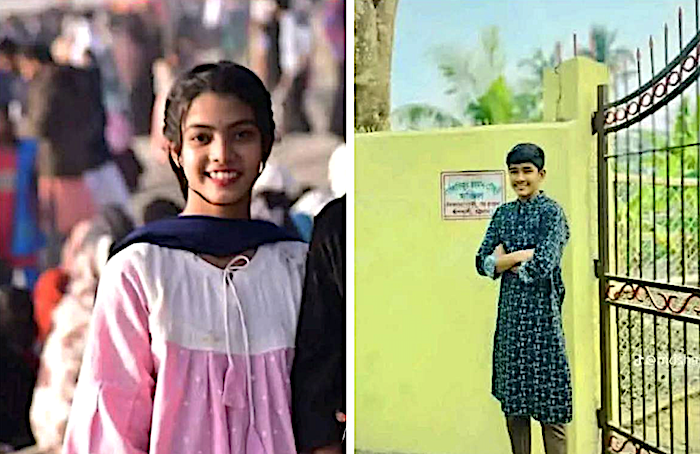
Case Summary
In Chittagong's Banshkhali upazila of Bangladesh, a 14-year-old Hindu girl named Sastika Dutta went missing under circumstances that caused serious concern among her family and the local Hindu community. The minor girl, a resident of Apana Bhaban in the Kali Bari area of Banshkhali, disappeared after a prolonged period during which a Muslim youth had been attempting to establish contact with and influence her through various forms of communication. Her disappearance left her family in distress and triggered appeals for urgent intervention and assistance in locating her. According to information provided by family members, the Muslim youth had been attempting to cultivate a relationship with Sastika Dutta for an extended period before her disappearance. Family members stated that the youth used different methods of communication, seduction, and persuasion to influence the minor girl. They further stated that Sastika Dutta subsequently disappeared from her home and had not returned, leading the family to believe that she had been taken away by the same individual. Following her disappearance, the family launched efforts to locate the minor girl and sought assistance from local authorities and members of the public. The incident generated anxiety among relatives and local residents, particularly because Sastika Dutta was only 14 years old and remained untraceable after leaving her family home. Her disappearance created growing concern regarding her safety and wellbeing. Family members indicated that they received information suggesting that Sastika Dutta and the Muslim youth could be in the Kalatali area of Cox's Bazar. However, no official confirmation regarding her whereabouts had been obtained. As a result, the search for the missing girl continued while the family sought assistance from law enforcement agencies and administrative authorities. Sastika Dutta's father described the family as being mentally devastated by her disappearance and appealed for immediate intervention from the authorities. He also requested cooperation from citizens across different parts of the country and urged anyone with information regarding his daughter's whereabouts to come forward. The family emphasised the urgency of locating the minor girl and ensuring her safe return. As news of the disappearance spread, local residents and concerned members of the community called for a serious investigation into the circumstances surrounding the incident. Demands were raised for the immediate recovery of the girl and for authorities to establish the full facts of the case. The family also requested that the matter be treated with the highest level of seriousness and that all necessary legal measures be taken. The case centred on the disappearance of a Hindu minor girl following sustained contact and influence by a Muslim youth, after which she became untraceable. The family maintained that the youth had taken Sastika Dutta from her home and continued to seek assistance from authorities and the public in locating her. At the time the matter became public, the girl had not been recovered and her whereabouts remained unknown. The incident occurred against the backdrop of a deteriorating security environment for Hindus in Bangladesh, where Hindu women and girls have increasingly been identified by community organisations as being vulnerable to coercion, targeting, disappearance, abduction, and religiously motivated victimisation. As a member of Bangladesh's Hindu minority community, Sastika Dutta's disappearance generated particular concern among local Hindus, who viewed the case within the broader pattern of insecurity faced by Hindu families across the country. This escalation of violence against Hindus in Bangladesh has unfolded in three distinct phases: first, following the ouster of Sheikh Hasina’s government in August 2024; second, after the death of Sharif Osman Bin Hadi in December 2025; and third, in the immediate aftermath of the 13th National Parliamentary Election 2026. Following the ouster of Sheikh Hasina, multiple reports documented attacks on Hindu homes, temples, and religious institutions, alongside intimidation campaigns, arson, and mob assaults targeting minority neighbourhoods. The Hinduphobia Tracker has recorded 336 such incidents against the Hindu minority, underscoring the scale and persistence of anti-Hindu violence during this period. A further escalation occurred following the death of Sharif Osman Bin Hadi, a Muslim political activist and student leader known for his anti-Hindu and anti-India rhetoric. Hadi had been involved in political unrest after the fall of the Hasina government and was killed in Dhaka on 18th December 2025 during clashes. In the aftermath of his death, Hindu communities were blamed and subsequently targeted in retaliatory violence. Hindu homes were selectively set ablaze in multiple localities, forcing families to flee and leaving many displaced. The attacks appeared patterned rather than sporadic, with Muslim mobs focusing on Hindu neighbourhoods, properties, and religious symbols. Among the victims was Dipu Chandra Das, who was lynched to death and his body was set ablaze by a Muslim mob over false blasphemy allegations. The Hinduphobia Tracker documented 51 incidents of anti-Hindu violence in the period following Hadi’s death alone. Such incidents underscored the vulnerability of the Hindu minority amid rising communal hostility and the weaponisation of religious accusations. Reports further indicated that posters and written materials calling for the extermination of Hindus were displayed in public spaces, signalling an alarming normalisation of genocidal rhetoric. When combined with acts of arson, vandalism, assault, and targeted intimidation, these developments suggested a coordinated environment of hostility aimed at terrorising the Hindu community and reinforcing majoritarian dominance. The third phase of violence was unleashed after the 13th National Parliamentary Election 2026. Within days of the announcement of results, Hindu families in districts such as Noakhali, Rangpur, Nilphamari, Sylhet, Thakurgaon, and Dinajpur reported coordinated attacks involving arson, looting, assault, and vandalism of temples and homes. In several instances, Hindu homes were selectively targeted, looted, and families were threatened with displacement.
Why it is Hate Crime ?
This case was added to the tracker under the primary category - Crimes against women in relationships and other sexual crimes. The subcategory selected is - Brainwashed and/or groomed. Under this, the tertiary category selected is - Family claims grooming. In our database, we have not added incidents where women have converted to another religion of their free will and no allegations of forced/involuntary conversion have been made. However, there are certain cases of conversion where the consent itself is a result of the brainwashing or grooming of a minor by the non-Hindu perpetrator trying to victimise a woman for her Hindu religious identity. The phenomenon of grooming points to non-Hindu perpetrators identifying their Hindu victims’ vulnerabilities and exploiting them over months and sometimes years, to extract the supposed ‘consent’ in order to convert their religion. In most cases of grooming, the victims are minors or the grooming started when the victim was a minor. In other cases of grooming, the non-Hindu perpetrator brainwashes and grooms a minor victim to extract their trust and then proceeds to rape them repeatedly with the intent of converting them to their faith. It is pertinent to understand here that when the victim is a minor, the ‘consent’ to convert or enter into a romantic relationship with an adult itself is redundant – addressed by POCSO. While every case of conversion of a minor and incidents of establishing a physical relationship with a minor by an adult is a crime, for the purpose of this database, a case would be considered a hate crime only if there is a distinct religious angle to the grooming. For example, in the UK, if a Hindu minor is targeted by Pakistani grooming gangs, it would be considered a hate crime because the victims are specifically targeted owing to their non-Muslim religious identity with the perpetrators being Muslim. In other cases, if a Hindu minor is brainwashed into entering a physical relationship with the non-Hindu adult perpetrator and the family alleges grooming/brainwashing of the minor to convert her religion, it would form a part of this database. If the victim is a Hindu adult, the case would form a part of this database only if the victim herself says that she was brainwashed/groomed to convert her religion. However, if the victim is deceased (murdered or otherwise), the case would form a part of this database if her family/friends provided testimony that the victim was brainwashed/groomed to convert her religion. Since these crimes have a distinct religious angle where the victim is being targeted owing to her Hindu religious identity, these cases are considered a hate crime. Another primary category selected for this case is - Attack not resulting in death. The subcategory selected is - Attacked for Hindu identity. In several cases, Hindus are attacked merely for their Hindu identity without any perceived provocation. A classic example of this category of religiously motivated hate crime is a murder in 2016. 7 ISIS terrorists were convicted for shooting a school principal in Kanpur because they got ‘triggered’ seeing the Kalava on his wrist and tilak that he had put. In this, the Hindu victim had offered no provocation except for his Hindu religious identity. The motivation for the murder was purely religious, driven by religious supremacy. Such cases where Hindus are targeted merely for their religious identity would be documented as a hate crime under this category. This case has been added to the tracker because the available information indicated that the 14-year-old Hindu minor, Sastika Dutta, had been subjected to sustained influence and cultivation by a Muslim youth prior to her disappearance. Family members stated that the individual had been attempting to establish contact with and influence the victim over an extended period through communication and other means before she went missing. According to the family's account, the same individual subsequently took the minor girl away from her home, after which she could not be located. The pattern described by the family reflected a process in which a vulnerable Hindu minor was gradually drawn into a relationship of influence with an older individual before disappearing from the custody and protection of her family. The significance of this factor is heightened by the victim's age. At just 14 years old, Sastika Dutta was legally and developmentally a child. Minors often lack the maturity, life experience, and decision-making capacity necessary to fully comprehend the long-term consequences of major personal decisions, making them particularly susceptible to manipulation, emotional pressure, deception, and psychological influence. It is further important to note that the victim was a minor, which means the element of meaningful consent and genuine independent decision-making was absent from the outset. Children are inherently vulnerable to grooming tactics because they can be influenced through emotional attachment, promises, attention, gifts, dependency, or other forms of psychological conditioning. In cases involving Hindu minor girls from vulnerable minority communities, such conduct raises serious concerns regarding exploitation and coercive influence. The family's account that the Muslim youth had been attempting to influence the victim for a prolonged period before her disappearance provided a factual basis for documenting the case under this category. The disappearance of the victim after this period of contact strengthened concerns that the grooming process had culminated in her removal from the safety of her family environment. The incident therefore extended beyond a simple missing-person case and involved indications of prior influence directed at a Hindu minor girl before her disappearance. For these reasons, the case has been documented under the category of brainwashing and/or grooming. Additionally, the family's concerns formed a central part of the case because they directly linked the victim's disappearance to a prolonged process of influence and cultivation rather than a sudden or unexplained event. Their statements indicated that the disappearance did not occur in isolation but followed a sustained period during which the Muslim youth had sought access to and influence over the Hindu minor. Furthermore, this case has further been included under Attacked for Hindu Identity due to the broader context in which the incident occurred and the victim's status as a member of Bangladesh's Hindu minority community. While the available information did not contain an explicit statement declaring a religious motive, the victim was a Hindu minor girl who disappeared after a prolonged period of influence by a Muslim youth. The incident occurred during a period in which Hindu minorities across Bangladesh were experiencing heightened vulnerability, insecurity, intimidation, displacement, and targeted attacks. Within such an environment, crimes directed against Hindu victims cannot be viewed entirely separate from the broader context of anti-Hindu hostility affecting the community. For the purpose of documenting the 2024 to 2026 ethnic cleansing of Hindus in Bangladesh and the subsequent persecution after the political exile of Sheikh Hasina, the death of Sharif Osman Hadi, and the 13th National Parliamentary Election 2026, the Hinduphobia Tracker records such incidents as likely religiously motivated at the point of entry. If any case is later established through credible investigation or court findings to stem from motivations other than religious hostility, it will be revised or removed from the hate crime database. The kidnapping and disappearance of a Hindu minor girl from a vulnerable minority family occurred within an environment where Hindu women and girls faced heightened risks arising from their minority status. The victim's family was left searching for their daughter while attempting to secure intervention from authorities and the wider public. The targeting of a Hindu child in these circumstances mirrored broader patterns of insecurity experienced by Hindu families during this period and reinforced fears within minority communities regarding the safety of their daughters. Against this backdrop, the disappearance and suspected kidnapping of Sastika Dutta represented the targeting of a Hindu minor girl from a vulnerable religious minority community. Given Bangladesh's sustained anti-Hindu persecution environment and the broader pattern of attacks on Hindu minorities, this case meets the threshold for inclusion in the Hinduphobia Tracker's hate crime database. Disclaimer: The exact date of when the Hindu minor girl and the Muslim perpetrator first came into contact was not specified in the available sources. However, the incident became publicly known through reports published on 7th June 2026. Accordingly, the Hinduphobia Tracker has recorded the respective date as the incident date for documentation purposes only.
Victim Details
Total Victim
1
Deceased
0
Gender
- Male 0
- Female 1
- Third Gender 0
- Unknown 0
Caste
- SC/ST 0
- OBC 0
- General 0
- Unknown 1
Age Group
- Minor 1
- Adult 0
- Senior Citizen 0
- Unknown 0


Case Status
Unknown


Perpetrators Details
Perpetrators
Muslim Extremists
Perpetrators Range
One Person
Perpetrators Gender
male
 Sources




