Hindu women across West Bengal systematically targeted by Muslim man using false Hindu matrimony profile
 Kolkata, West Bengal, India
  1 June, 2026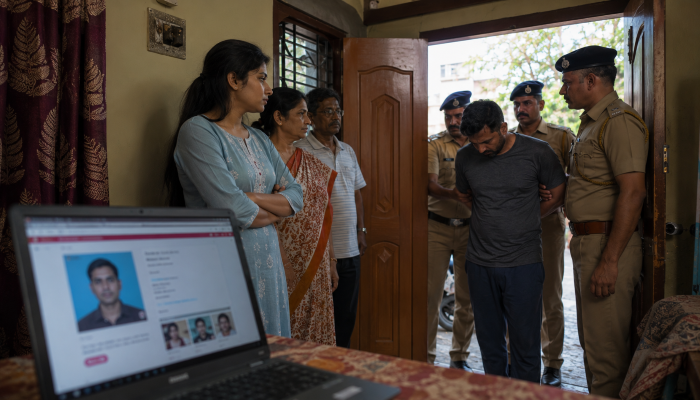
Case Summary
Hindu women across multiple districts of West Bengal were systematically defrauded, exploited, and raped by Moniur Rahman, a Muslim man from the Baubazar area, Kolkata, who created a matrimony profile under the false Hindu name "Manik Roy" and presented himself as a senior automobile company executive with an annual salary of Rs 1.5 crore to gain the trust of Hindu women seeking marriage. At least 15 Hindu women were targeted through the same matrimony website before he was arrested at a Hindu woman's home in Naihati, North 24 Parganas, after she exposed his deception through social media investigation and lured him into a police trap. As per details, Moniur Rahman created a profile under the Hindu name "Manik Roy" on a matrimony website and used it to contact Hindu women seeking marriage. He presented himself as a highly paid corporate executive to establish financial credibility. Over approximately three months of contact with each victim, he cultivated deep emotional dependency before beginning to extract cash and jewellery under various pretexts, including blessing ceremonies and fabricated family emergencies. He impersonated his own father during phone calls to make the deception more convincing, speaking to the victims' families as the prospective groom's father. He disappeared from each victim's life after extracting sufficient money and valuables. A young Hindu woman from Naihati contacted Moniur through the matrimony site. Over three months, he deepened the friendship, created emotional pressure, extracted Rs 85,000 in cash and a gold bracelet from her, and repeatedly told her they would marry soon. When he fabricated a story about his uncle dying and asked her to send money to an account he claimed belonged to someone in Mumbai, she investigated and discovered the account belonged to someone in Bardhaman. She then searched social media and found multiple women who had been in contact with him for two months before losing touch. She contacted these women and confirmed the pattern of deception. She then invited Moniur to her home under the pretext that a senior family member would bless him with a gold chain, informed the police in advance, and had him arrested upon arrival. He was charged with fraud, rape, and financial embezzlement at the Naihati police station. Police confirmed approximately 15 victims had been defrauded.
Why it is Hate Crime ?
The primary category for this case is "Crimes against women in relationships and other sexual crimes". The sub-category for this case is "Man pretends to be Hindu". The tertiary categories here are "Name changed" and "Pattern of targeting Hindus". When a non-Hindu man pretends to be a Hindu to deceive a Hindu woman into a relationship, the act is seen as triggered by malafide intentions. In some cases, the woman eventually accepts the man’s original religious identity and converts after the man’s identity is revealed. These cases could be argued as cases of religious brainwashing and a result of the pressure a woman feels after getting into a relationship with a man. The woman, it can be argued, also changed her religious identity because of the stigma she believes she might face if she chooses to walk out of a deceptive relationship. However, for the purpose of documenting hate crimes, the cases in this subcategory are limited to those where there is explicit violence aimed at religious conversion against the wishes of the victim (force-feeding beef, blackmailing with intimate videos, rape on refusal to convert, etc), or if the woman herself complains of the man’s religious deception. In such cases, it is established that the deception of the non-Hindu man had a specific aim of religious conversion or targeting of the victim due to her Hindu religious identity, therefore, making it a religiously motivated hate crime. Moniur Rahman's operation was built on a single foundational deception: a Hindu name on a Hindu matrimony platform. The name "Manik Roy" is unambiguously Hindu in character. Its deployment on a matrimony website was not accidental. Matrimony platforms catering to Hindu families operate on the assumption that the profiles presented on them belong to individuals from within the Hindu community seeking Hindu partners for marriage. By presenting himself as a Hindu man, Moniur was able to access a level of trust that would otherwise have been unavailable to him. The religious motive of the crime is evident from the fact that the false Hindu identity was not incidental to the deception but the very mechanism through which the victims were approached, groomed, and exploited. If religion had no role in the offence, there would have been no need to conceal his true identity and assume a Hindu one. The scale of the operation is its most significant marker. At least 15 Hindu women across multiple districts were targeted through the same profile, the same false identity, and the same grooming methodology. This was not an isolated act directed at a single victim. The matrimony profile served as the entry point; the fabricated corporate identity and claims of wealth served as credibility-building tools; and prolonged communication was used to cultivate trust before exploitation. The repeated use of the same model across numerous victims suggests a systematic and organised pattern rather than a one-off deception. The impersonation of his own father on phone calls further demonstrates the depth of the fraud. Hindu matrimonial arrangements are typically family-centred, involving discussions and trust-building between both families. By presenting a fabricated Hindu family background and extending the deception to parents and relatives, the accused exploited not only individual trust but also the social and cultural norms that underpin Hindu matrimonial practices. This allowed him to penetrate one of the most trusted spaces within the community through sustained misrepresentation. The religious significance of this deception lies in the fact that Hindu identity itself was weaponised as a tool of access. The accused did not merely lie about his profession, income, or personal circumstances. He adopted a false Hindu identity because he understood that sharing the same religious background would make Hindu women and their families more comfortable, trusting, and receptive. In doing so, he treated Hindu identity as a disguise to be worn whenever it became useful for manipulation and exploitation. Such conduct demonstrates a disregard for the religious boundaries, customs, and trust structures that the victims were entitled to rely upon while making important matrimonial decisions. The victim who eventually exposed the operation did so by contacting other women who had interacted with the accused and discovering a recurring pattern. Their collective experiences revealed that the deception was not directed at a single individual but formed part of a broader pattern of targeting Hindu women through the same false Hindu persona. The existence of multiple victims reinforces the conclusion that the adoption of a Hindu identity was a deliberate strategy rather than an incidental misrepresentation. The case, therefore, extends beyond ordinary fraud or personal misconduct. The use of a fabricated Hindu identity to gain access to Hindu women, combined with the systematic nature of the targeting, indicates that the victims' religious identity was central to the operation. In cases such as this, adopting a false Hindu identity to manipulate and ensnare Hindu individuals is not merely an act of personal deception. It reflects a willingness to exploit the trust associated with Hindu identity and can reasonably be interpreted as demonstrating disregard for the religious beliefs, customs, and community structures of the victims. For these reasons, the case was classified as a religiously motivated hate crime and included in the tracker. Disclaimer: The exact date on which Moniur Rahman first created his false Hindu matrimony profile and began targeting Hindu women was not confirmed in the source. The tracker records incident dates based on when the crime occurred rather than when it was reported or published. This case involved a sustained course of conduct across multiple victims over an extended period prior to the arrest. In this case, therefore, 2 June 2026 has been used as the indicative incident date, reflecting the publication date as the earliest available reference point since the exact commencement of the conduct was not confirmed in the source. This date has been recorded for documentation purposes only. Disclaimer: The exact number of Hindu women targeted and defrauded by Moniur Rahman was not confirmed beyond the approximate figure of 15 cited in the source. Police confirmed approximately 15 victims had been defrauded, but the source also notes that many victims may not have come forward out of fear of social stigma. 15 has been recorded as the confirmed minimum number of documented victims at the time of publication. The actual number of Hindu women targeted by the operation may be significantly higher. This was recorded for documentation purposes only.
Victim Details
Total Victim
15
Deceased
0
Gender
- Male 0
- Female 15
- Third Gender 0
- Unknown 0
Caste
- SC/ST 0
- OBC 0
- General 0
- Unknown 15
Age Group
- Minor 0
- Adult 0
- Senior Citizen 0
- Unknown 15


Case Status
Arrested


Perpetrators Details
Perpetrators
Muslim Extremists
Perpetrators Range
One Person
Perpetrators Gender
male
 Sources




