Attack on Hindu sentiments: Muslims urinate on sacred walls of a Hindu temple in Aligarh, Uttar Pradesh
 Aligarh, Uttar Pradesh, India
  2 June, 2026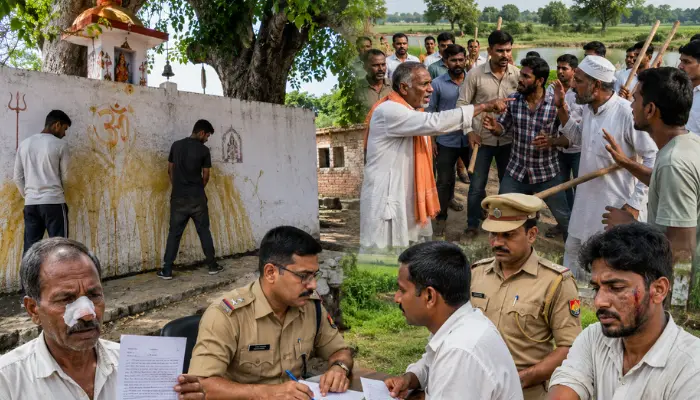
Case Summary
In Nagla Banjara, Bilauti village, under the Akrabad Police Station area of Aligarh, Uttar Pradesh, the sanctity of a Hindu temple was desecrated when a few Muslim youths urinated on the temple walls, causing massive outrage and religious tensions. This incident came to light when an argument and fight broke out between Hindu and Muslim communities over a water dispute. During this, the Hindu side stated that members of the Muslim community had urinated on the temple walls, causing outrage. Kanhi, son of Kaptan Singh and a resident of Nagla Banjara, filed a complaint with the police on 3 June 2026. He stated that there was a Shiva temple under a peepal tree in the village, near which were farms belonging to members of the Muslim community from Nanau village. Kanhi stated that on 3 June 2026, at around 4 p.m., members of the Muslim community urinated on the wall of the Shiva temple and threatened to do so again. Local police arrived at the scene and investigated the matter. After investigations, the police later claimed that the allegation of urination on the temple wall was false. On the Muslim side, Sagir, son of Mohammad Sharif and a resident of Nanau, also filed a written complaint. Sagir claimed that he was putting up a fence around the paddy plants in his leased field when Kanhi, son of Kaptan Singh, and several other people approached him and began arguing with him over not taking water from the tank. According to Sagir, Kanhi and the others attacked him and his grandson, Faisal, with sticks with the intention of killing them. Sagir sustained injuries to his nose and other parts of his body during the assault. Sub-Inspector Amit Raghuvanshi stated that the dispute arose between the Hindu owner of the pond and the farmer from the Muslim community over the refusal to take water from the pond, which escalated into a physical altercation. He further claimed that the allegation of urinating on the temple wall was false.
Why it is Hate Crime ?
This case is being added to the Undecided Database of the Hinduphobia Tracker due to the absence of conclusive evidence establishing a religious motive behind the incident. Firstly, in this case, the sanctity of a Hindu temple was said to have been desecrated after Muslim youths urinated on the temple walls, which subsequently led to communal tensions, disputes, and a clash between Hindus and Muslims in the area. The assertion that the temple was targeted and desecrated originated from members of the Hindu community themselves, and a formal complaint was also filed regarding the incident. These assertions raise serious concerns and suspicions about whether the act did in fact occur and, if it did, whether it was motivated by religious animosity. Such concerns arise because there is a historical precedent of Hindu temples being targeted and desecrated by Muslims due to religious hostility. Even the Hinduphobia Tracker has documented at least 563 cases between January 2023 and 5 June 2026 in which Hindu religious representations, including temples, idols, and sacred symbols such as the Kalava, were desecrated by Muslim perpetrators. This documented pattern raises valid concerns, and therefore, the complaint and assertions made by the Hindu side cannot be dismissed outright and raise legitimate questions about the possibility of a religiously motivated act. Secondly, the communal clash that followed the desecration also raises suspicions. Historically, incidents involving the desecration of Hindu temples have often resulted in tensions and clashes between Hindus and Muslims, particularly when members of the Hindu community have opposed or protested such acts. The fact that a dispute escalated into a communal confrontation after the temple desecration lends some weight to the concerns expressed by local Hindus and warrants further scrutiny. However, the police investigation complicates the matter significantly. Local police investigated the incident and claimed that the allegation regarding urination on the temple wall was false. This is not a situation where authorities merely denied a communal angle while accepting that the underlying incident occurred. Rather, the police stated that the act of desecration itself did not take place. Consequently, it remains possible that the matter originated as an ordinary dispute, particularly one connected to the water-related disagreement between the parties, and that religious allegations emerged during or after the conflict. If the police findings are accurate, then the incident may represent a local dispute that later acquired communal overtones rather than a genuine act of religious desecration. At the same time, it is important to acknowledge that police statements alone cannot always be treated as definitive proof regarding the presence or absence of a communal crime. In numerous cases involving attacks on Hindu temples or other communal incidents targeting Hindus, law enforcement authorities have downplayed or minimised the communal nature of offences in an effort to maintain law and order and prevent further escalation of tensions. Authorities may also have institutional incentives to avoid acknowledging communal disturbances within their jurisdiction, particularly when such acknowledgements could attract scrutiny from higher authorities or contribute to unrest in sensitive areas. For this reason, determining whether a crime is communal in nature or even whether the communal crime occurred requires consideration not only of official police statements but also of ground realities, witness accounts, victim testimonies, and broader contextual evidence. A notable example is the case of Rinku Sharma, the Bajrang Dal activist who was stabbed to death in his home in Delhi's Mangolpuri area in 2021. At the time, sections of the leftist media and even the police maintained that there was no communal angle to the crime. However, accounts from individuals close to the family and local residents suggested that communal tensions in the area were significant and that resentment had developed against Rinku Sharma because of his participation in activities connected to the Ram Mandir movement. Cases such as these demonstrate that police conclusions alone are not always sufficient to establish whether a communal motive was present or whether a communal crime took place. Applying the same principle to the present case, the statements made by local Hindus that the temple was indeed desecrated continue to raise legitimate suspicions. It therefore remains possible that the act occurred and that its communal nature was understated or overlooked during the investigation. Equally, it remains possible that the police findings are correct and that the incident was fundamentally a non-communal dispute that later became entangled with religious allegations. Hinduphobia Tracker also attempted to obtain the First Information Report related to this case in order to independently verify the allegations and assess the available evidence. However, the First Information Report was not available through any publicly accessible online source. Attempts were also made to contact the concerned police authorities for clarification and additional information, but the police could not be reached. As a result, independent verification of the allegations was not possible. This further limits the ability to conclusively determine whether the desecration of the temple actually occurred and, if it did, whether it was motivated by religious animosity. Since Hinduphobia Tracker follows strict evidentiary standards before classifying an incident as a religiously motivated hate crime, the absence of verifiable documentation and corroborating evidence prevents a definitive conclusion in this case. Therefore, at present, it cannot be conclusively stated that this incident constituted a hate crime. In the absence of definitive evidence proving either scenario, it is presently not possible to conclusively establish that the incident constituted a religiously motivated hate crime. Therefore, this case will remain in the Undecided Database. If any new evidence emerges confirming that the temple was desecrated and demonstrating a religious motive behind the act, the case will subsequently be reassessed and moved to the Hate Crime Database. Disclaimer: In this case, the report stated that a communal clash took place between Hindus and Muslims. However, it did not specify the total number of victims or perpetrators involved. The report mentioned certain individuals by name, including Kaanhi, a Hindu, and Sagir, a Muslim. However, it did not state that Sagir was involved in the desecration of the temple, nor did it specify that Kaanhi was assaulted or otherwise became a victim of violence during the incident. As the report did not clarify the roles of these individuals, and because the total number of victims and perpetrators remains unspecified, it is not possible to accurately determine either count. Therefore, both the victim count and perpetrator count have been recorded as unknown.


Case Status
Complaint filed


Perpetrators Details
Perpetrators
Muslim Extremists
Perpetrators Range
Unknown
Perpetrators Gender
unknown
 Sources




