Hindu officer driven to suicide after facing constant harassment for wearing a tilak by Muslim colleague
 Budaun, Uttar Pradesh, India
  3 June, 2026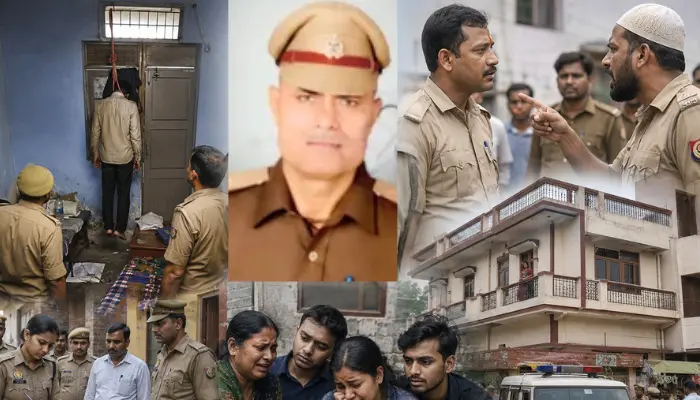
Case Summary
In Badaun, Uttar Pradesh, a Hindu officer named Megh Shyam Gautam was driven to suicide after facing repeated harassment over wearing a tilak by Shahid Ali, a Muslim court security officer. The body of the Hindu victim was found hanging inside his rented accommodation in Madhuvan Colony, where he had been residing while posted on court security duty. Megh Shyam Gautam was originally a resident of Sakna village under Govindnagar Police Station in Mathura district. He was transferred from Bareilly to Badaun on 24 August 2024 and was subsequently posted to court security duty. He lived in a rented room on the first floor of a house owned by Vikas Kumar in Madhuvan Colony. According to the victim's family, Megh Shyam Gautam had been under severe mental distress for several days prior to his death. They stated that Shahid Ali, a court security officer and colleague of the deceased, regularly harassed him over his Hindu religious practices, particularly his wearing of a tilak. Family members said that whenever Megh Shyam Gautam wore a tilak on his forehead, Shahid Ali objected to it and frequently engaged in arguments with him, causing him significant mental anguish. On 25 May 2026, Megh Shyam Gautam went on a two-day leave and returned to Badaun on 3 June 2026. His son, Brijnandan, accompanied him before returning home. On the morning of 4 June 2026, his daughter, Radhika, attempted to contact him by telephone, but he did not answer. Concerned by the lack of response, she contacted the landlord, Vikas Kumar, and requested that he check on her father. As Vikas Kumar was away in his native village, he provided the contact details of his wife, Preeti. When Preeti went upstairs to check on Megh Shyam Gautam, she received no response despite repeatedly calling out to him. The family was informed, following which Brijnandan contacted the Uttar Pradesh Police emergency service and requested assistance. Police personnel arrived at the scene and forced open the locked room. Inside, they discovered the body of Megh Shyam Gautam hanging from a metal window support above the door. Senior police officials, including Civil Lines Inspector Harendra Singh, Senior Superintendent of Police Ankita Sharma, Superintendent of Police (City) Abhishek Kumar Singh, and Circle Officer (City) Rajneesh Upadhyay, reached the location and initiated an inquiry into the incident. Following the preliminary investigation, the body was sent for a post-mortem examination. Megh Shyam Gautam's wife, Vimlesh, sons Brijnandan and Madhav, and daughter Radhika arrived at the mortuary and directly accused Shahid Ali of harassing and mentally torturing the deceased. They maintained that the persistent harassment he faced over wearing a tilak had severely affected his mental well-being. The post-mortem examination confirmed that the cause of death was hanging. Following the examination, the family met Senior Superintendent of Police Ankita Sharma and demanded strict action against Shahid Ali. Police stated that while the death initially appeared to be a case of suicide, the assertions made by the family were being thoroughly investigated and further action would be taken based on the findings of the inquiry.
Why it is Hate Crime ?
The first primary category selected is: Attack resulting in death. The subcategory selected is: Attacked for Hindu identity. In several cases, Hindus are attacked merely for their Hindu identity without any perceived provocation. A classic example of this category of religiously motivated hate crime is a murder in 2016. 7 ISIS terrorists were convicted for shooting a school principal in Kanpur because they got ‘triggered’ seeing the Kalava on his wrist and tilak that he had put. In this, the Hindu victim had offered no provocation except for his Hindu religious identity. The motivation for the murder was purely religious, driven by religious supremacy. Such cases where Hindus are targeted merely for their religious identity would be documented as a hate crime. Under this category, cases where the attack led to the death of the Hindu victim/s would be documented. The second primary category selected is: Restriction/ban on Hindu practices. The subcategory selected is: Restriction on expression of Hindu identity. An example of the state-affected prejudicial and targeted orders against the Hindu community would be a government denying the right of a Hindu or a group of Hindus to hold a religious procession owing to the animosity of non-Hindu groups. Denial of the religious right of the Hindus to assuage the non-Hindu group which harbours animosity to a point where it could lead to violence against Hindus is not only a failure of law and order but is a prejudicial order against Hindus, denying them their fundamental rights to express their religious identity. An example of a hate crime against Hindus by a non-Hindu would be a non-Hindu institution forcing its Hindu employees to abandon religious symbols that a Hindu would wear as an expression of faith owing to inherent prejudice against the faith professed by the victim or a non-Hindu group of people restricting a Hindu group from constructing a place of worship simply because the demography of the area in which the temple is being built is dominated by non-Hindus. Such actions are driven by religious animosity and/or prejudice against Hindus and their faith and would therefore be categorized as a hate crime. This case is a clear example of a religiously motivated hate crime because the Hindu officer was driven to suicide as a direct consequence of constant harassment for wearing a tilak by his Muslim colleague. Harassing an individual to such an extreme extent for wearing a sacred forehead mark that they feel compelled to end their own life showcases the profound depth of hostility and hatred that the Muslim perpetrator targeted the victim with solely for expressing his religious identity. The tilak holds immense religious and spiritual significance in Hinduism, serving as a sacred symbol of devotion, mindfulness, and alignment with spiritual consciousness. It is applied on the forehead at the space between the eyebrows, a critical point associated with the third eye or the Ajna chakra, representing spiritual awakening and the centring of thoughts. Beyond its spiritual purpose, the tilak acts as a visible assertion of one's cultural inheritance and personal devotion, functioning as an integral component of a Hindu's daily ritualistic life and identity. Targeting a Hindu individual specifically for wearing this sacred mark or engaging in his traditional religious practices showcases a deep-seated religious animosity towards his Hindu identity, making this a definitive case of a Hinduphobic hate crime. Targeting someone in a manner that results in their death by suicide highlights the severe toll and extreme depth of the harassment that the perpetrator subjected the victim to on a regular basis at his workplace. This deliberate and persistent targeted bullying caused the victim intense humiliation and a severe, destructive impact on his mental health, entirely due to his Hindu identity. The tragic death of the victim serves as definitive proof of the severity of the hostility he faced, establishing that targeting Hindu individuals for wearing religious symbols associated with their faith amounts to an undeniable religiously motivated hate crime. This systematic harassment was carried out by a Muslim colleague at their shared workplace, which demonstrates that the perpetrator made the life of the Hindu officer entirely miserable in his professional environment because of his choice to wear a tilak. The actions of the Muslim colleague effectively restricted the Hindu victim from wearing his sacred religious symbol, imposing informal restrictions and creating an atmosphere of suppression of his religious identity at his place of employment. The Muslim officer's hostile actions made the Hindu victim feel that he had to forcibly conceal his faith simply to work without facing harassment, forcing him into a psychological corner where his basic freedom of expression was denied. This forced concealment highlights the sheer level of hostility the victim faced, where the workplace was transformed into an environment where his visible faith was treated as an offence. This deliberate restriction and suppression of a core religious practice amounts to a direct restriction and suppression of the victim's Hindu identity itself, as the tilak and associated religious practices are primary means through which Hindus express their faith and identity. When these fundamental faith symbols are targeted, and when Hindus are targeted specifically for wearing them, the situation ceases to be a random personal dispute and instead becomes a clear, religiously motivated hate crime. The constant assertion of the victim's family confirms that the victim was indeed targeted and driven to suicide specifically because of this relentless harassment and coercion from the Muslim employee regarding the wearing of a tilak. This sustained pattern of intimidation and hostility showcases the true depth of animosity that the perpetrator possessed for the victim's Hindu identity, confirming the event as a clear case of a religiously motivated hate crime. Consequently, due to the explicitly documented nature of the religious targeting, the systemic workplace harassment, and the Hinduphobic animus that drove the victim to his death, this case is being officially added to the hate crime database of the Hinduphobia Tracker. Disclaimer: The Hinduphobia Tracker records incident dates based on when the victim's ordeal begins or when the crime itself occurred, rather than when it is subsequently reported by the media. In this current case, however, media reports have not stated the exact date from which the victim was first subjected to systematic harassment for wearing a tilak. Consequently, the date when he committed suicide, which is 4 June 2026, is being selected as the indicative incident date. This specific date is recorded for documentation purposes only.
Victim Details
Total Victim
1
Deceased
1
Gender
- Male 1
- Female 0
- Third Gender 0
- Unknown 0
Caste
- SC/ST 0
- OBC 0
- General 0
- Unknown 1
Age Group
- Minor 0
- Adult 1
- Senior Citizen 0
- Unknown 0


Case Status
Complaint filed


Perpetrators Details
Perpetrators
Muslim Extremists
Perpetrators Range
One Person
Perpetrators Gender
male
 Sources




