Hindu man lured to attend Eid al-Adha celebrations, subjected to gang-rape, casteist abuse and assault by Muslim youths in Meerut
 Meerut, Uttar Pradesh, India
  27 May, 2026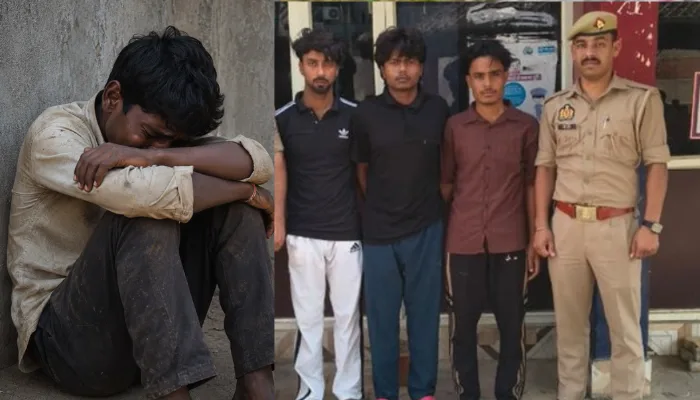
Case Summary
In Meerut, Uttar Pradesh, a Dalit Hindu youth was lured to attend a Bakrid (Eid al-Adha) feast by his Muslim acquaintances, where he was subjected to gang rape, assault, casteist abuse, and blackmail. The accused filmed the crime and later threatened the victim with making the video viral on social media. This incident occurred in a village under the Parikshitgarh Police Station area of Meerut district. On 28 May 2026, four Muslim men identified as Ayan, Gul Mohammad, Adnan, and Uvaish raped the Hindu youth after luring him to a Bakrid feast. Acting on the complaint, the police arrested three of the accused, while one accused remained absconding and efforts were underway to apprehend him. The victim, a resident of Sona village, was invited by Ayan, a fellow villager, to his house on the occasion of Bakrid. The youth reached Ayan's house at around 8:00 pm. At approximately 9:00 pm, Ayan's associates, Gul Mohammad, Adnan, and Uvaish, also arrived at the location. According to the complaint, after their arrival, the victim was taken to a room inside the house. The accused forcibly grabbed him, stripped him, and raped him. When he resisted, the accused assaulted him and ignored his pleas. The incident left him frightened and mentally distressed. The complaint further stated that the accused recorded an obscene video of the assault. The video was later used to intimidate and pressure the victim. The accused threatened to circulate the footage on social media and the internet, causing him to live in fear and emotional distress. The victim also stated that the accused abused him using casteist slurs during and after the assault. Based on the victim's complaint, the police included relevant provisions relating to caste-based abuse in the case and initiated an investigation into the matter. Based on the complaint filed by the victim, the police registered a case under several serious provisions, including charges relating to rape, assault, and the Scheduled Castes and the Scheduled Tribes (Prevention of Atrocities) Act. Digital evidence and other material connected to the case were also examined as part of the investigation. Parikshitgarh Police stated that three accused wanted in connection with the assault, rape, and offences under the Scheduled Castes and the Scheduled Tribes (Prevention of Atrocities) Act had been arrested and produced before the court. At the time of writing this report, one accused remained absconding, and the police stated that efforts were ongoing to arrest him. Officials added that the matter was being investigated from all angles and that further action would be taken based on the evidence collected during the investigation.
Why it is Hate Crime ?
The primary category selected in this case is: Attack not resulting in death. The subcategory selected is: Attacked for Hindu identity. In several cases, Hindus are attacked merely for their Hindu identity without any perceived provocation. A classic example of this category of religiously motivated hate crime is a murder in 2016. 7 ISIS terrorists were convicted for shooting a school principal in Kanpur because they got ‘triggered’ seeing the Kalava on his wrist and tilak that he had put. In this, the Hindu victim had offered no provocation except for his Hindu religious identity. The motivation for the murder was purely religious, driven by religious supremacy. Such cases where Hindus are targeted merely for their religious identity would be documented as a hate crime under this category. The other subcategory selected is: Attacked for opposing radicals or trying to save a victim. In several cases, Hindus are attacked for opposing religiously motivated crimes being committed against a fellow Hindu or simply for voicing an opinion opposing radical elements, who either have in the past or continue to persecute Hindus. In such cases, the initial attack against the victim, against which the Hindu was trying to defend the victim, would also need to be classified as a religiously motivated hate crime. Since the initial crime itself was religiously motivated and the subsequent crime of attempting to save the victim or speaking against the radical elements ends up inviting a violent attack, it would also be classified as a religiously motivated hate crime under this category. Another primary category selected is: Hate Speech against Hindus. The subcategory selected is: Anti-Hindu slurs, mocking faith. Anti-Hindu slurs and the deliberate mocking of the Hindu faith owing to religious animosity involve the usage of derogatory terms, stereotypes, or offensive references to religious practices, symbols, or figures. One of the common anti-Hindu slurs used against Hindus is “cow-worshipper” and “cow piss drinker”. The intention of using this term is to demean and mock Hindus as a group and their religious beliefs since Hindus consider the cow holy. Additionally, some symbols and the slurs attached to them have a historical context that exacerbates the insult, hate, stereotyping, dehumanisation and oppression against Hindus. Cow worship has been used for centuries to denigrate Hindus, insult their faith and oppress Hindus specifically as a religious group. There has been overwhelming documentation about how cow slaughter has been used to persecute Hindus with cow meat being thrown in temples and places of worship. There has also been overwhelming documentation where cow meat (beef) has been force-fed to Hindus to either forcefully convert them to Islam or denigrate their faith. Apart from cow worship, the Swastika – which holds deep religious significance for the Hindus – has also been misinterpreted and distorted to use as a slur against Hindus. Similarly, the worship of the Shivling has been used by supremacist ideologies and religions to denigrate Hindus owing to religious animosity. Such slurs and denigration stem out of inherent animosity and hate towards Hindus and their faith, therefore, it is categorised as hate speech targeted at Hindus specifically owing to their religious identity. An analysis of the circumstances surrounding this case demonstrates that the nature of the assault, the targeted deception, and the targeted nature of the abuse align with the criteria of a religiously motivated hate crime. A Dalit Hindu youth was intentionally lured to an Islamic religious event, only to be subjected to gang rape, physical assault, casteist abuse, and systematic blackmail by the Muslim perpetrators. This deliberate positioning of the victim within this specific setting indicates that the incident transcends isolated criminal behaviour. The overarching dynamics of the encounter point to a targeted act driven by religious animosity towards the victim due to his Hindu identity. The primary religious factor behind this entire incident, which showcases the deep-seated religious animosity, is the specific nature of the slurs used. While some may claim that the casteist slurs used during the rape and attack on the Hindu victim were solely due to his membership in the Dalit community and not directed towards his religious identity, a critical analysis reveals a broader reality. When dealing with Abrahamic religions, the micro-identities of caste, language, or region are entirely subsumed; their animosity is predominantly driven by the victim's overarching Hindu identity. Caste is not considered as a distinct entity during such attacks, as the fundamental hatred is directed entirely towards the victim's identity as a Hindu. Therefore, the casteist slurs used against the Dalit Hindu youth in this case were not merely a reflection of internal social hierarchy, but were instead directed at him because he is a Hindu. This use of casteist slurs showcases a clear anti-Hindu hostility, proving that the victim was targeted for rape and assault due to his Hindu identity, making it an undeniable case of a religiously motivated hate crime. The act of religiously profiling a victim based on his Hindu identity, luring him to an Eid event where he was completely vulnerable and surrounded by the domination of Muslims, and then subjecting him to gang rape exposes the perpetrators' deep-seated hatred towards his faith. Religiously motivated rapes targeting Hindu individuals due to their faith identity display the absolute depth of hostility present in this case. In this context, rape was not committed merely for sexual gratification; it was weaponised as a deliberate method to dominate, humiliate, and subjugate a victim for his religious identity, defining it as a clear hate crime. When the victim opposed the gang rape, he was immediately subjected to brutal physical assault. The fact that a Hindu youth, already being victimised for a religiously motivated rape, faced even more vicious violence the moment he resisted highlights the extreme hostility of the perpetrators. This secondary wave of violence showcases that the perpetrators were willing to go to any length to silence and humiliate a Hindu youth for his faith, further solidifying the incident as a clear case of a hate crime. The act of filming the rape and subsequently blackmailing the victim with threats of circulating the footage on social media highlights a calculated effort to enforce total domination. This psychological warfare was designed to humiliate the victim permanently, breaking his resolve completely and ensuring their control over him extended far beyond the physical attack. This systematic campaign of intimidation and psychological destruction makes it a clear case of a hate crime. The use of casteist slurs throughout this case functioned directly as anti-Hindu slurs. The fact that the victim was subjected to these religiously driven hate slurs for the entirety of the assault significantly increases the severity of the crime. This persistent abuse demonstrates that an intense hatred towards the victim's Hindu faith was actively driving the perpetrators' minds while they committed the act, making it an undeniable instance of a religiously motivated hate crime. The timing of the entire act, occurring specifically during a major Islamic religious event, serves as definitive proof of the premeditated hostility driving the perpetrators. By using a sacred occasion like Eid al-Adha as the backdrop for this assault, the perpetrators consciously weaponised their religious celebration as a tool to target, isolate, and violate an individual of the Hindu faith. This specific timing reflects a mindset rooted in a theological hierarchy where non-Muslims are viewed as inferior, creating a sense of religious entitlement that the perpetrators used to justify the complete humiliation and dehumanisation of a Hindu youth. Choosing this exact occasion demonstrates that the crime was not a random act of opportunity, but a calculated manifestation of religious supremacy, where the celebration itself was used to facilitate and legitimise the degradation of the victim based entirely on his Hindu identity. Consequently, this calculated timing removes all ambiguity, establishing the incident as an undeniable, religiously motivated hate crime. Given that this case meets several parameters of a hate-driven offence, it is being added to the hate crime database of the Hinduphobia tracker.
Victim Details
Total Victim
1
Deceased
0
Gender
- Male 1
- Female 0
- Third Gender 0
- Unknown 0
Caste
- SC/ST 1
- OBC 0
- General 0
- Unknown 0
Age Group
- Minor 0
- Adult 1
- Senior Citizen 0
- Unknown 0


Case Status
Case sub-judice


Perpetrators Details
Perpetrators
Muslim Extremists
Perpetrators Range
From 2 To 5
Perpetrators Gender
male
 Sources




