Attack on Hindu faith: Leftist historian distorts Hindu scriptures, makes denigrating remarks against Lord Ram
 United States
  19 April, 2018
Case Summary
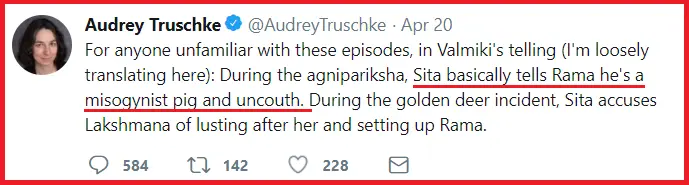
On 20 April 2018, Hindu sentiments were outraged after leftist historian Audrey Truschke posted derogatory and misleading comments on social media towards Lord Ram and distorted a revered Hindu scripture, the Ramayana. In a tweet discussing episodes from Valmiki’s Ramayana, Truschke wrote that during the agnipariksha (trial by fire), Sita “basically tells Rama he's a misogynist pig and uncouth”, claiming that she was “loosely translating” the text. The post attracted widespread criticism from Hindu scholars, writers and social media users, who objected to the language used to describe one of Hinduism’s most revered deities and questioned the accuracy of her interpretation. Following criticism, Truschke defended her remarks by claiming that she had offered a “loose, colloquial translation” rather than a literal rendering of the Sanskrit text and argued that translated texts should be made more accessible to modern audiences. However, several scholars and commentators challenged her interpretation and pointed to the original verses from Valmiki’s Ramayana, arguing that Sita’s words expressed anguish and criticism over Lord Ram’s distrust but did not contain language comparable to the phrase “misogynistic pig”. Critics further noted that the textual references cited by Truschke did not support the wording she used and stated that she was presenting a misleading characterisation of the episode. The controversy intensified as historians, authors and Sanskrit scholars publicly disputed her translation. Commentators such as True Indology, Abhinav Agarwal, Hindol Sengupta and Amish Tripathi criticised the description as a deliberate misrepresentation of a sacred Hindu text and an insulting portrayal of Lord Ram. They argued that reducing a revered religious figure to such terminology, which is not even supported by translation, went beyond interpretation and amounted to a derogatory depiction of a central figure of Hindu belief. The incident generated significant outrage among Hindus, who called the remarks as offensive to their faith and an example of prejudice in the portrayal of Hindu scriptures and deities. Despite sustained criticism and repeated demands for clarification, Truschke maintained her position claiming that the wording was intended as a colloquial translation and did not issue an apology for the remarks.
Case Images
Why it is Hate Crime ?
This case has been added to the tracker under the primary category of - Hate speech against Hindus. Within it, the sub-category selected is - Anti-Hindu slurs, mocking faith. Anti-Hindu slurs and the deliberate mocking of the Hindu faith owing to religious animosity involve the usage of derogatory terms, stereotypes, or offensive references to religious practices, symbols, or figures. One of the common anti-Hindu slurs used against Hindus is “cow-worshipper” and “cow piss drinker”. The intention of using this term is to demean and mock Hindus as a group and their religious beliefs since Hindus consider the cow holy. Additionally, some symbols and the slurs attached to them have a historical context that exacerbates the insult, hate, stereotyping, dehumanisation and oppression against Hindus. Cow worship has been used for centuries to denigrate Hindus, insult their faith and oppress Hindus specifically as a religious group. There has been overwhelming documentation about how cow slaughter has been used to persecute Hindus with cow meat being thrown in temples and places of worship. There has also been overwhelming documentation where cow meat (beef) has been force-fed to Hindus to either forcefully convert them to Islam or denigrate their faith. Apart from cow worship, the Swastika – which holds deep religious significance for the Hindus – has also been misinterpreted and distorted to use as a slur against Hindus. Similarly, the worship of the Shivling has been used by supremacist ideologies and religions to denigrate Hindus owing to religious animosity. Such slurs and denigration stem out of inherent animosity and hate towards Hindus and their faith, therefore, it is categorised as hate speech targeted at Hindus specifically owing to their religious identity. The other sub-category selected here is - Subversion of scriptures. Subverting the religious scriptures of Hindus has particularly devastating consequences. Subversion of the scriptures of Hindus is often done to justify or promote hatred, discrimination, or violence against specific individuals or groups of Hindus. Religious scriptures are often nuanced and those who harbour religious animosity towards Hindus often misquote or misrepresent the scripture to legitimise their animosity and hate towards the faith and its adherents. Any such misquoting of scriptures or subversion to justify hate, violence and discrimination against Hindus owing to religious animosity is hate speech and is categorised as such. This case has been included in the tracker because it involved the public denigration of a central figure of the Hindu faith through language that was as insulting, derogatory and unsupported by the source text being discussed. Lord Ram is one of the most revered deities in Hinduism and is worshipped by millions of Hindus as an embodiment of virtue, righteousness, honour and ideal conduct. Referring to such a revered religious figure as a “misogynist pig” in a public social media post went far beyond ordinary academic interpretation and constituted a direct insult to a sacred figure of Hindu belief. The use of such inflammatory and degrading terminology had the effect of ridiculing a deity deeply revered by Hindus and was therefore was offensive to Hindu religious sentiments. Derogatory attacks on revered religious figures do not merely target the individual figure in question; they also demean the faith, traditions and community that hold that figure sacred. The incident is particularly significant because the derogatory characterisation was presented as a translation or interpretation of the Ramayana, one of Hinduism's most important and revered scriptures. Several scholars, writers and Sanskrit commentators challenged the interpretation and stated that the original verses did not contain language comparable to the phrase used by Audrey Truschke. Critics pointed out that Sita's words in the relevant passage expressed anguish, disappointment and criticism regarding Lord Ram's conduct, but did not amount to calling him a “misogynist pig”. By attributing such language to a sacred text without textual support, the remarks were a distortion of both the scripture and the character of Lord Ram. The fact that the characterisation was presented under the guise of translation or scholarship further intensified concerns. If a sacred text is represented in a manner that is not supported by the original wording and such representation portrays a revered religious figure in a degrading manner, it contributes to the distortion and negative portrayal of the religious tradition itself. Many Hindus, therefore, called the remarks a misrepresentation of both the Ramayana and Lord Ram. The case also demonstrates a broader pattern in which Hindu religious figures, scriptures and traditions are subjected to ridicule, derogatory reinterpretation or selective characterisation in public discourse. While academic scrutiny of religious texts is legitimate, the use of pejorative language for revered religious gods crosses the boundary between scholarly critique and contemptuous portrayal, rooted in religious animosity. In this instance, the controversy did not arise merely because an interpretation was offered, but because the interpretation employed language that was demeaning, hostile and hateful towards a revered Hindu deity, particularly when critics argued that such terminology was absent from the original text. Furthermore, the remarks were disseminated through a public platform with a large audience, amplifying their impact and increasing their potential to shape perceptions about Hindu beliefs and sacred figures. The widespread backlash from Hindu scholars, authors and members of the public demonstrated that the comments were not in good faith but were an insult directed at a central figure of Hindu worship. The incident, therefore, falls within the ambit of anti-Hindu hate speech, as it involved the public portrayal of a revered Hindu deity in a manner that many Hindus considered offensive, derogatory and inconsistent with the source scripture being discussed.


Case Status
Unknown


Perpetrators Details
Perpetrators
Christian Extremists
Perpetrators Range
One Person
Perpetrators Gender
male
 Sources




