Hindu devotees left shocked as Yali Vahana procession at Kanchipuram temple abruptly cancelled after commencing in Tamil Nadu
 Kanchipuram, Tamil Nadu, India
  1 June, 2026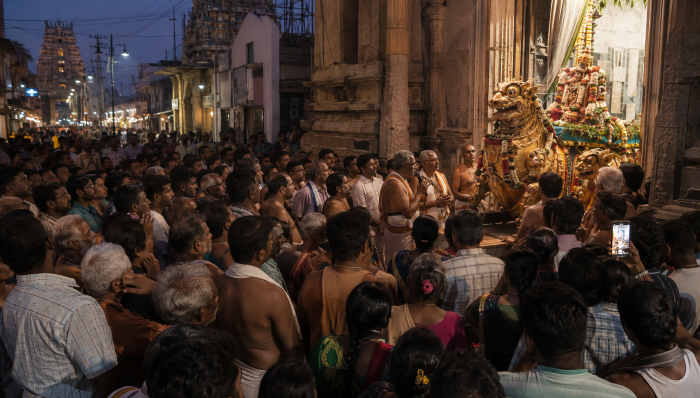
Case Summary
Devotees in Kanchipuram, Tamil Nadu, were left disappointed after the Yali Vahana procession of the famed Varadaraja Perumal Temple was abruptly cancelled during the annual Vaikasi Brahmotsavam festival. The cancellation came just a day after the Naga Vahana procession had also been called off, triggering concern and criticism among devotees over repeated disruptions to one of the temple's most important annual religious celebrations. The Vaikasi Brahmotsavam, one of the most significant festivals of the Varadaraja Perumal Temple, commenced on 28 May 2026 with the ceremonial flag hoisting and continued with various traditional rituals and processions. The first three days of the festival reportedly proceeded without disruption. However, on the fourth day, the Naga Vahana procession was halted shortly after it began when a crack was reportedly found in the beam supporting the deity. Temple authorities subsequently returned the deity to the temple, resulting in the cancellation of the procession. On the fifth day of the festival, Varadaraja Perumal and Nachiyar were taken in a golden palanquin procession through various streets of Kanchipuram before returning to the temple premises. Preparations were then made for the traditional Yali Vahana procession. The deity was adorned with special decorations and mounted on the Yali Vahanam in accordance with long-standing temple customs. The procession commenced at the temple before reaching Sannadhi Street. At that point, temple authorities abruptly announced its cancellation and returned the deity to the Vahana Mandapam. The sudden decision reportedly shocked devotees who had gathered in large numbers and waited for hours to witness the procession. The repeated cancellation of major festival processions within two consecutive days led to criticism of the temple administration and raised concerns among devotees regarding the conduct of the remaining Brahmotsavam events. Several worshippers questioned why traditional processions, which are an integral part of the temple's religious observances, were being disrupted. The controversy intensified after allegations surfaced on social media regarding the reason behind the cancellation. A devotee claimed that when concerns were raised with officials of the Hindu Religious and Charitable Endowments (HR&CE) Department, devotees were informed that the cancellation had been carried out on the instructions of HR&CE Minister Ramesh. The allegation subsequently generated widespread discussion and concern among devotees. The claim prompted questions from worshippers regarding the role of government authorities in temple rituals and religious observances. Devotees expressed concern over the possibility of administrative intervention in a centuries-old religious tradition and sought clarification regarding the circumstances under which the procession had been halted. At the time of reporting, neither the HR&CE Department nor Minister Ramesh had issued any official statement responding to the allegations. Devotees continued to seek clarity regarding the repeated cancellations and the reasons behind the disruption of established temple traditions during one of the most important Vaishnavite festivals in Tamil Nadu.
Why it is Hate Crime ?
The primary category for this case is "Restriction/ban on Hindu practices". The sub-category for this case is "Administration disallows religious procession". The tertiary category is "Religious procession". In several cases, it is seen that the administration/state disallows a religious procession owing to prejudicial orders and concerns, targeted specifically against the Hindu community. Such restriction/prohibition would be considered documented as a hate crime because the orders are often a result of pressure by groups that harbour animosity towards Hinduism and Hindus. Often, the restriction by the authorities is driven by bias, hostility, or prejudice against the specific community being stopped from holding a religious procession, by pressure groups that harbour animosity towards Hindus, intrinsic to their faith. Since the religious procession is inherent to the faith of the Hindus, such prejudicial restriction is considered a curtailing of the fundamental rights of the Hindu community. In several cases, for example, the authorities ban a Hindu religious procession due to pressure from groups opposed to the religion. In other instances, the prohibition is selectively enforced against one religious group (Hindus) while others are allowed to proceed. There are still other cases where the authorities preemptively restrict a religious process by Hindus because those who hold animosity towards Hindus may get “provoked” leading to them being violent, thereby assuaging the sentiments of those who hold animosity towards Hindus by curtailing the religious rights of Hindus. Such acts and orders are prejudiced, indicating discriminatory motives owing to the capitulation to groups that harbour animosity towards Hindus and therefore, would be categorized as a religiously motivated hate crime since the original pressure leading to the order itself is a result of hatred/bias/prejudice/religious hate against Hindus. The abrupt cancellation of the Yali Vahana procession at the Varadaraja Perumal Temple was not a logistical decision made on technical grounds. The procession had already left the temple premises and reached Sannadhi Street before temple authorities abruptly reversed the decision and returned the deity to the Vahana Mandapam. A procession that has already commenced and reached a public street is not cancelled for logistical reasons. It is cancelled because an external instruction overrides the temple's own ceremonial planning. The sequence of events, preparation completed, deity mounted, procession commenced, public route reached, and then abrupt cancellation, reflects a decision made at the last moment by an authority external to the temple's ritual management rather than a planned adjustment by those responsible for the festival. The disclosure that surfaced on social media establish the most significant religious marker of this case. When devotees raised concerns with HR&CE Department officials about the cancellation, they were informed that the decision had been taken on the instructions of HR&CE Minister Ramesh. The HR&CE Department is not a neutral administrative body. It is a state government mechanism through which the DMK government exercises direct institutional control over Hindu temples in Tamil Nadu, appointing administrators, managing temple finances, and, as this case establishes, intervening in ceremonial decisions. The disclosure that a minister in a secular government issued instructions cancelling a centuries-old Hindu religious procession reflects the specific danger of state control over Hindu religious institutions: when a government with a documented record of hostility toward Hindu religious practices controls the administrative apparatus of Hindu temples, the cancellation of Hindu processions on ministerial instruction becomes institutionally possible in a way that would not be conceivable for the religious practices of any other community. The Varadaraja Perumal Temple is not a minor or peripheral institution. It is one of the 108 Divya Desams [sacred Vaishnava temples revered in the devotional tradition of Sri Vaishnavism], among the most significant and ancient Hindu sacred sites in South India. The Vaikasi Brahmotsavam is not a recently established festival. It is a centuries-old tradition of structured processional worship in which the deity is taken through the streets of the temple town in specific vahanas [sacred divine vehicles] on specific days, allowing the broader community of devotees to receive the deity's darshan [sacred sight] outside the temple premises. The cancellation of the Yali Vahana procession after it had already commenced was not merely an administrative disruption. It was the interruption of a sacred ritual act that thousands of devotees had gathered along the route to witness, in a tradition that has been performed for centuries. The second disruption within two days, following the cancellation of the Naga Vahana procession on the fourth day, establishes a pattern of interference with the Brahmotsavam rather than an isolated incident. Two major processional rituals cancelled within two days of the same festival, with the second cancelled after it had already commenced and reached a public street, reflects a sustained pattern of disruption to Hindu sacred ceremonial practice during one of the most significant annual festivals at one of Hinduism's most revered temples. Given that this case met the parameters of a religiously motivated hate crime, the cancellation of the Yali Vahana procession on the alleged instructions of HR&CE Minister Ramesh reflected more than an administrative decision or a logistical adjustment. By instructing the cancellation of a centuries-old Hindu processional ritual at one of the 108 Divya Desams after the procession had already commenced, the minister's alleged intervention demonstrated a deliberate exercise of state power against the performance of a sacred Hindu religious tradition that has been observed at the Varadaraja Perumal Temple for centuries. The devotees of Varadaraja Perumal were denied the performance of their most sacred annual festival ritual specifically because the state institution that controls their temple chose to intervene in its ceremonial conduct. This reflects an underlying hostility toward Hindu religious practice that cannot be characterised as anything other than religiously motivated. Given that this case met the parameters of a religiously motivated hate crime, it was added to the hate crime database of the tracker.


Case Status
Complaint filed


Perpetrators Details
Perpetrators
State and Establishment
Perpetrators Range
One Person
Perpetrators Gender
male
 Sources




