Hindu youth's murder glorified by Muslim man in threatening knife video from Meerut
 Meerut, Uttar Pradesh, India
  2 June, 2026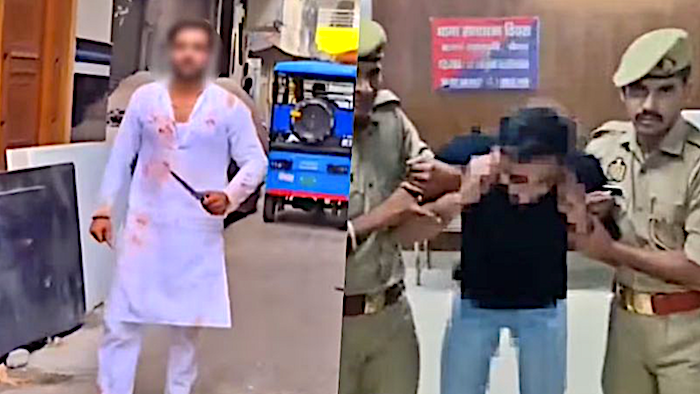
Case Summary
On May 28 2026, the day of Bakrid, a Hindu youth named Surya Chauhan was brutally stabbed to death for saying "no" to witness animal slaughter on the Muslim festival. Subsequently, his assasin Asad was killed in a police encounter. Days later, another Muslim youth created and circulated a video glorifying the deceased accused. The video directly referenced the heinous murder of the Hindu youth and conveyed support for the perpetrator who had killed the Hindu victim. The video opened with photographs of the deceased Hindu victim Surya Chauhan and deceased perpetrator Asad. It also featured an image of Uttar Pradesh Chief Minister Yogi Adityanath. Aman then appeared on screen wearing a white kurta pyjama stained with blood while brandishing a knife. Aman went on to deliver a message referencing the encounter and the deceased perpetrator. He stated, "How many Asads will you kill? I too have my weapons ready." The message was circulated publicly through social media platforms. The content explicitly invoked the name of the perpetrator involved in the murder of the Hindu youth and projected readiness for further violence while displaying a weapon. The video drew attention from law enforcement authorities. On 2nd June 2026, Brahmapuri Police Station identified Aman as the creator of the video. He was traced to the Harinagar Angoor Wali Masjid area in Meerut and was apprehended near Kachha Dagda Bhumiya Bridge. During the operation, police recovered the knife that had been displayed in the video. Following his arrest, Aman appeared in police custody in another video. He was seen apologising, holding his ears and walking with a limp. The police continued proceedings in connection with the inflammatory social media content. The case remained under investigation.
Why it is Hate Crime ?
This case has been added to the tracker under the primary category- Hate speech against Hindus. Within this, the sub-category is - Violent threats. Violent threats, explicit, implicit or implied, is the most dangerous form of hate speech since it goes beyond discriminatory and prejudicial language to express the intent of causing harm to an individual or a group of people based on their religious identity and faith. There could be several different kinds of threats that are issued to Hindus based on religious animosity. An explicit threat would mean the direct threat of violence towards an individual Hindu, a group of Hindus or Hindus at large. Physical violence, death threats, threats of destruction of property belonging to Hindus and threats of genocide would mean explicit threats against Hindus for their religious identity. Implicit threats may not be a direct threat but implied through the use of symbols of actions – for example – in the Nupur Sharma case, other than explicit threats, there were also implicit threats when Islamists took to the streets to burn and beat her effigies. It implies that they want to do the same to Nupur Sharma – thereby is considered an implicit threat. Violent threats can be delivered in person, through letters, phone calls, graffiti, or increasingly through social media and other online platforms. It would be important to understand that a threat – explicit or implicit, online or offline – to an individual who happens to be a Hindu does not qualify as a religiously motivated threat. Such a threat, while vile and dangerous, could be owing to non-religious reasons and/or personal animosity. To qualify as a religiously motivated threat, it would need to exhibit an indication that the individual is being targeted for religious reasons and/or owing to his/her religious identity as a Hindu. This case has been included in the tracker because it involved the glorification and endorsement of a murder that was itself rooted in religious targeting. The video did not merely discuss a criminal incident or comment on a police encounter. Instead, it celebrated and valorised an individual accused of killing a Hindu youth after he objected to witnessing animal slaughter during Bakrid. By praising the perpetrator and presenting him as a figure worthy of admiration, the content effectively endorsed the underlying act of violence directed against the Hindu victim. The religious dimension of the case is central to understanding its significance. Surya Chauhan was reportedly murdered after expressing his unwillingness to witness animal slaughter associated with a religious festival. The subsequent video was created in the aftermath of that killing and explicitly referenced the accused responsible for the attack. Rather than expressing sympathy for the victim or condemning the violence, the creator chose to honour the perpetrator. In doing so, he transformed a religiously charged murder into a symbol to be celebrated and emulated. The imagery used in the video further reinforced this message. The creator appeared with blood-stained clothing while openly displaying a knife, a symbol closely associated with the killing itself. The video also juxtaposed images of the deceased Hindu victim and the deceased accused, ensuring that viewers would immediately understand the context being referenced. The deliberate inclusion of these visual elements was not incidental. It served to romanticise the violence and elevate the accused into a heroic figure despite the fact that he stood accused of murdering a Hindu youth. The most disturbing aspect of the video was the message delivered by the creator. By declaring, "How many Asads will you kill? I too have my weapons ready," while brandishing a knife, he moved beyond glorification and into the realm of intimidation and incitement. The statement conveyed solidarity with the deceased accused and suggested a willingness to continue or replicate similar acts of violence. The message effectively portrayed the perpetrator not as a criminal but as part of a larger cause deserving support and continuation. The video also carried a broader communal message. Glorifying an individual accused of killing a Hindu youth for objecting to animal slaughter sends a signal that violence against Hindus who resist, question, or oppose such practices is justified and worthy of admiration. Such messaging serves to intimidate the wider Hindu community by communicating that the murder of one Hindu victim is not condemned but celebrated. The threat implicit in the statement about having weapons "ready" extends beyond the original victim and creates fear among other Hindus who may hold similar objections or seek to assert their rights. Such conduct also reflects the deep-seated animosity that radicalised individuals harbour towards Hindus, to the extent that the brutal killing of a Hindu youth is not viewed as a wrongful act deserving condemnation but as an act worthy of admiration and emulation. The glorification of the perpetrator despite the gravity of the crime demonstrates a mindset in which communal solidarity overrides basic moral distinctions between right and wrong. The glorification of the accused also appeared to be rooted in an extreme and distorted sense of religious solidarity, where allegiance to a fellow member of the Ummah eclipsed moral accountability for his actions. In such a mindset, the suffering of the Hindu victim becomes secondary to communal loyalty, leading to the celebration of an individual who should instead have been universally condemned for his violent actions. Seen in its entirety, the incident was not merely an instance of offensive social media content. It involved the public glorification of a perpetrator accused of killing a Hindu youth, the symbolic celebration of religiously motivated violence, and the projection of readiness to carry out similar acts in the future. By endorsing the killing, threatening further violence, and expressing solidarity with the accused, the video targeted the Hindu community and sought to normalise aggression against those who challenge or resist such acts. For these reasons, the incident constitutes anti-Hindu hate speech and has been included in the tracker as a case of religiously motivated intimidation and glorification of violence against Hindus. Disclaimer: The exact date on which the video was recorded and uploaded was not specified in the available sources. Therefore, for documentation and tracking purposes only, the article publication date of 3rd June 2026 has been used as the incident date in the tracker.


Case Status
Arrested


Perpetrators Details
Perpetrators
Muslim Extremists
Perpetrators Range
One Person
Perpetrators Gender
male
 Sources




