Hindu faith insulted, devotees outraged by blasphemous depiction of Congress leader as Lord Shiva for political glorification by Kannada newspaper in Karnataka
 Karnataka, India
  2 June, 2026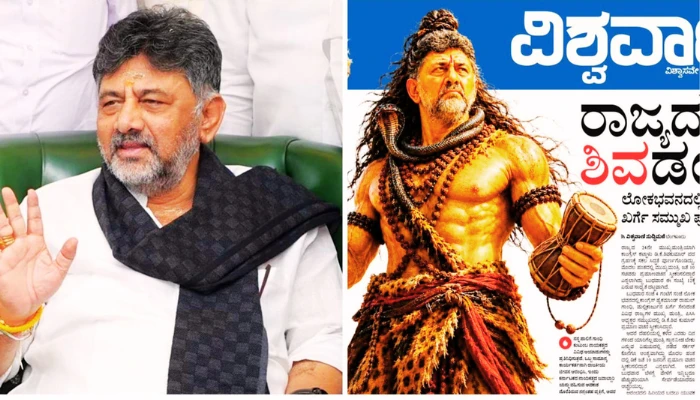
Case Summary
In Bengaluru, Karnataka, the iconography of the Hindu God, Lord Shiva, was desecrated, defamed and distorted by depicting Congress leader D.K. Shivakumar as the revered Hindu deity by the Kannada newspaper Vishwavani. The publication occurred ahead of his swearing-in as the Chief Minister of Karnataka. The Bengaluru-based daily carried the illustration on its front page and also shared it on social media through its Editor-in-Chief, Vishweshwar Bhat. The artwork portrayed Shivakumar using iconography traditionally associated with Lord Shiva, including matted locks, a tiger-skin garment, a trishul, and a damru, drawing widespread criticism from members of the Hindu community and social media users. Following the publication of the illustration, several Hindu devotees objected to the depiction and accused the newspaper of hurting Hindu religious sentiments. Critics argued that equating a contemporary political leader with a revered Hindu deity was inappropriate and amounted to the misuse of sacred religious imagery. Many social media users described the portrayal as blasphemous and questioned the editorial decision to employ the image of Lord Shiva for political glorification. One social media user stated, “This is blasphemy. I don’t understand how people are treating this as normal.” Another user criticised the newspaper's editorial standards and questioned whether a similar portrayal involving figures sacred to other religions would have been tolerated without provoking outrage. The depiction also attracted criticism from Karnataka-based advocate Girish Bharadwaj, who stated that representing politicians as gods was against Dharma and diminished the reverence associated with Hindu deities. He expressed concern that sacred Hindu iconography was being used to elevate a political figure and argued that such portrayals undermined the sanctity attached to Hindu gods. Several social media users further objected to the comparison by pointing to D.K. Shivakumar's past legal controversies and questioning the appropriateness of depicting a politician as Lord Shiva. Others criticised the illustration as an example of excessive political sycophancy and an inappropriate use of religious symbolism in political discourse. The controversy triggered a wider public debate regarding the use of sacred Hindu symbols, deities, and religious imagery in media and political communication. While some supporters viewed the illustration as a symbolic tribute to Shivakumar's political ascent, critics maintained that employing the image of a revered Hindu deity for political messaging trivialised the faith and offended Hindu believers. The controversy emerged shortly before D.K. Shivakumar was scheduled to take oath as the Chief Minister of Karnataka at Bengaluru's Glass House in Lok Bhavan, following the resolution of a prolonged leadership tussle within the Congress party.
Why it is Hate Crime ?
The first primary category selected in this case is- Attack on Hindu religious representations. The subcategory selected is- Iconoclastic representation of Hindu Gods/Goddesses. An icon is a symbol of someone or something that is revered, or a religious representation of a spiritual ideal. Iconography is of vital significance in the Hindu milieu. It helps connect people’s spiritual beliefs with the real world. Iconography within the Hindu faith takes several shapes and forms. Murtis are of most significance to Hindus, to which daily rituals, prayers and offerings are done. Besides the murtis, there are several other symbols which have deep significance in the Hindu faith – the Om and Swastika, for example. Any iconoclastic representation of these symbols, images and murtis is an affront to the religious beliefs and faith of the Hindu community itself since the symbols and icons are deeply religious in nature. In this sub-category of crime, we would record hate crimes and iconoclastic representations, in words, art, or any other form of representations of symbols that hold religious significance for the Hindu community. Since these symbols, icons and murtis are central to the Hindu faith, any iconoclastic representation of these symbols is born out of animosity towards the faith itself, manifesting itself through these symbols, and therefore, these representations would be considered religiously motivated hate crimes. This case was included in the Hinduphobia Tracker because it involved the appropriation and distortion of the sacred iconography of Lord Shiva for political glorification, resulting in the denigration of a revered Hindu religious representation. The most concerning aspect of the incident is not that a political leader was praised or celebrated, but that such praise was achieved by depicting him as Lord Shiva, one of the most revered deities in Hinduism. Political figures can be honoured in numerous ways; however, using the image of a deity worshipped by millions transforms a sacred religious symbol into a political tool, which is deeply offensive for Hindus. For Hindus, Lord Shiva is not a symbolic character, cultural motif, or artistic archetype. He is a living object of devotion whose image and iconography carry immense religious significance. The trishul, damru, matted locks, tiger skin, and other attributes associated with Lord Shiva are sacred symbols that form part of Hindu religious consciousness. By replacing the deity's image with that of a contemporary politician while retaining these sacred attributes, the depiction blurred the line between the divine and the political, diminishing the sanctity attached to the deity and hurting the religious sentiments of devotees. The apparent purpose of the illustration further heightens these concerns. The depiction was not created in a religious, educational, or theological context. Rather, it was used to celebrate a political milestone and elevate a political personality. In effect, a revered Hindu deity and the sacred symbolism associated with Him were repurposed for political messaging. This reduced a deeply venerated religious representation to an instrument of personality glorification, a use that many Hindus would reasonably view as disrespectful and irreverent. The incident also reflects a broader tendency to treat Hindu religious imagery as available for casual political or public use in ways that would be considered unacceptable with many other faith traditions. For Hindus, murtis and visual representations of gods and goddesses are not empty objects or mere artistic expressions. They embody profound spiritual meaning and serve as a vital connection between devotees and the divine. Consequently, repurposing such sacred imagery for secular political objectives is perceived not as harmless creativity but as a desecration of something held holy. Given the nature of the depiction, the use of Lord Shiva's sacred iconography for political glorification, and the resulting injury to Hindu religious sentiments, this case falls within the category of attack on Hindu religious representations, specifically iconoclastic representation and desecration of a Hindu religious symbol. Further, by trivialising and reducing a revered Hindu deity to a political instrument, the act also amounted to the mocking and denigration of Hindu religious beliefs, warranting its inclusion under hate speech directed against Hindus and their faith.


Case Status
Unknown


Perpetrators Details
Perpetrators
Others
Perpetrators Range
Unknown
Perpetrators Gender
unknown
 Sources




