Hindus threatened as Jamaat leader urges mobilisation and calls Muslims to prepare against India and BSF amidst ongoing persecution of Hindu minorities in Bangladesh
 Jessore District, Bangladesh
  2 June, 2026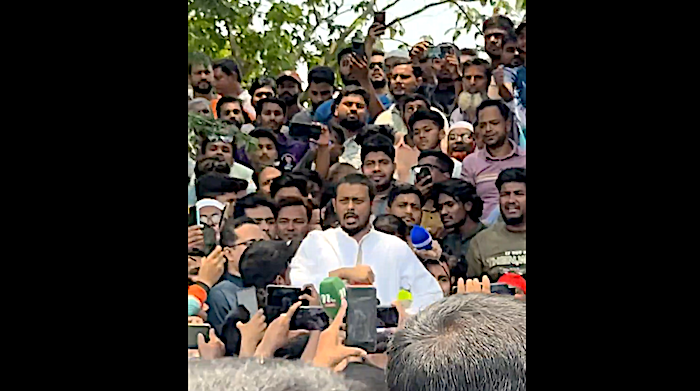
Case Summary
In Bangladesh's Jessore district, tensions escalated along the Benapole-Petrapole border after Jamaat leader Nasiruddin Patwari made provocative speeches directed at India and the Border Security Force (BSF). The incident occurred in the Benapole border area, where Patwari was mobilising and influencing local Muslim youth while delivering inflammatory rhetoric that encouraged hostility and confrontation against India and by extansion against Hindus. According to available information, Patwari travelled to the border region at a time when security concerns were already heightened. Local residents stated that he delivered speeches targeting India and the BSF and encouraged preparations for confrontation. The statements came shortly after an earlier border incident in which an elderly man attempted to attack BSF personnel following a provocative speech attributed to Patwari. That incident was contained after intervention by members of the Border Guard Bangladesh (BGB), preventing further escalation. As concerns grew over renewed tensions, additional security measures were introduced along the border. Surveillance was increased and security personnel remained on alert amid fears that further inflammatory speeches could trigger unrest. Local residents identified Patwari as an influential Jamaat leader with a strong organisational presence in border regions, including Benapole. Sources stated that networks associated with Jamaat had been engaged in spreading religious fanaticism and attempting to influence local populations in border communities. The speeches and mobilisation efforts occurred against a backdrop of growing political instability in Bangladesh and increasing activity by Islamist groups in several parts of the country. Political observers and local residents expressed concern that attempts to radicalise local youth and inflame communal sentiments in sensitive border regions could destabilise the area and aggravate tensions between neighbouring countries. Video material circulated from the incident showed Patwari speaking about protecting Bangladeshi citizens from what he described as "murderers" and framing the issue in confrontational terms. The rhetoric was disseminated alongside calls encouraging resistance and hostility towards India and the BSF. Local accounts stated that such speeches contributed to heightened tensions in the border region and increased concerns regarding communal radicalisation. The incident took place amid a broader climate of rising Islamist mobilisation and increasing insecurity for religious minorities in Bangladesh. Hindu communities living in border districts have historically been among the most vulnerable groups during periods of political and communal unrest. In such environments, inflammatory rhetoric rooted in religious fanaticism and majoritarian mobilisation carries particular significance because it contributes to conditions in which minority communities face heightened risks of intimidation, exclusion, and violence. This escalation of violence against Hindus in Bangladesh has unfolded in three distinct phases: first, following the ouster of Sheikh Hasina's government in August 2024; second, after the death of Sharif Osman Bin Hadi in December 2025; and third, in the immediate aftermath of the 13th National Parliamentary Election 2026. Following the ouster of Sheikh Hasina, multiple reports documented attacks on Hindu homes, temples, and religious institutions, alongside intimidation campaigns, arson, and mob assaults targeting minority neighbourhoods. The Hinduphobia Tracker has recorded 336 such incidents against the Hindu minority, underscoring the scale and persistence of anti-Hindu violence during this period. A further escalation occurred following the death of Sharif Osman Bin Hadi, a Muslim political activist and student leader known for his anti-Hindu and anti-India rhetoric. Hadi had been involved in political unrest after the fall of the Hasina government and was killed in Dhaka on 18th December 2025 during clashes. In the aftermath of his death, Hindu communities were blamed and subsequently targeted in retaliatory violence. Hindu homes were selectively set ablaze in multiple localities, forcing families to flee and leaving many displaced. The attacks appeared patterned rather than sporadic, with Muslim mobs focusing on Hindu neighbourhoods, properties, and religious symbols. Among the victims was Dipu Chandra Das, who was lynched to death and his body was set ablaze by a Muslim mob over false blasphemy allegations. The Hinduphobia Tracker documented 51 incidents of anti-Hindu violence in the period following Hadi's death alone. Reports further indicated that posters and written materials calling for the extermination of Hindus were displayed in public spaces. Combined with acts of arson, vandalism, assault, and intimidation, these developments contributed to an atmosphere of fear and insecurity for Bangladesh's Hindu minority. The third phase of violence unfolded after the 13th National Parliamentary Election 2026. Within days of the announcement of results, Hindu families in districts including Noakhali, Rangpur, Nilphamari, Sylhet, Thakurgaon, and Dinajpur experienced attacks involving arson, looting, assault, and vandalism of temples and homes. In several instances, Hindu families were specifically targeted and threatened with displacement. Against this backdrop, the speeches delivered by Nasiruddin Patwari assumed wider significance because they centred on mobilisation through religious fanaticism and confrontation. The incident heightened concerns among observers regarding the continuing influence of extremist rhetoric in Bangladesh's border regions and its potential impact on communal harmony, regional stability, and the security of vulnerable minority communities, including Hindus. At the time of reporting, heightened security measures remained in place in the Benapole border area and authorities continued monitoring the situation.
Why it is Hate Crime ?
This case has been added to the tracker under the primary category - Hate speech against Hindus. Within this, the sub-category selected is - Violent threats. Violent threats, explicit, implicit or implied, is the most dangerous form of hate speech since it goes beyond discriminatory and prejudicial language to express the intent of causing harm to an individual or a group of people based on their religious identity and faith. There could be several different kinds of threats that are issued to Hindus based on religious animosity. An explicit threat would mean the direct threat of violence towards an individual Hindu, a group of Hindus or Hindus at large. Physical violence, death threats, threats of destruction of property belonging to Hindus and threats of genocide would mean explicit threats against Hindus for their religious identity. Implicit threats may not be a direct threat but implied through the use of symbols of actions – for example – in the Nupur Sharma case, other than explicit threats, there were also implicit threats when Islamists took to the streets to burn and beat her effigies. It implies that they want to do the same to Nupur Sharma – thereby is considered an implicit threat. Violent threats can be delivered in person, through letters, phone calls, graffiti, or increasingly through social media and other online platforms. It would be important to understand that a threat – explicit or implicit, online or offline – to an individual who happens to be a Hindu does not qualify as a religiously motivated threat. Such a threat, while vile and dangerous, could be owing to non-religious reasons and/or personal animosity. To qualify as a religiously motivated threat, it would need to exhibit an indication that the individual is being targeted for religious reasons and/or owing to his/her religious identity as a Hindu. This case has been included in the tracker because the speeches delivered by Jamaat leader Nasiruddin Patwari went beyond ordinary political criticism of India and carried a clear potential to inflame hostility towards Hindus in a context where anti-India mobilisation has repeatedly translated into anti-Hindu sentiment and violence. The incident is significant because it involved the active mobilisation of Muslim youth through inflammatory rhetoric in a sensitive border region at a time of rising Islamist radicalisation and growing insecurity for Hindu minorities in Bangladesh. A key factor in assessing the religious dimension of the incident is the ideological framework within which such rhetoric is often delivered. Islamist groups in Bangladesh frequently portray India not merely as a neighbouring country or geopolitical rival but as a Hindu civilisational entity and a collective representative of Hindu interests. Within this worldview, hostility towards India often acquires an anti-Hindu character because Hindus are perceived as part of the same collective that is being opposed. The conduct of Patwari reflects this mindset. Rather than engaging in political advocacy, he travelled to a sensitive border region and delivered provocative speeches aimed at mobilising local Muslim youth and encouraging confrontation. Such rhetoric is particularly concerning because it seeks to transform political disagreements into communal grievances. By portraying India as an adversary and encouraging resistance, the speeches reinforced narratives that cast Hindus and India as part of a single opposing bloc. This reflects a worldview in which Hindu identity is treated not as an equal component of society but as something aligned with a perceived religious enemy. The incident must also be viewed against a broader pattern in Bangladesh where anti-India mobilisation often acquires an anti-Hindu dimension. Local Hindus are frequently treated as symbolic representatives or proxies of India despite having no connection to the policies or actions of the Indian state. As a result, periods of heightened anti-India rhetoric have repeatedly coincided with attacks on Hindu homes, temples, businesses, and individuals. The victims are targeted not for anything they have done, but because they are associated with the same religious identity that radical actors attribute to India. Another important aspect is the role of religious solidarity and Ummah consciousness in such mobilisation. Radical Islamist actors often frame political developments involving India through the lens of Muslim brotherhood, encouraging supporters to identify with Muslims across borders while simultaneously portraying India as a Hindu collective. This creates a communal mindset in which Muslims are viewed as part of a shared religious fraternity while Hindus are viewed as members of an opposing religious camp. Such narratives deepen communal polarisation and make Hindu minorities especially vulnerable whenever anti-India sentiment is stirred. The danger of Patwari's speeches therefore lies not only in the words spoken but in the atmosphere they help create. In a country where Hindus have repeatedly faced violence during periods of political and religious mobilisation, inflammatory rhetoric directed against a state that is routinely portrayed as a Hindu entity carries foreseeable consequences for local Hindu communities. By encouraging confrontation, amplifying religious polarisation, and promoting narratives that blur the distinction between India and Hindus, such speeches contribute to an environment in which hostility towards Hindus is normalised and intensified. Viewed in its entirety, this incident was not merely an expression of political opinion. It involved the communal mobilisation of Muslim youth through rhetoric rooted in religious polarisation and hostility towards a perceived Hindu collective. Given the established pattern of anti-India agitation translating into anti-Hindu targeting in Bangladesh, the speeches carried a clear anti-Hindu dimension and contributed to an atmosphere of intimidation and insecurity for Hindu minorities. For these reasons, the incident has been included in the tracker as a case of anti-Hindu hate speech and religiously motivated communal mobilisation. Disclaimer: The source material did not specify the exact date on which Nasiruddin Patwari delivered the statements or undertook the activities described. Therefore, for documentation and database purposes only, the article's publication date, 3rd June 2026, has been used as the incident date. This date serves solely as a reference point for recording the case until more precise chronological information becomes available.


Case Status
Arrested


Perpetrators Details
Perpetrators
Muslim Extremists
Perpetrators Range
One Person
Perpetrators Gender
male
 Sources




