Hindu sentiments outraged as Muslim man offers namaz inside premises of a Hindu temple in Bulandshahr
 Bulandshahr, Uttar Pradesh, India
  30 May, 2026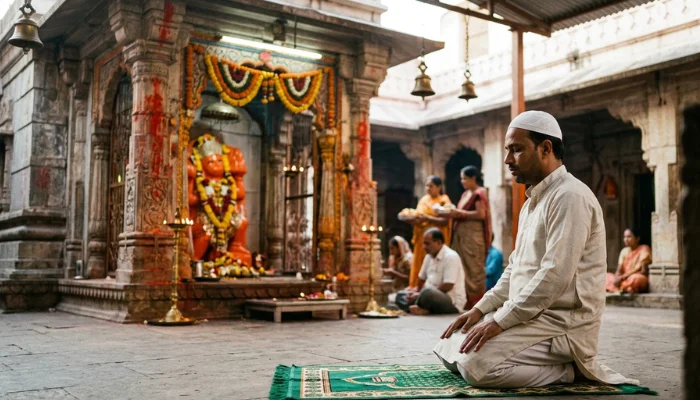
Case Summary
In Aulina village, Bulandshahr, Uttar Pradesh, the sanctity of a Hindu temple was desecrated when a Muslim man, Asar Mohammad, offered namaz inside the temple premises. A video of the incident circulated on the internet, causing outrage from Hindu users on social media. The police took cognisance of the video, registered a case against three accused individuals, and began investigating the matter. The main accused, Asar Mohammad, was arrested. As per reports, a man named Rajkumar was having his house constructed by a mason from Zahra village. During the lunch break, some labourers left for lunch, while Asar Mohammad, the mason, went to the Hanuman temple complex situated opposite the house under construction. Asar Mohammad said that, due to a light drizzle and at Rajkumar's request, he offered namaz inside the temple premises. His Muslim companion, Nazar Mohammad, was also present there. Someone recorded the incident and circulated the video on the internet. Villagers were outraged by the offering of namaz inside the Hanuman temple. Upon receiving information from local residents, Aurangabad Police Station in-charge Mohammad Aslam arrived at the scene with a large police contingent, took Asar Mohammad into custody, and brought him to the police station. Investigating Officer Abhishek Tewatia stated that the police investigation found that an attempt had been made to desecrate a Hindu place of worship and disturb communal harmony with the intention of insulting the religion of the Hindu community. The act was found to have insulted Hindu religious beliefs and hurt the sentiments of Hindus. Following this, the police registered a case against Asar Mohammad, Nazar Mohammad, and the property owner, Rajkumar, under the relevant legal provisions. Asar Mohammad was subsequently sent to jail. Station House Officer Mohammad Aslam stated that the incident had occurred on 31 May 2026. Upon arriving at the scene and conducting an investigation, the police found that construction workers had offered namaz there. Following the incident, resentment was felt among members of the Hindu community. He added that the police had taken cognisance of the entire matter, registered a First Information Report, and initiated legal proceedings.
Why it is Hate Crime ?
This case has been added to the tracker under the primary category of: - Attack on Hindu religious representations. Within it, the sub-category selected is: - Breaking rules of places of worship. Sanatan Dharma is not a religion of one book, which is to say that while it has religious scriptures that form the central tenets of the faith, there are several traditions followed through thousands of years, mostly passed from generation to generation orally. One of these oral traditions or written traditions is the rules of specific temples. Certain temples have rules which are traditional rules, dependent on the worship of the presiding deities. These rules and traditions have been followed for thousands of years whether they find scriptural mention or not. Such traditions are based on the nature and rules of worship of the presiding deity of that temple. Any non-compliance of these traditions owing to animosity towards the faith or for the sake of activism stems not only from the lack of faith in the presiding deity but also disregard for the faith of the devotees of that deity/temple and implicit bias against the faith, the tradition and the deity itself. Since these specific traditions are central to the faith of the devotees of that specific temple and presiding deity, any non-compliance with these traditional rules would be considered a religiously motivated hate crime. The other sub-category relevant here is: - Defiling religious customs. In Hinduism, a temple is the abode of the Deity. The Deity in the Temple is consecrated, thereby, making it a real, breathing entity. Hindus believe that not just the Deity but the temple premises itself are sacred to Hindus since Hindus hold the faith that the entire Temple space is an amalgamation of the divine energy of the deity. Similarly, religious activities hold deep significance for Hindus, as they are intricately connected to their spiritual, cultural, and social lives. These practices encompass rituals, festivals, prayers, and pilgrimages that celebrate and honour various deities, fostering a sense of spiritual connection, community, and cultural continuity. Given the central significance of Temples and religious activities in Hindu Dharma, any aggressive Abrahamic chanting outside Temples or during religious activities negates the divinity of the religious space because the chanting itself negates the existence of any other God other than the God of the Abrahamic faith. Such chanting is specifically done to negate the faith of Hindus, establish religious supremacy, intimidate the devotees and mock the faith. Besides temples, such Abrahamic chanting outside any Hindu place of worship or religious structure or during any religious activity has the same effect. Since such acts are rooted in an inherent religious supremacist mentality driven by religious animosity, such crimes would be considered religiously motivated hate crimes under this category. This incident exemplifies a religiously motivated hate crime, as a Muslim man offered namaz inside a Hindu temple dedicated to Lord Hanuman, violating the sanctity of a sacred Hindu place of worship. The deliberate choice to perform a non-Hindu religious ritual within the temple premises transformed the incident from a mere act of trespass into an affront to the religious beliefs and customs of the Hindu community. The act constituted a direct violation of the sacred character of the temple and amounted to an intrusion into a space reserved exclusively for Hindu worship. For Hindus, a temple is far more than a physical structure; it is regarded as the dwelling place of the particular Hindu deity and a spiritually charged space maintained through rituals of consecration, purity, and devotion. Devotees visit temples to offer prayers, perform puja, participate in aarti, and seek blessings from the presiding deity. The sanctity of the temple is preserved through strict religious customs and traditions that govern the conduct of worship within its premises. Any act that violates these sacred Hindu traditions is deeply offensive to the faith and sentiments of Hindu worshippers. Consequently, the offering of namaz inside the Hanuman temple caused distress and anger among Hindus, who viewed it as a desecration of a sacred space central to their religious life. The act of offering namaz inside the temple further contravened the traditional religious norms that govern Hindu places of worship. Hindu temples function according to long-established ritual practices rooted in scriptural traditions such as the Agamas, which prescribe the manner in which worship is conducted, and the sanctity of consecrated spaces is maintained. These traditions are intended to preserve the spiritual character of the temple as a site dedicated exclusively to the worship of Hindu deities. The introduction of a religious practice belonging to another faith within the temple premises therefore constituted a violation of these sacred norms and disrupted the religious sanctity of the site. By choosing to perform namaz within a Hindu temple rather than in a neutral space or a mosque, the act acquired a symbolic significance that extended beyond personal prayer. It represented a blatant disregard for the religious boundaries and sacred customs associated with a Hindu shrine. The resulting outrage among villagers and the subsequent police action underscored the extent to which the incident was viewed as an offence against the sanctity of the temple and the religious sentiments of Hindus. Henceforth, this case is being added to the hate crime database of the Hinduphobia Tracker. Disclaimer: While this tracker acknowledges that three individuals were named as accused in this case, for documentation purposes, the religion of the perpetrators has been recorded as Muslim since the principal accused, Asar Mohammad, and the co-accused, Nazar Mohammad, are confirmed to be Muslim. The third accused, Rajkumar, whose identity is unknown, was named in the police case due to his role in facilitating or permitting the incident to occur within the temple premises. However, the act that forms the basis of this hate crime documentation, the offering of namaz inside a Hindu temple and the resulting desecration of its sanctity, was carried out by the Muslim accused. Accordingly, the case has been categorised under Muslim perpetrators for consistency in classification. This approach ensures clarity in data representation while acknowledging the involvement of all accused individuals named in the case.


Case Status
Case sub-judice


Perpetrators Details
Perpetrators
Muslim Extremists
Perpetrators Range
From 2 To 5
Perpetrators Gender
male
 Sources




