Hindu tribal communities in Rajasthan subjected to organised conversion operation across multiple villages
 Sirohi, Rajasthan, India
  1 June, 2026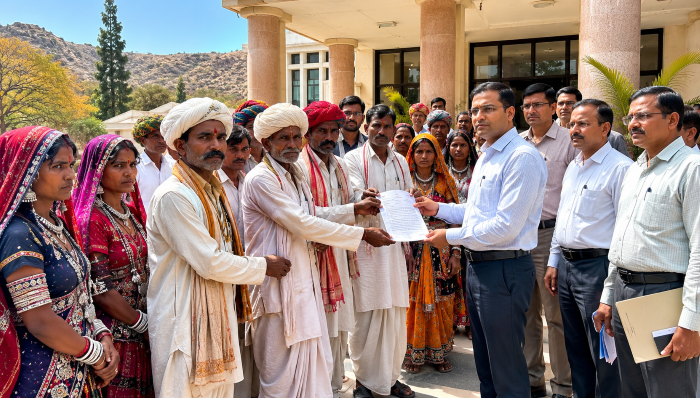
Case Summary
Hindu tribal communities across multiple villages in Sirohi district, Rajasthan, were subjected to large-scale illegal conversion operations by missionaries and anti-religion elements. They were targeting innocent Adivasi tribal families through misleading propaganda and various inducement tactics. Ekal Abhiyan Anchal Sirohi submitted a memorandum to the District Collector demanding an immediate ban on the conversion activities, strict action against those responsible, and administrative surveillance of affected areas. The organisation warned of an indefinite sit-in protest from 6 July if strict action was not taken. As per details, the conversion operations had been ongoing for some time across Sirohi district and surrounding areas, specifically targeting the tribal Adivasi community through misleading propaganda and various coercive tactics. The memorandum submitted to the District Collector identified multiple affected locations including Kaldari village in Shivganj tehsil, Thandi Beri Panchayat area in Pindwara tehsil, areas near Ultratech company, Chitriya Fali, Muri village, Kudal, Sabela, Moras, and Isra Rural. In Abu Road area, Kui, Khara, Bhainsa Singh, Amba, Pipar Bhat, Bordhani, Dairy, Jaloiya Fali, Mata Fali, and Khejda areas were also identified as affected. Karoti and surrounding areas in Rewdar tehsil were additionally mentioned. Ekal Abhiyan officials stated that the tribal community had been an integral part of Sanatan culture since ancient times and that the illegal conversion activities constituted a direct attack on the traditional, religious, and cultural heritage of the tribal Hindu community, causing deep resentment in local society. The organisation demanded that forces and institutions conducting conversions through inducement and misleading propaganda be immediately identified and their activities curbed, that strict legal action be taken against those misleading poor tribal families, and that strict administrative surveillance be maintained in rural and sensitive areas. The organisation warned to undertake an indefinite sit-in protest if actions were not taken against the illegal conversion activities.
Why it is Hate Crime ?
The primary category for this case is "Predatory Proselytisation". The sub--category for this case is "Conversion/attempts to convert by inducement". Predatory Proselytisation is not just limited to threat, harassment, force and violence, but it also has contours of stealth. In several cases, the Hindu victim is exploited to convert, with non-Hindus taking advantage of their poverty. In such cases, the Hindu victim who is suffering financially is offered monetary benefits, including lucrative offers for jobs, health treatment, education, etc, to induce the victim into changing his/her religion. In such cases, the religious identity of the victim and the aim to disenfranchise him from his faith form the heart of the crime. Also, taking advantage of and exploiting an individual’s economic vulnerabilities is widely acknowledged as exploitation, forms of which are often penalised by law. Such cases therefore are considered religiously motivated hate crimes since the victim’s religious identity forms the very heart of the crime itself. Another sub-category for this case is "Proselytisation by grooming, brainwashing, manipulation or subtle indoctrination. The tertiary category here is "Pattern of targeting Hindus". Religious brainwashing essentially means the often subtle and forcible indoctrination to induce someone to give up their religious beliefs to accept contrasting regimented ideas. Religious grooming or brainwashing also involves propaganda and manipulation. It involves the systematic effort, driven by religious malice and indoctrination, to persuade “non-believers’ to accept allegiance, command, or doctrine to and of a contrasting faith. Cases of such grooming or brainwashing are far more nuanced than direct threats, coercion, inducement and violence. In such cases, it is often seen that there is repeated, subtle and continual manipulation of the victim to induce disaffection towards their own faith and acceptance of the contrasting faith of the perpetrator. While subtle indoctrination is widely acknowledged as predatory, an element which is often understated in such conversions or the attempts of such conversion is the role of loyalty and trust which might develop between the perpetrator and the victim. Fiduciary relationships are often abused to affect such religious conversion. For example, an educator transmitting religious doctrine of a competing faith to a Hindu student. The Hindu student is likely to accept what the teacher is transmitting owing to existence of the fiduciary relationship. The exploitation of the fiduciary relationship to religiously indoctrinate victims would also be included in this category. Since the underlying animosity towards the victim’s faith forms the basis of predatory proselytization, such cases are considered religiously motivated hate crimes. This case has been included in the tracker because it involved the organised targeting of Hindu tribal communities for religious conversion. The victims were not selected randomly. They were targeted specifically because they belonged to Hindu Adivasi communities whose religious and cultural traditions remain rooted in the broader Sanatan framework. The clearest religious marker in this case is the attempt to induce Hindus to abandon their existing faith and adopt another religion. Conversion efforts based on inducements, misleading claims, or the exploitation of economic vulnerability are fundamentally different from the voluntary adoption of a faith through informed personal conviction. Many tribal communities live with limited economic resources and face significant social and developmental challenges. Offers of financial assistance, material benefits, educational support, healthcare, employment opportunities, or other incentives can therefore exert disproportionate influence on individuals who are struggling to meet basic needs. Such inducements exploit vulnerability rather than foster genuine religious conviction. Instead of allowing a person to make a free and informed spiritual choice, they create circumstances in which economic necessity becomes intertwined with religious conversion. In this way, attachment to an ancestral faith is gradually weakened and religious change is secured through dependency, influence, or material considerations rather than sincere belief. The targeting of tribal Hindus carries an additional dimension because tribal religious traditions are deeply intertwined with community identity, ancestral customs, local deities, and inherited systems of worship. Consequently, conversion efforts directed at such communities do not merely affect individual beliefs. They also disrupt the religious and cultural continuity of the wider community. When members of tribal societies are encouraged to abandon their traditional practices and adopt an alien faith, the impact extends beyond the individual and affects the collective religious heritage preserved across generations. The religious motivation is evident from the fact that the targets were selected because they were Hindu and because the objective was their conversion out of Hinduism. The purpose was not religious coexistence but religious replacement. Such conduct reflects hostility towards the continued existence of the victims' faith and seeks to reduce adherence to Hindu traditions through organised proselytisation. On the whole, the incident represents more than an exercise of religious freedom. It involved the systematic targeting of vulnerable Hindu tribal communities with the objective of securing their conversion away from their ancestral faith. The victims were selected on the basis of their Hindu identity and the objective was the abandonment of Hindu beliefs, practices, and traditions in favour of another religion. Since such predatory conversion efforts stem from Abrahamic doctrines like Christianity that view non-believers with disdain until they convert, fostering contempt that manifests in targeted crimes against Hindus, this case constitutes a hate crime warranting inclusion in the Hinduphobia Tracker's hate crime database. Disclaimer: The tracker records incident dates based on when the crime occurred or the victim's ordeal began rather than when it was reported or published. However, in cases where this information is not available, the tracker uses the earliest available date. Here, the exact date on which the conversion operations began in Sirohi district was not confirmed in the source. Therefore, 2 June 2026 has been used as the indicative incident date, reflecting the publication date as the earliest available reference point. This date has been recorded for documentation purposes only.


Case Status
Complaint filed


Perpetrators Details
Perpetrators
Christian Extremists
Perpetrators Range
Unknown
Perpetrators Gender
unknown
 Sources




