Disabled Hindu children and their families targeted for forced conversion at Christian missionary institute in Dehradun, Uttarakhand
 Dehradun, Uttarakhand, India
  1 June, 2026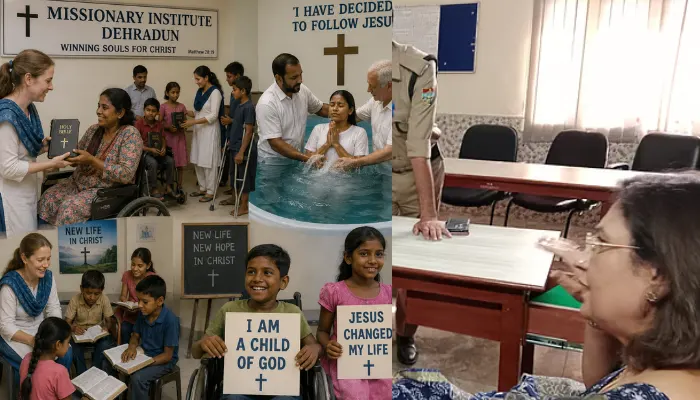
Case Summary
In the Premnagar area of Dehradun, Uttarakhand, disabled Hindu children and their families were targeted for forced religious conversion at a Christian missionary institution. The matter came to light during a raid conducted by the Uttarakhand State Commission for Protection of Child Rights at the "Medical Ambassador" institution in Khairi village, Premnagar, on 2 May 2026. The operation was supervised by the commission's Secretary, S.K. Barnwal. During the inspection, the Commission's team seized registers, files, posters, promotional materials, literature, and other documents from the premises. Commission Chairperson Dr Geeta Khanna, considering the matter serious, handed over all the recovered documents to the police administration and ordered a detailed investigation. Dr Geeta Khanna stated that the institution was ostensibly operating in the name of children's education, social service, and assistance. However, according to the Commission's prima facie findings, the institution's activities extended beyond education and welfare work. The Commission stated that the recovered documents, campus posters, available literature, and institutional records showcased concerted efforts to attract people towards Christianity and promote forced Christian conversions. According to the Commission, preliminary investigations revealed attempts to influence minor Hindu children and their families toward Christianity under the guise of educational and social service activities. During the inspection, the Commission found insufficient evidence of regular and systematic educational activities being conducted at the institute. The team also found that a driver from Manipur who was working as a staff member and a family from Pauri district that had been residing on the campus for several years were both assisting the institution and participating in its conversion activities. The Commission further stated that, under the guise of assisting disabled minor Hindu children and their families, efforts were being made to obtain financial support from various departments, institutions, and other sources. According to the Commission, benefits, assistance, privileges, and other inducements were being used to influence the religious beliefs of vulnerable Hindu children and their families and encourage religious conversion. During the investigation, the Commission's team also recovered documents suggesting possible links between the missionary institution and a hospital located on Canal Road. According to the Commission, the recovered records also revealed that there was financial assistance from foreign sources to carry out proselytisation activities. The Commission further expressed concern that the network's activities may not be confined to Dehradun and could extend to other states as well, warranting investigation by the relevant authorities. Commenting on the matter, Dr Geeta Khanna stated that exploiting children's innocence, education, economic condition, or disability for religious, ideological, or other purposes is a serious issue. She emphasised that children should receive education, protection, and values, and should not become targets of influence, inducement, or conversion pressure. The Commission also noted that several issues uncovered during the inspection fell outside its direct jurisdiction, which was one of the reasons all documents, records, files, and other materials were handed over to the police administration for further investigation. Dr Khanna stated that such acts of religious conversion activities, misuse of foreign funding, violations of children's rights, or any other illegal acts, should be dealt with strictly by the state government and that all perpetrators should be punished.
Why it is Hate Crime ?
The primary category selected in this case is: Predatory Proselytisation. The subcategory selected is: Proselytisation by grooming, brainwashing, manipulation or subtle indoctrination. The tertiary categories selected are: Conversion of Minor, Pattern of targeting Hindus. Religious brainwashing essentially means the often subtle and forcible indoctrination to induce someone to give up their religious beliefs to accept contrasting regimented ideas. Religious grooming or brainwashing also involves propaganda and manipulation. It involves the systematic effort, driven by religious malice and indoctrination, to persuade “non-believers’ to accept allegiance, command, or doctrine to and of a contrasting faith. Cases of such grooming or brainwashing are far more nuanced than direct threats, coercion, inducement and violence. In such cases, it is often seen that there is repeated, subtle and continual manipulation of the victim to induce disaffection towards their own faith and acceptance of the contrasting faith of the perpetrator. While subtle indoctrination is widely acknowledged as predatory, an element which is often understated in such conversions or the attempts of such conversion is the role of loyalty and trust which might develop between the perpetrator and the victim. Fiduciary relationships are often abused to affect such religious conversion. For example, an educator transmitting religious doctrine of a competing faith to a Hindu student. The Hindu student is likely to accept what the teacher is transmitting owing to existence of the fiduciary relationship. The exploitation of the fiduciary relationship to religiously indoctrinate victims would also be included in this category. Since the underlying animosity towards the victim’s faith forms the basis of predatory proselytization, such cases are considered religiously motivated hate crimes. The other subcategory selected is- Conversion/ attempts to convert by inducement. Predatory Proselytisation is not just limited to threat, harassment, force and violence, but it also has contours of stealth. In several cases, the Hindu victim is exploited to convert, with non-Hindus taking advantage of their poverty. In such cases, the Hindu victim who is suffering financially is offered monetary benefits, including lucrative offers for jobs, health treatment, education, etc, to induce the victim into changing his/her religion. In such cases, the religious identity of the victim and the aim to disenfranchise him from his faith form the heart of the crime. Also, taking advantage of and exploiting an individual’s economic vulnerabilities is widely acknowledged as exploitation, forms of which are often penalised by law. Such cases therefore are considered religiously motivated hate crimes since the victim’s religious identity forms the very heart of the crime itself. This case is a clear example of a religiously motivated hate crime because disabled Hindu minor children were targeted for forced conversion to Christianity at a missionary institute in Dehradun, Uttarakhand. The targeting was not limited to individual children but extended to their families as well, indicating a broader effort directed at members of a specific religious community, here, Hindus. The focus on Hindu children and Hindu families demonstrates that the victims were selected on the basis of their religious identity. When individuals belonging to a particular faith are singled out and subjected to organised attempts to alter or replace their religious beliefs, the conduct goes beyond ordinary wrongdoing and enters the realm of a religiously motivated hate crime. The fact that the majority of the victims were minor children further aggravates the seriousness of the offence and highlights its predatory nature. Children are among the most vulnerable sections of society because they lack the maturity, life experience, and independent judgement necessary to fully understand the long-term implications of religious conversion. They are more susceptible to influence, persuasion, and coercion by authority figures and institutions. The Christian perpetrators exploited this vulnerability by targeting children who were incapable of giving informed and meaningful consent to such profound religious changes. The use of manipulative and coercive methods against Hindu minors demonstrates a deliberate attempt to achieve religious conversion through the exploitation of vulnerability, making the offence a clear example of a religiously motivated hate crime. An additional layer of vulnerability arose from the fact that many of the children involved were disabled. Disabled children often depend heavily upon caregivers, educators, institutions, and the wider community for support and guidance. This dependence can make them particularly vulnerable to undue influence and pressure. Bringing such children into an environment where they were exposed to persistent efforts encouraging conversion to Christianity created circumstances in which their disability was exploited to advance a religious objective. The targeting of disabled Hindu children demonstrates a calculated effort to take advantage of those least able to resist pressure, further underscoring the religiously motivated nature of the conduct. The use of Christian religious materials, posters, texts, and promotional content to influence children is also highly significant. Such materials were employed not merely for religious instruction but as part of a sustained effort to encourage Hindu children to abandon their ancestral faith and embrace Christianity. The systematic use of religious messaging directed at vulnerable children reflects an ideological objective rather than a neutral educational purpose. By repeatedly exposing Hindu children to content designed to reshape their beliefs and religious identity, the perpetrators sought to facilitate conversion through indoctrination, psychological influence, and manipulation. Such conduct reflects deep-rooted hostility towards the continued religious identity of the Hindu victims and therefore constitutes a clear manifestation of anti-Hindu animosity. The use of incentives, benefits, educational assistance, and other forms of support as inducements for conversion further strengthens the conclusion that this was a religiously motivated hate crime. Genuine charity is provided without conditions attached to an individual's faith or religious identity. However, when material benefits are offered as a means of encouraging or pressuring individuals to abandon their religion, those benefits cease to be acts of goodwill and instead become instruments of religious coercion. In this case, the use of inducements was directed towards weakening the Hindu identity of vulnerable children and encouraging forced religious conversion. The use of such methods demonstrates an intent to undermine the religious beliefs of the victims and replace them with another faith, Christianity, thereby reinforcing the hate-motivated character of the offence. The targeting extended beyond the children themselves and included their families. Economically and socially vulnerable families were approached through inducements, promises of assistance, and other forms of influence intended to encourage conversion. The pattern demonstrates a coordinated effort aimed not at isolated individuals but at entire Hindu family units. Such conduct demonstrates an intention to weaken and ultimately replace the religious identity of a community by targeting those facing economic or social hardship. The exploitation of the vulnerability of the Hindu victims for the purpose of religious conversion reflects hateful treatment based on religion and constitutes strong evidence of religious animosity directed towards Hindus. The conversion racket was linked to wider networks and supported by external funding, demonstrating that this was not an isolated or spontaneous incident. Rather, it formed part of a broader and more organised effort directed towards religious conversion. The existence of structured networks, financial backing, and coordinated activities points to a deliberate strategy aimed at transforming the religious identity of members of the Hindu community. Such organised efforts are particularly concerning because they reflect sustained and systematic attempts to reduce the Hindu presence in the locality while increasing the Christian population through targeted conversions, thereby altering the religious demographics of the area. The targeting of the Hindu community for demographic transformation goes beyond individual acts of proselytisation and reflects a concerted effort to erode the religious identity, continuity, and cultural presence of Hindus. The conduct therefore demonstrates hostility towards the religious identity of the targeted community and strengthens the conclusion that this was a religiously motivated hate crime. Given that this case satisfies the parameters of a religiously driven offence involving the targeting of individuals on the basis of their Hindu identity, the exploitation of vulnerable children and disabled persons, the use of inducements, and organised efforts to secure religious conversion, it is being added to the Hinduphobia Tracker's hate crime database. Disclaimer: The Hinduphobia Tracker records incident dates based on when the victim's ordeal or the underlying offence begins, rather than the date on which the incident is reported by the media. In the present case, media reports do not specify the exact date on which the conversion activities or efforts commenced. The only clearly identified date mentioned in the reports is 2 June 2026, which is the date on which the authorities conducted a raid at the institute. Accordingly, 2 June 2026 has been selected as the indicative incident date for documentation purposes. With respect to perpetrator count, reports indicate the involvement of multiple individuals in the conversion activities. However, only one driver from Manipur and a family from Pauri district have been specifically identified in publicly available reports. Since the exact number of individuals belonging to the family from Pauri district has not been specified, and only the driver from Manipur has been individually identified, the perpetrator count has been recorded as one. This figure represents a conservative estimate adopted solely for documentation and database standardisation purposes and should not be interpreted as reflecting the total number of individuals involved in the incident.


Case Status
Complaint filed


Perpetrators Details
Perpetrators
Christian Extremists
Perpetrators Range
One Person
Perpetrators Gender
unknown
 Sources




