Hindu sacred space violated as Muslim man dumps goat remains at the entrance of Valmiki temple in Rudrapur
 Udham Singh Nagar, Uttarakhand, India
  28 May, 2026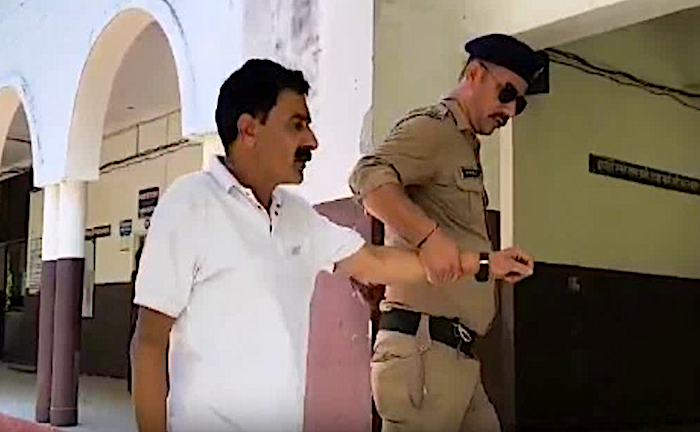
Case Summary
Hindu devotees in Rudrapur, Uttarakhand, faced a deeply disturbing incident after goat remains were dumped at the entrance of a temple revered by the local Valmiki community. The incident occurred in a residential area where the temple served as an important place of worship and community gathering for Hindu devotees. The discovery of the animal remains at the temple entrance caused immediate concern among local Hindus and led to widespread anger within the neighbourhood. The accused, Police Constable Mohammad Azeem, who had defiled the sacred temple space by dumping meat waste after Bakrid, was subsequently arrested. On 29th May 2026, a goat was sacrificed in the vicinity of the Lord Valmiki Temple located in Bhootbangla Ward No. 20, Rudrapur, Uttarakhand. Following the sacrifice, the animal's remains and associated waste were taken and deposited directly in front of the main entrance of the Hindu temple. The remains were placed at a location used regularly by Hindu devotees entering and exiting the temple premises. The temple is an established place of worship for members of the Valmiki community and other Hindu residents living in the area. The remains were not discarded at a general waste site or any unrelated location. Instead, they were left directly at the temple entrance, ensuring that Hindu devotees visiting the shrine would encounter them. The placement of the remains at the temple gate became the central issue that triggered outrage among local residents. After the remains were discovered, Hindu residents and members of the Valmiki community objected to the act and confronted the perpetrator. During the confrontation, the perpetrator abused local residents and issued threats to kill them when objections were raised. Residents stated that attempts were also made to intimidate community members by asserting official influence and authority. The incident created tension throughout the locality and prompted concern among Hindu residents about the targeting of their place of worship. Local residents gathered near the temple and raised objections regarding the dumping of animal remains at the entrance of a sacred Hindu site. Several residents who witnessed the events were later identified as eyewitnesses. A written complaint was submitted by Vijendra, son of Rajendra and a resident of Bhootbangla Ward No. 20. The complaint detailed the sacrifice of the goat, the dumping of the remains at the temple entrance, the abuse directed at residents, and the threats issued when community members objected. The complaint also documented local Hindus' concerns about the incident's impact on the temple and the surrounding area. Following receipt of the complaint, the police registered a case under relevant legal provisions and initiated an investigation. Officers examined available evidence, including footage from closed-circuit television cameras installed near the scene. The investigation identified Mohammad Azeem, a police constable, as the perpetrator. He was arrested, and legal proceedings were initiated against him. Senior police officials confirmed both his arrest and suspension from service. Authorities stated that he would be produced before the court and that further action would be taken based on the evidence gathered during the investigation. The investigation remained ongoing at the time of the latest update.
Why it is Hate Crime ?
This case has been added to the tracker under the primary category - Attack on Hindu religious representations. The subcategory selected within this is - Breaking rules of place of worship. Sanatan Dharma is not a religion of one book, which is to say that while it has religious scriptures that form the central tenets of the faith, there are several traditions followed through thousands of years, mostly passed from generation to generation orally. One of these oral traditions or written traditions is the rules of specific temples. Certain temples have rules which are traditional rules, dependent on the worship of the presiding deities. These rules and traditions have been followed for thousands of years whether they find scriptural mention or not. Such traditions are based on the nature and rules of worship of the presiding deity of that temple. Any non-compliance of these traditions owing to animosity towards the faith or for the sake of activism stems not only from the lack of faith in the presiding deity but also disregard for the faith of the devotees of that deity/temple and implicit bias against the faith, the tradition and the deity itself. Since these specific traditions are central to the faith of the devotees of that specific temple and presiding deity, any non-compliance with these traditional rules would be considered a religiously motivated hate crime. Another sub-category selected for this case is - Defiling religious customs. Sanatan Dharma is not a religion of one book, which is to say that while it has religious scriptures that form the central tenets of the faith, there are several traditions followed through thousands of years, mostly passed from generation to generation orally. There are several such customs and traditions that are followed by various Hindus and Hindu sects. Defiling of these traditions and customs is a breach of an individual or group’s religious practices. Such practices can range from dietary restrictions like not eating non-vegetarian food for a certain period of the year, not eating non-vegetarian food at all, not eating beef since the cow is considered holy in Hinduism, the sanctity of religious customs followed in the house (like many ISCKON devotees), etc. Any malicious action leading to the breach of such traditions or defilement of these traditions owing to animosity towards the faith or for the sake of activism stems not only from the lack of faith in the religion itself but also from disregard for the faith of the devotees who follow the customs/traditions and implicit bias against the faith, the tradition itself. Since these specific traditions are central to the faith of the devotees of that specific sect of Hindus, any non-compliance with these traditional rules would be considered a religiously motivated hate crime. The primary religious marker in this case was the deliberate dumping of goat remains at the entrance of a Hindu temple. This was not an instance of animal waste being discarded at a random location or public dumping ground. The remains were placed directly at the entrance of the Lord Valmiki Temple, a site regularly visited by Hindu devotees for worship and religious observance. The choice of location was therefore significant. By depositing the remains at the point through which devotees entered and exited the temple, the perpetrator ensured that the act would directly impact the Hindu community and interfere with the sanctity associated with the temple premises. It is important to note that the temple entrance is not separate from the temple's sacred space. In Hindu tradition, the sanctity of a temple extends beyond the inner sanctum and encompasses the entire religious precinct. Devotees often bow their heads, remove their footwear, and prepare themselves spiritually even before crossing the threshold. Therefore, leaving animal remains at the entrance is not meaningfully different from leaving them inside the temple itself. Both acts demonstrate the same disregard for the sanctity of religious space and are experienced by devotees as desecration. Another significant marker was the act's deliberate nature. The remains were not merely left near the temple but specifically positioned at its main entrance, where they would be encountered by worshippers. This ensured maximum visibility and maximum offence. Such conduct cannot be viewed as an ordinary sanitation issue or neighbourhood dispute. The placement of the remains transformed them into a tool for insulting and degrading a Hindu place of worship. The incident's religiously aggravating nature became even more evident in the perpetrator's conduct after objections were raised. Rather than expressing remorse or attempting to rectify the situation, he allegedly abused Hindu residents and threatened them when they protested. The threats and intimidation were directed at members of the community who sought to protect the sanctity of their temple. This demonstrated that the incident was not merely about the disposal of animal remains but involved hostility towards those defending a Hindu religious institution. The cumulative effect of these actions was the desecration of a Hindu place of worship and the intimidation of Hindu devotees who objected to that desecration. By choosing a temple entrance as the dumping site, violating the sanctity of a sacred space, and threatening community members who resisted, the perpetrator targeted both the religious sentiments of Hindus and their right to freely worship without interference. For these reasons, the incident bears the hallmarks of a religiously motivated hate crime directed against a Hindu religious institution and its devotees.


Case Status
Arrested


Perpetrators Details
Perpetrators
Muslim Extremists
Perpetrators Range
One Person
Perpetrators Gender
male
 Sources




