Economically vulnerable Hindus targeted with miracle-healing claims to induce religious conversion by Christian missionaries in Delhi
 West Delhi, Delhi, India
  31 May, 2026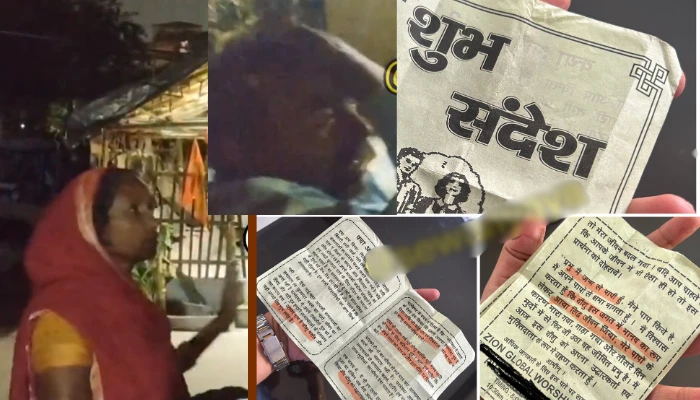
Case Summary
In Delhi's Punjabi Bagh area, economically vulnerable Hindu residents were targeted and lured towards religious conversion by Christian missionaries through fake claims of miraculous healing. Pamphlets promoting acceptance of Jesus were distributed among Hindu residents and directed them to a Christian centre operating in West Patel Nagar. The incident came to light when a team at Sewanyaya visited Jhuggi Jhopri in Delhi's Punjabi Bagh and conversed with the Hindus. The local Hindu residents of the area stated that they were being encouraged to attend prayer meetings and faith-healing sessions where they were urged to accept Jesus. Following the discovery, a formal complaint was submitted to the Delhi Police seeking an investigation into the activities. It was further found that pamphlets were being distributed among the Hindu residents. The pamphlets promised relief from illnesses and other life problems through acceptance of "Yeshu" and directed recipients to a centre located in West Patel Nagar. The pamphlets asked recipients to make the following declaration: "I am a born sinner. I believe that Yeshu came into this world 2,000 years ago, died for my sins, was resurrected, and is alive. I accept Him as my Saviour." During the course of the inquiry, the organisation identified a woman named Pramila Devi, who residents said distributed the pamphlets within the Punjabi Bagh colony and encouraged people to attend gatherings linked to the centre. In a video statement recorded during the inquiry, a local woman stated that two individuals associated with the church had approached residents and invited them to attend Sunday prayer meetings. According to her, around ten to fifteen people were invited, though she alone attended the gathering. The organisation also met a man named Sanjay, who stated that he had attended the West Patel Nagar centre after being approached by Pramila Devi. He said that a pastor placed his hand on his forehead and told him that he would be healed. Sanjay further stated that he saw other people lying on the ground during the session and deliberately lay down as well after being told that he would recover like them. Based on the pamphlets collected and statements recorded during the inquiry, Sewa Nyaya submitted a formal complaint to the Delhi Police via email, seeking an investigation into the activities being conducted from the West Patel Nagar centre and the distribution of religious inducement material among residents of the Punjabi Bagh jhuggi colony. The organisation expressed concern that vulnerable individuals were being targeted through faith-based inducements and claims of miraculous healing.
Why it is Hate Crime ?
The primary category for this case is "Predatory Proselytisation". The sub-category for this case is "Conversion/attempts to convert by inducement". Predatory Proselytisation is not just limited to threat, harassment, force and violence, but it also has contours of stealth. In several cases, the Hindu victim is exploited to convert, with non-Hindus taking advantage of their poverty. In such cases, the Hindu victim who is suffering financially is offered monetary benefits, including lucrative offers for jobs, health treatment, education, etc, to induce the victim into changing his/her religion. In such cases, the religious identity of the victim and the aim to disenfranchise him from his faith form the heart of the crime. Also, taking advantage of and exploiting an individual’s economic vulnerabilities is widely acknowledged as exploitation, forms of which are often penalised by law. Such cases, therefore, are considered religiously motivated hate crimes since the victim’s religious identity forms the very heart of the crime itself. Another sub-category for this case is "Proselytisation by grooming, brainwashing, manipulation and subtle indoctrination". The tertiary category for this case is "Pattern of targeting Hindus". Religious brainwashing essentially means the often subtle and forcible indoctrination to induce someone to give up their religious beliefs to accept contrasting, regimented ideas. Religious grooming or brainwashing also involves propaganda and manipulation. It involves the systematic effort, driven by religious malice and indoctrination, to persuade “non-believers’ to accept allegiance, command, or doctrine to and of a contrasting faith. Cases of such grooming or brainwashing are far more nuanced than direct threats, coercion, inducement and violence. In such cases, it is often seen that there is repeated, subtle and continual manipulation of the victim to induce disaffection towards their own faith and acceptance of the contrasting faith of the perpetrator. While subtle indoctrination is widely acknowledged as predatory, an element which is often understated in such conversions or the attempts of such conversion is the role of loyalty and trust which might develop between the perpetrator and the victim. Fiduciary relationships are often abused to affect such religious conversion. For example, an educator transmitting religious doctrine of a competing faith to a Hindu student. The Hindu student is likely to accept what the teacher is transmitting owing to the existence of the fiduciary relationship. The exploitation of the fiduciary relationship to religiously indoctrinate victims would also be included in this category. Since the underlying animosity towards the victim’s faith forms the basis of predatory proselytisation, such cases are considered religiously motivated hate crimes. This case has been added to the tracker because economically vulnerable Hindu residents were specifically targeted with promises of miraculous healing and relief from personal hardships to encourage acceptance of a different religion. The issue in this case was not the mere expression of religious beliefs. Rather, it was the use of faith-based inducements directed at vulnerable Hindus, where conversion was presented as a pathway to healing, recovery, and relief from suffering. The approach adopted in this case relied on exploiting human vulnerability. Instead of encouraging a voluntary and informed religious choice, the accused used claims of supernatural healing and solutions to personal problems to attract participants. For economically disadvantaged individuals struggling with illness, financial hardship, or limited access to support systems, promises of miraculous healing functioned as a powerful inducement. They were used to create trust, generate dependency, and ultimately encourage acceptance of a different religion. Furthermore, the operation followed a structured process designed to draw individuals into the conversion pipeline. Residents were approached within their locality, invited to prayer meetings, directed to a designated centre, and exposed to faith-healing practices intended to reinforce belief in the claimed supernatural powers of the organisers. Significantly, the pamphlets distributed among residents did not merely invite people to attend religious gatherings. They contained a pre-written declaration accepting Jesus as a saviour, demonstrating that the objective extended beyond prayer or worship and was directed towards securing religious acceptance and conversion. The exploitation of vulnerability through promises of healing is a recurring feature in documented cases of predatory proselytisation. Such tactics seek to influence religious choices by linking conversion with physical recovery, emotional relief, or improvement in personal circumstances. Consequently, the decision being encouraged is shaped not solely by matters of faith or conviction but by inducements specifically designed to overcome resistance and make conversion appear beneficial. The targeting of economically vulnerable Hindu communities through claims of miraculous healing reflected a deliberate attempt to leverage hardship and insecurity for religious ends. Since vulnerable Hindus were approached with promises of healing and drawn into a process aimed at securing religious conversion, this case met the threshold for a religiously motivated hate crime and has therefore been included in the Hinduphobia Tracker database.
Victim Details
Total Victim
15
Deceased
0
Gender
- Male 8
- Female 7
- Third Gender 0
- Unknown 0
Caste
- SC/ST 0
- OBC 0
- General 0
- Unknown 15
Age Group
- Minor 0
- Adult 15
- Senior Citizen 0
- Unknown 0


Case Status
Complaint filed


Perpetrators Details
Perpetrators
Christian Extremists
Perpetrators Range
From 2 To 5
Perpetrators Gender
both
 Sources




