Minor Hindu girl attempts suicide after Muslim youth pressured her to convert to Islam for marriage
 Meerut, Uttar Pradesh, India
  31 May, 2024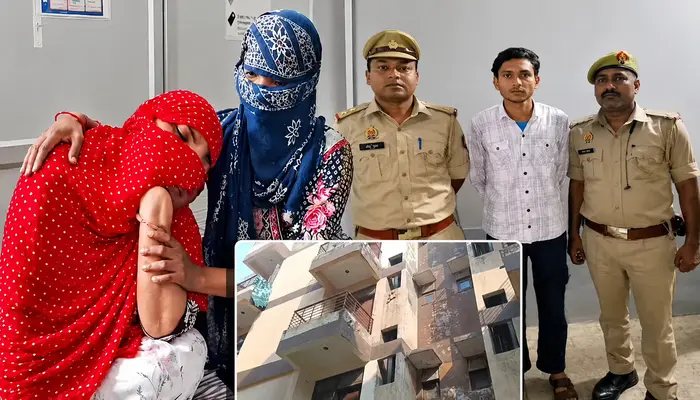
Case Summary
In the Mawana in Meerut district, Uttar Pradesh, a minor Hindu girl attempted to commit suicide after being pressured to convert to Islam by a Muslim youth, Junaid, who lured her into a relationship. According to reports, the victim had become acquainted with the accused, Junaid, around two years earlier in 2024, while he was working at a medical store in Mawana. The accused gradually lured her into a romantic relationship, which came to the attention of the girl's family. Concerned about the relationship, the family relocated from Mawana to a rented accommodation in the Medical Police Station area of Meerut in an attempt to distance the girl from Junaid. On 31 May 2026, while the victim was alone at home, Junaid visited her residence. The two were discovered together by the girl's brother, who attempted to stop Junaid, but he managed to escape before other family members arrived. Following the incident, the girl's mother contacted Junaid and proposed a meeting the following morning to discuss the matter. Junaid agreed to attend the meeting. However, on the morning of 1 June 2026, he failed to appear. When contacted by telephone, he initially avoided the calls and later refused to come. During the conversation, the girl's family also spoke with members of Junaid's family. According to the victim's family, the discussion became distressing, and the girl's mother was informed that no further relationship would be accepted. Reports stated that the victim had expressed a desire to marry Junaid, but he pressured her to convert to Islam and put conversion as a pre-condition for marriage. The girl was listening to the telephone conversation on speakerphone and became deeply distressed by the developments. Shortly afterwards, she climbed onto the railing of the third floor of the building and jumped. The fall left her critically injured. Local residents rushed to assist after hearing the impact, and she was taken to Meerut Medical College for treatment. Medical examinations found that she had suffered fractures to her leg and spine. Police responded after receiving information through Dial 112 and recorded statements from the victim and her family. During the investigation, police stated that Junaid had maintained contact with the minor girl under the promise of marriage and that the circumstances surrounding his conduct had contributed to her suicide attempt. Based on the complaint submitted by the family, a case was registered against Junaid, son of Aamir, under relevant provisions of the Bharatiya Nyaya Sanhita and Sections 3 and 4 of the Protection of Children from Sexual Offences (POCSO) Act. Police subsequently arrested Junaid and initiated further legal proceedings.
Why it is Hate Crime ?
This case has been added to the tracker under the primary category of - Predatory Proselytisation. Within it, the sub-category selected here - Proselytisation by grooming, brainwashing, manipulation or subtle indoctrination, with the tertiary category being - Conversion of minor and Family claims grooming. Religious brainwashing essentially means the often subtle and forcible indoctrination to induce someone to give up their religious beliefs to accept contrasting regimented ideas. Religious grooming or brainwashing also involves propaganda and manipulation. It involves the systematic effort, driven by religious malice and indoctrination, to persuade “non-believers’ to accept allegiance, command, or doctrine to and of a contrasting faith. Cases of such grooming or brainwashing are far more nuanced than direct threats, coercion, inducement and violence. In such cases, it is often seen that there is repeated, subtle and continual manipulation of the victim to induce disaffection towards their own faith and acceptance of the contrasting faith of the perpetrator. While subtle indoctrination is widely acknowledged as predatory, an element which is often understated in such conversions or the attempts of such conversion is the role of loyalty and trust which might develop between the perpetrator and the victim. Fiduciary relationships are often abused to affect such religious conversion. For example, an educator transmitting religious doctrine of a competing faith to a Hindu student. The Hindu student is likely to accept what the teacher is transmitting owing to existence of the fiduciary relationship. The exploitation of the fiduciary relationship to religiously indoctrinate victims would also be included in this category. Since the underlying animosity towards the victim’s faith forms the basis of predatory proselytization, such cases are considered religiously motivated hate crimes. The other sub-category selected is - Harassment, threats, coercion for conversion. Harassment covers a wide range of behaviours of an offensive nature. It is commonly understood as behaviour that demeans, humiliates, and intimidates a person, including threats and coercion. Harassment and threats, in this case, find their root on discriminatory grounds which has the effect of nullifying a person’s rights or infringing upon his freedom to exercise his right specifically owing to the victim’s religious identity. Verbal and physical threats and psychological or physical harassment are often used against Hindu victims because they choose to practice their professed religion. Religious harassment also includes forced and involuntary conversions by harassment, threats or coercion. Coercion includes intimidatory tactics like force-feeding a Hindu victim beef to convert to another religion, forceful circumcision etc. In several cases documented, non-Hindu perpetrators or those who harbour specific animosity towards Hinduism, harass victims simply based on their religious identity. Such cases often also include harassment to ensure the Hindu victim abandons his/her professed religion and adopts the religion of the perpetrator. Such cases where Hindu victims are harassed to convert to the perpetrator’s religion are rooted in animosity towards the victim’s religious identity and are therefore documented as religiously motivated hate crimes. This case has been added to the tracker because a minor Hindu girl attempted to commit suicide after being pressured to convert to Islam by a Muslim youth, Junaid, who had drawn her into a relationship and subsequently made conversion a condition for marriage. Firstly, it is important to note here that the victim was a minor, which means the element of consent and genuine change of conscience was missing ab initio. Minors, due to their young age and lack of maturity, are particularly vulnerable to manipulation and coercion. They may not have the ability to fully understand the implications of converting to another religion, and the Muslim perpetrator purposely targeted and exploited this vulnerability of the victim. Since this case exemplifies the use of coercion and manipulation to achieve religious conversion, it is a blatant act of religious hate. Such acts are not merely criminal in nature; they are ideologically charged, revealing religious prejudice and a calculated intent to alter the religious identity of a minor without her volition. The use of grooming, where trust is built only to exploit, is an insidious method that exploits the child’s naivety and dependence. In this context, the testimony of the family holds considerable weight. Secondly, in Islam, marriage to a non-Muslim partner is prohibited, which is why she was pressured for religious conversion. Pressuring a Hindu individual to discard her religious faith or putting conversion as a precondition of marriage was a direct attack on her religious identity and dignity. It was not a matter of personal choice; it was coercion rooted in hostility towards the victim's Hindu identity. Such an attempt reflects religious animosity because the act was not simply about personal differences but about erasing the victim’s Hindu faith, making it a religiously motivated crime. Another significant aspect of this case is that the pressure exerted on the minor Hindu girl escalated to the point where she attempted to take her own life. The victim became severely distressed after learning that conversion to Islam was being imposed as a condition for continuing the relationship and for marriage. The psychological impact of this pressure was so profound that she jumped from the third floor of her residence. The suicide attempt was not an isolated act disconnected from the broader circumstances of the case; rather, it occurred in the immediate context of the victim's emotional turmoil arising from the relationship and the demand that she abandon her faith. The incident therefore demonstrates the severe mental and emotional harm that can result when a vulnerable minor is subjected to pressure regarding her religious identity. The case further demonstrates how grooming and emotional dependency is used to influence vulnerable individuals. By cultivating trust and emotional attachment over a prolonged period, the accused acquired significant influence over the minor's decisions and beliefs. When such influence is subsequently used to pressure the minor to change her religion, the issue extends beyond an interpersonal relationship and enters the realm of religious coercion. The victim's vulnerability as a minor, coupled with the reported demand that she abandon her faith, makes the religious dimension of the case particularly significant. Such actions stem from inherent hostility towards the victim's professed faith since Abrahamic faiths believe that any non-adherent to the faith is subject to being dehumanised till they convert. Therefore, religious conversions, even of minors, are often seen as a badge of honour, totally disregarding the methods used to achieve it. Since such predatory actions stem from doctrinal animosity towards the Hindu faith and its adherents, this case is being documented as a religiously motivated hate crime. Disclaimer: It is important to clarify that none of the media sources covering this case have specified the exact date when the victim's ordeal began, though it is mentioned that she came into contact with the accused in 2024. Thus, to document this case, we have used an indicative date, 1 June 2024, as a placeholder to represent the beginning of her suffering. While media coverage of the incident emerged on 1 June 2026, the Hinduphobia Tracker records the incident based on when the victim’s ordeal began, not when it was reported.
Victim Details
Total Victim
1
Deceased
0
Gender
- Male 0
- Female 1
- Third Gender 0
- Unknown 0
Caste
- SC/ST 0
- OBC 0
- General 0
- Unknown 1
Age Group
- Minor 1
- Adult 0
- Senior Citizen 0
- Unknown 0


Case Status
Arrested


Perpetrators Details
Perpetrators
Muslim Extremists
Perpetrators Range
One Person
Perpetrators Gender
male
 Sources




