Hindus lured to convert to Christianity through inducements, brainwashing, and denigration of the Hindu faith in Jabalpur
 Jabalpur, Madhya Pradesh, India
  30 May, 2026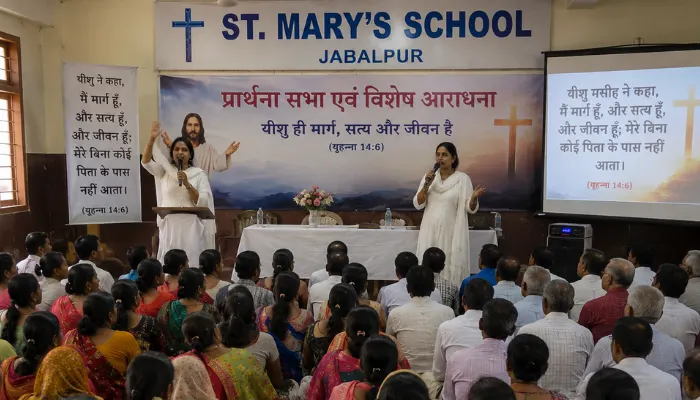
Case Summary
In Madhya Pradesh’s Jabalpur, Hindus were targeted for forced Christian conversion by missionaries. These conversions took place inside a missionary school campus known as St Mary’s Convent School. The Hindus who attended were offered various inducements for conversion. They were subjected to brainwashing, and their faith and deities were denigrated by Christian individuals involved in the conversion process. On Sunday, 31 May 2026, Anita Ben and Lakshmi Ben, sisters and residents of Purani Suhagi, attended a Christian prayer meeting on the St Mary’s Convent School campus after being informed about it. They were told about meeting a man named Peter Joseph at the school and that praying to Jesus Christ could help resolve their personal and family problems. During the interaction, they were given financial assistance of ₹5,000 and other inducements. During the same interaction, offensive remarks were made about Hindu deities. Following this, Anita and Lakshmi observed that several Hindus were present at the gathering and subsequently contacted the police. After this, Anita Ben and Lakshmi Ben spoke about the incident. A complaint regarding the matter was filed against two Christian women and one Christian man, Peter Joseph. Based on the complaint, a case was registered against one of the accused under the Madhya Pradesh Freedom of Religion Act and other relevant sections. Upon receiving information about the incident on 31 May 2026, a large number of Bajrang Dal and Vishwa Hindu Parishad workers reached the St Mary’s Convent School campus in the Suhagi area under Adhartal Police Station limits in Jabalpur. They staged protests and raised slogans against the prayer meeting taking place at the school. A tense situation developed in the area for some time before police reached the spot and brought the situation under control. During preliminary investigation, police took three Christian individuals, including two women, to the police station for questioning. Based on the complaint and investigation, a case was registered against Peter Joseph, a resident of Adhartal, under the Madhya Pradesh Freedom of Religion Act and other relevant provisions. At the time of writing this report, the police investigation was ongoing.
Why it is Hate Crime ?
The primary category selected in this case is: Predatory Proselytisation. The subcategory selected is: Conversion/ attempts to convert by inducements. Predatory Proselytisation is not just limited to threat, harassment, force and violence, but it also has contours of stealth. In several cases, the Hindu victim is exploited to convert, with non-Hindus taking advantage of their poverty. In such cases, the Hindu victim who is suffering financially is offered monetary benefits, including lucrative offers for jobs, health treatment, education, etc, to induce the victim into changing his/her religion. In such cases, the religious identity of the victim and the aim to disenfranchise him from his faith form the heart of the crime. Also, taking advantage of and exploiting an individual’s economic vulnerabilities is widely acknowledged as exploitation, forms of which are often penalised by law. Such cases therefore are considered religiously motivated hate crimes since the victim’s religious identity forms the very heart of the crime itself. The other subcategory selected is: Proselytisation by grooming, brainwashing, manipulation or subtle indoctrination. The tertiary category selected is: Pattern of targeting Hindus. Religious brainwashing essentially means the often subtle and forcible indoctrination to induce someone to give up their religious beliefs to accept contrasting regimented ideas. Religious grooming or brainwashing also involves propaganda and manipulation. It involves the systematic effort, driven by religious malice and indoctrination, to persuade “non-believers’ to accept allegiance, command, or doctrine to and of a contrasting faith. Cases of such grooming or brainwashing are far more nuanced than direct threats, coercion, inducement and violence. In such cases, it is often seen that there is repeated, subtle and continual manipulation of the victim to induce disaffection towards their own faith and acceptance of the contrasting faith of the perpetrator. While subtle indoctrination is widely acknowledged as predatory, an element which is often understated in such conversions or the attempts of such conversion is the role of loyalty and trust which might develop between the perpetrator and the victim. Fiduciary relationships are often abused to affect such religious conversion. For example, an educator transmitting religious doctrine of a competing faith to a Hindu student. The Hindu student is likely to accept what the teacher is transmitting owing to the existence of the fiduciary relationship. The exploitation of the fiduciary relationship to religiously indoctrinate victims would also be included in this category. Since the underlying animosity towards the victim’s faith forms the basis of predatory proselytization, such cases are considered religiously motivated hate crimes. The other subcategory selected is: Attempting to convert/ converting by denigrating Hinduism. In several cases, Hindus are converted or an attempt is made to convert Hindus by denigrating their faith, Hinduism. In such cases, the Hindus associate with the non-Hindu perpetrators often by choice and then, the attempt to convert them by insulting their faith, showing the faith down etc begins. An example of this would be a non-Hindu gathering where the Hindus are attending the gathering of their own free will. However, once they attend the gathering, there is an explicit attempt to convert them by abusing their faith and hailing the faith of the perpetrator. The denigration of the Hindu faith is often based on misrepresentation of the Hindu faith, its doctrine and scriptures and insult to espoused traditions if not blatant lies about Hindu beliefs and ways. Such conversions or attempts at conversions are driven by animosity towards the Hindu faith and are therefore documented as religiously motivated hate crimes. In this case, Hindus were to attend a Christian prayer meeting held at St Mary’s Convent School campus in Jabalpur. The gathering involved attempts to influence attendees to adopt Christianity through inducements such as monetary assistance and assurances that prayers to Jesus Christ would resolve personal and family issues. During the interaction, financial assistance of ₹5,000 was provided along with other incentives. Reports from the incident also indicated that derogatory remarks were made about Hindu beliefs and deities during the gathering. The combination of inducements, psychological influence, and religious denigration demonstrated a targeted effort to persuade Hindu attendees to abandon their faith and adopt Christianity. All this makes this incident a clear example of a religiously motivated hate crime. One of the primary indicators of predatory proselytisation in this case was the use of monetary and material inducements to influence the religious choices of Hindu victims. Financial assistance and other incentives were provided to attendees in direct connection with their participation in the Christian prayer meeting and engagement with Christian religious messaging, with the underlying objective of encouraging them to convert from Hinduism to Christianity. Such inducements were not neutral welfare measures or acts of charity, but were clearly linked to religious persuasion and conversion efforts. By offering financial benefits and material support to individuals identified as Hindu participants, the perpetrators exploited their vulnerability, socio-economic circumstances, and personal difficulties in order to weaken their attachment to Hinduism and facilitate their conversion to Christianity. This approach demonstrated a calculated attempt to replace genuine religious conviction towards Hinduism with material incentives, thereby undermining free, voluntary, and informed religious choice. The use of inducements as a tool for conversion reflected a broader pattern of targeting economically or socially vulnerable Hindu individuals and constituted a religiously motivated effort to alter their religious identity and facilitate conversion from Hinduism to Christianity. A second significant religious marker was the use of structured religious messaging and evangelistic interaction during the gathering involving Hindu victims, where attendees were told that prayer to Jesus Christ could resolve personal and family problems, thereby positioning conversion-linked belief as a solution to life difficulties and implicitly encouraging them to convert from Hinduism to Christianity. Such messaging functioned as a psychological and manipulative influence, creating emotional dependence and encouraging acceptance of a different faith through perceived personal benefit. In such contexts, repeated religious messaging, reassurance, and problem-resolution narratives were used to gradually shape perceptions among Hindu attendees and create openness to conversion from Hinduism to Christianity. This method went beyond casual religious discussion and formed part of a structured attempt to influence belief systems through suggestion, trust-building, and dependency creation, ultimately aimed at facilitating religious conversion. A further and critical marker was the denigration of Hindu beliefs during the interaction with Hindu victims, where offensive remarks were made about Hindu deities and religious traditions, which served to undermine the dignity, legitimacy, and spiritual foundation of Hinduism. Such denigration is a recognised method of facilitating conversion, as it seeks to create doubt, insecurity, and emotional distancing from one’s own religion while elevating another faith as superior, thereby encouraging Hindu individuals to convert from Hinduism to Christianity. By insulting Hindu beliefs in a setting where conversion-linked messaging was simultaneously being promoted, the perpetrators attempted to weaken the religious confidence of Hindu attendees and promote religious realignment towards Christianity. This demonstrated clear hostility towards Hinduism and formed an integral part of the overall conversion strategy targeting Hindu victims. Such conduct, taken as a whole, reflected a coordinated pattern of predatory proselytisation aimed at Hindu victims, combining inducements, structured religious messaging, psychological influence, and denigration of Hinduism to facilitate conversion from Hinduism to Christianity. This approach substantially undermined the victims’ religious autonomy by placing them in an environment where their ability to make a free, informed, and voluntary choice regarding their faith was compromised through financial incentives, emotional persuasion, and repeated evangelistic narratives. By targeting Hindu individuals for conversion through such methods, the perpetrators interfered with the victims’ fundamental right to freely profess, practise, and preserve their religion, effectively pressuring them to abandon Hinduism rather than allowing genuine spiritual agency. The deliberate undermining of Hindu beliefs alongside the promotion of Christianity further demonstrated that the objective was not neutral religious dialogue but the systematic replacement of Hindu religious identity. This combination of coercive influence and religious disparagement also revealed clear hostility towards Hinduism, as the victims were singled out as Hindus and subjected to efforts designed to weaken their faith and reorient their religious identity, thereby evidencing a religiously motivated pattern of animosity and infringement of religious freedoms. The scale and nature of attendance further showcased a pattern of targeted engagement. Multiple Hindu participants were present at a single organised gathering within a school campus, suggesting a structured outreach rather than an incidental interaction. The gathering of Hindu individuals in a controlled setting, combined with coordinated messaging and inducements, reflected a systematic approach to religious influence rather than isolated persuasion attempts. The involvement of multiple facilitators and repeated interaction reinforced the organised nature of the activity and its focus on members of the Hindu community. These instances of targeted proselytisation activities stemmed from hostility towards the victims’ professed faith, as conversion efforts were accompanied by inducements, psychological influence, and denigration of Hinduism. Such conduct was therefore recorded as a religiously motivated incident in the hate crime database of the Hinduphobia Tracker. Disclaimer: In this case, although multiple Hindu individuals were victims, only two Hindu victims, Lakshmi Ben and Anita Ben, have been clearly identified and specified in the available reports. As a result, the recorded victim count has been conservatively set at two for documentation purposes.
Victim Details
Total Victim
2
Deceased
0
Gender
- Male 0
- Female 2
- Third Gender 0
- Unknown 0
Caste
- SC/ST 0
- OBC 0
- General 0
- Unknown 2
Age Group
- Minor 0
- Adult 2
- Senior Citizen 0
- Unknown 0


Case Status
Complaint registered


Perpetrators Details
Perpetrators
Christian Extremists
Perpetrators Range
From 2 To 5
Perpetrators Gender
both
 Sources




