Dalit Hindu man and family abused with casteist slurs and assaulted, their homes attacked with stones over 500 rupees dispute by Muslim neighbours
 Aligarh, Uttar Pradesh, India
  26 May, 2026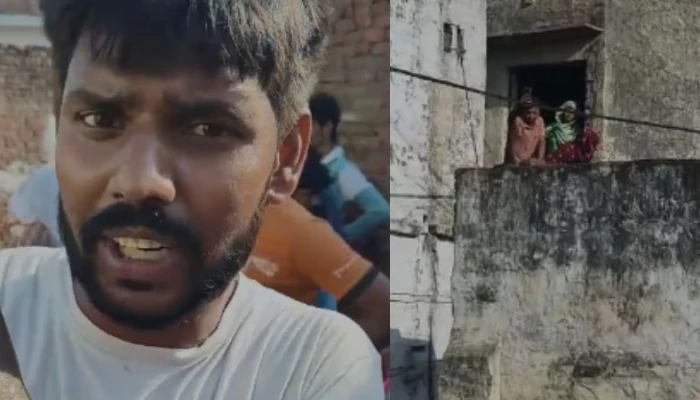
Case Summary
In Jadaula village under the Harduaganj police station area of Aligarh district, Uttar Pradesh, a Scheduled Caste Hindu man named Lavkush and his family were abused with caste-based slurs and assaulted by a Muslim family following a dispute over ₹500 meant for the reconstruction of a damaged village kharanja (brick-paved road). The accused were identified as Akbar Khan's wife, Parveen; his sons, Mohammad Qasim, Nasir, Salman, and Aas Mohammad; other family members; and their associates. Lavkush, who worked as a daily-wage labourer and earned approximately ₹700 per day, lived with his wife Prabha and their two sons, one aged 4 years and the other around 5 to 6 months old. According to Lavkush, his elder son had been suffering from typhoid, due to which he had been unable to work for around ten days. As a result, the family's financial condition had deteriorated significantly. As per the victim, a road constructed by the village head had caused the kharanja in the locality to sink, resulting in drainage water accumulating in the area. He stated that a neighbouring Muslim family subsequently removed the entire kharanja, worsening the problem. Thereafter, residents decided to raise funds to reconstruct it, with each household asked to contribute ₹500. When Lavkush was asked to pay his share, he requested additional time due to his son's illness and his financial difficulties. The disagreement over the contribution led to an argument between Lavkush's wife, Prabha, and Parveen, Akbar Khan's wife. According to the complaint, on the morning of 27 May 2026, at around 8 a.m., Parveen entered Lavkush's house and demanded the money. When Prabha explained the family's financial situation and informed her about their son's illness, Parveen responded by saying, "Mara to nahin hai na tera beta, mar kyon nahin jata?" ("Your son has not died yet, so why doesn't he die?"). This led to a heated argument between the two women. According to Lavkush, Parveen then called her sons and daughters-in-law to the house. Thereafter, Parveen, her sons and other family members assaulted Prabha. She was beaten with sticks, punched, kicked, and thrown to the ground, and her clothes were torn during the attack. When Lavkush intervened to protect his wife, he was also beaten with sticks. Hearing the commotion, residents arrived and rescued the couple. Lavkush further stated that while leaving, the accused threatened the family and said, "Saale Chamaron, aaj to bach gaye, dobara pakad mein aaye to jaan se maar denge ya gaon se bhaga denge" ("You Chamars have escaped today, but if we catch you again, we will kill you or drive you out of the village"). The complaint stated that caste-based abuses and threats were directed at the family during the assault. According to Lavkush, the harassment did not stop there. On 30 May 2026, Parveen, her sons and daughters-in-law attacked the family's house by pelting bricks and stones from their rooftop. Lavkush and his brother Deepak sustained injuries in the attack, suffering wounds to their hands and heads. A video of the incident showed women on the rooftop collecting bricks and throwing stones towards the Hindu family's house while Lavkush attempted to shield himself from the attack. Villagers were seen standing nearby, while members of the Muslim family remained inside their house. Following the incidents, Lavkush approached Harduaganj Police Station and sought legal action. According to him, the police initially refused to register an FIR. Thereafter, he contacted the Vishva Hindu Parishad (VHP), which intervened and assisted him in getting a case registered. Based on Lavkush's complaint, the police registered an FIR against Mohammad Qasim, Nasir, Salman, Aas Mohammad, Parveen, Anis, Gulfasa, Aslam, son of Iqbal, Sheru, son of Badshah, and Yamin, son of Lalkhan. The FIR invoked provisions of the Scheduled Castes and Scheduled Tribes (Prevention of Atrocities) Act along with sections of the Bharatiya Nyaya Sanhita relating to caste-based offences, unlawful assembly, assault, outraging the modesty of a woman, criminal intimidation, causing hurt, and trespass. Soon after Lavkush's FIR was registered, the Muslim side also lodged a complaint. Based on their complaint, police registered a cross-FIR against Lavkush, his wife Prabha, his brother Deepak, Deepak's wife Kranti, Sherpal, Guddu, Sonu, Pirmukhi, Devendra, Rajkumar, and 15–20 unidentified persons. In this FIR, the Muslim complainants accused them of assault, rioting, damaging property, trespass, and issuing threats. At the time of reporting, FIRs filed by both sides remained under investigation, while police continued proceedings in the matter.
Why it is Hate Crime ?
This case has been added to the tracker under the primary category- Attack not resulting in death. Within this, the subcategory selected is - Attacked for Hindu identity. In several cases, Hindus are attacked merely for their Hindu identity without any perceived provocation. A classic example of this category of religiously motivated hate crime is a murder in 2016. 7 ISIS terrorists were convicted for shooting a school principal in Kanpur because they got ‘triggered’ seeing the Kalava on his wrist and the tilak that he had put. In this, the Hindu victim had offered no provocation except for his Hindu religious identity. The motivation for the murder was purely religious, driven by religious supremacy. Such cases where Hindus are targeted merely for their religious identity would be documented as a hate crime under this category. The other primary category selected here is- Hate speech against Hindus, and within this, the subcategory selected is- Anti-Hindu slurs, mocking faith. Anti-Hindu slurs and the deliberate mocking of the Hindu faith owing to religious animosity involve the usage of derogatory terms, stereotypes, or offensive references to religious practices, symbols, or figures. One of the common anti-Hindu slurs used against Hindus is “cow-worshipper” and “cow piss drinker”. The intention of using this term is to demean and mock Hindus as a group and their religious beliefs since Hindus consider the cow holy. Additionally, some symbols and the slurs attached to them have a historical context that exacerbates the insult, hate, stereotyping, dehumanisation and oppression against Hindus. Cow worship has been used for centuries to denigrate Hindus, insult their faith and oppress Hindus specifically as a religious group. There has been overwhelming documentation about how cow slaughter has been used to persecute Hindus with cow meat being thrown in temples and places of worship. There has also been overwhelming documentation where cow meat (beef) has been force-fed to Hindus to either forcefully convert them to Islam or denigrate their faith. Apart from cow worship, the Swastika – which holds deep religious significance for the Hindus – has also been misinterpreted and distorted to use as a slur against Hindus. Similarly, the worship of the Shivling has been used by supremacist ideologies and religions to denigrate Hindus owing to religious animosity. Such slurs and denigration stem out of inherent animosity and hate towards Hindus and their faith, therefore, it is categorised as hate speech targeted at Hindus specifically owing to their religious identity. This case was included because the violence directed at Lavkush and his family was not confined to a disagreement over a monetary contribution for the reconstruction of a village road. While the immediate trigger was the family's inability to pay ₹500 due to financial hardship caused by their child's illness, the confrontation rapidly escalated into physical violence, humiliation, caste-based abuse, and threats. What began as a dispute over money evolved into a sustained attack on a vulnerable Hindu Dalit family, involving multiple members of a Muslim family acting together against them. A key factor behind the inclusion of this case is the explicit use of caste-based slurs against the victims. During the assault, the accused abused the family using derogatory caste terms and threatened to kill them or drive them out of the village. It can be argued that a caste-specific slur is directed at the victim's micro identity as a member of the Dalit community rather than at their Hindu identity itself. However, as far as Abrahamic religious communities are concerned, micro identities such as caste, region, and language are often secondary to the broader religious identity of the victim. It is frequently the Hindu identity that forms the basis of the hostility, while caste markers are used as a means to express that animosity in a particularly degrading manner. In this case, while the perpetrators hurled caste abuses at the victims, the abuse was directed at a Hindu Dalit family and served to humiliate them through an identity that is inseparable from their place within the Hindu community. The use of such slurs during the attack elevated the incident beyond an ordinary neighbourhood quarrel and revealed a clear element of identity-based targeting. The nature of the violence further strengthened this conclusion. The dispute did not remain a verbal altercation between two women. After the argument, multiple members of the Muslim family gathered and allegedly entered the victims' home, where Prabha was beaten, thrown to the ground, and subjected to public humiliation through the tearing of her clothes. When Lavkush intervened to protect his wife, he too was assaulted. The violence was accompanied by threats warning the family that they would be killed or expelled from the village if they encountered the accused again. Such threats were not merely expressions of anger. They carried a broader message of intimidation, intended to instil fear and reinforce the victims' vulnerability. The subsequent events demonstrated that the hostility did not end with the first assault. A few days later, members of the accused family allegedly attacked the victims' house by pelting bricks and stones from their rooftop, causing injuries to Lavkush and his brother Deepak. The continuation of violence after the initial incident showed that this was not a spontaneous clash that ended in the heat of the moment. Rather, it reflected a continuing effort to intimidate and harass the family. The repeated attacks, the involvement of multiple perpetrators, the use of caste-based abuses, and the threats of murder and displacement collectively pointed towards a pattern of targeted hostility against the victims. The Hinduphobia Tracker follows strict documentation standards, where cases are included when there is evidence that identity markers associated with Hindus are invoked during the commission of violence or intimidation. In this case, the victims were repeatedly abused using caste slurs that specifically targeted their identity as Hindu Dalits. While the original dispute revolved around a monetary contribution, the language used during the assault and the subsequent threats revealed that the perpetrators chose to attack and humiliate the victims through their identity. The invocation of caste-based abuses, coupled with repeated physical attacks and intimidation, made this more than a simple local dispute and warranted its inclusion in the tracker.
Victim Details
Total Victim
3
Deceased
0
Gender
- Male 2
- Female 1
- Third Gender 0
- Unknown 0
Caste
- SC/ST 3
- OBC 0
- General 0
- Unknown 0
Age Group
- Minor 0
- Adult 2
- Senior Citizen 0
- Unknown 1


Case Status
Complaint filed


Perpetrators Details
Perpetrators
Muslim Extremists
Perpetrators Range
From 5 to 10
Perpetrators Gender
both
 Sources




