Hindu women pressured to convert to Christianity; lured with inducements, indoctrinated with religious texts, and their faith denigrated
 Kushinagar, Uttar Pradesh, India
  30 May, 2026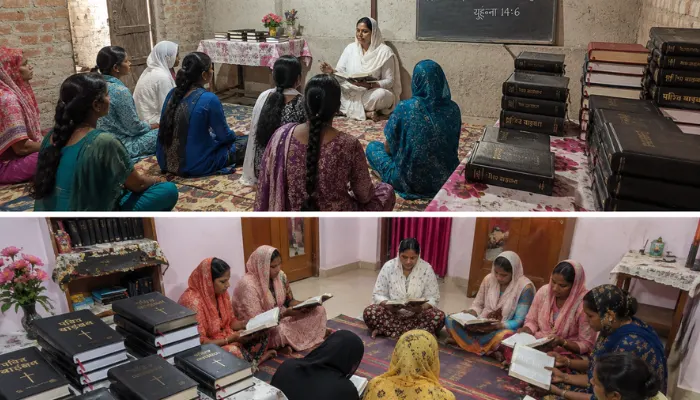
Case Summary
More than 40 Hindu women were lured to a house in Bansgaon Khas village under the Vishunpura Police Station area of Kushinagar district, Uttar Pradesh, where Christian missionaries were conducting a prayer meeting and attempting forced religious conversions. Religious literature and other materials associated with Christianity were being distributed among the attendees. Objectionable remarks about the Hindu faith were also being made with the apparent objective of encouraging Hindu women to convert to Christianity. The incident came to light on 31 May 2026 after local residents received information regarding religious conversion activities taking place during a prayer meeting. Following the information, workers of the Rashtriya Bajrang Dal reached the location and found more than 40 Hindu women participating in the gathering. A Christian man and two Christian women, who were conducting the programme, were detained at the spot and handed over to the police. According to the complaint submitted by Bajrang Dal worker Arpit Rai, the three individuals had come from Bihar and were persuading Hindus to convert to Christianity by offering monetary inducements. During the inspection of the premises, Christian religious books and bottles filled with water were recovered. The complainants further stated that derogatory remarks were being made about Hinduism and that attendees were being misled in an effort to facilitate religious conversion. Upon receiving the information, police arrived at the scene and took the three accused individuals into custody for questioning. The recovered materials were seized, and an investigation was initiated into the activities being conducted at the premises. Station House Officer Vinay Mishra stated that a complaint had been received in the matter and that the detained individuals were being interrogated. Further legal action was to be taken based on the findings of the investigation.
Why it is Hate Crime ?
The primary category selected in this case is: Predatory Proselytisation. The subcategory selected is: Conversion/ attempts to convert by inducements. Predatory Proselytisation is not just limited to threat, harassment, force and violence, but it also has contours of stealth. In several cases, the Hindu victim is exploited to convert, with non-Hindus taking advantage of their poverty. In such cases, the Hindu victim who is suffering financially is offered monetary benefits, including lucrative offers for jobs, health treatment, education, etc, to induce the victim into changing his/her religion. In such cases, the religious identity of the victim and the aim to disenfranchise him from his faith form the heart of the crime. Also, taking advantage of and exploiting an individual’s economic vulnerabilities is widely acknowledged as exploitation, forms of which are often penalised by law. Such cases therefore are considered religiously motivated hate crimes since the victim’s religious identity forms the very heart of the crime itself. The other subcategory selected is: Proselytisation by grooming, brainwashing, manipulation or subtle indoctrination. The tertiary category selected is: Pattern of targeting Hindus. Religious brainwashing essentially means the often subtle and forcible indoctrination to induce someone to give up their religious beliefs to accept contrasting regimented ideas. Religious grooming or brainwashing also involves propaganda and manipulation. It involves the systematic effort, driven by religious malice and indoctrination, to persuade “non-believers’ to accept allegiance, command, or doctrine to and of a contrasting faith. Cases of such grooming or brainwashing are far more nuanced than direct threats, coercion, inducement and violence. In such cases, it is often seen that there is repeated, subtle and continual manipulation of the victim to induce disaffection towards their own faith and acceptance of the contrasting faith of the perpetrator. While subtle indoctrination is widely acknowledged as predatory, an element which is often understated in such conversions or the attempts of such conversion is the role of loyalty and trust which might develop between the perpetrator and the victim. Fiduciary relationships are often abused to affect such religious conversion. For example, an educator transmitting religious doctrine of a competing faith to a Hindu student. The Hindu student is likely to accept what the teacher is transmitting owing to existence of the fiduciary relationship. The exploitation of the fiduciary relationship to religiously indoctrinate victims would also be included in this category. Since the underlying animosity towards the victim’s faith forms the basis of predatory proselytization, such cases are considered religiously motivated hate crimes. The other subcategory selected is- Attempting to convert/ converting by denigrating Hinduism. In several cases, Hindus are converted or an attempt is made to convert Hindus by denigrating their faith, Hinduism. In such cases, the Hindus associate with the non-Hindu perpetrators often by choice and then, the attempt to convert them by insulting their faith, showing the faith down etc begins. An example of this would be a non-Hindu gathering where the Hindus are attending the gathering of their own free will. However, once they attend the gathering, there is an explicit attempt to convert them by abusing their faith and hailing the faith of the perpetrator. The denigration of the Hindu faith is often based on misrepresentation of the Hindu faith, its doctrine and scriptures and insult to espoused traditions if not blatant lies about Hindu beliefs and ways. Such conversions or attempts at conversions are driven by animosity towards the Hindu faith and are therefore documented as religiously motivated hate crimes. In this case, more than 40 Hindu women were lured to attend a prayer meeting where Christian evangelists were attempting to convert them to Christianity. The conversion efforts involved the use of monetary inducements, the distribution of Christian religious literature, and derogatory remarks directed at Hindu beliefs and practices. The targeting of Hindus as a religious group, combined with efforts to persuade them to abandon their faith and adopt Christianity, demonstrates hostility towards the religious identity of the victims and constitutes a religiously motivated hate incident. One of the clearest indicators of religious targeting in this case was the use of inducements to encourage conversion. The perpetrators were offering financial benefits and other incentives to vulnerable Hindus in order to persuade them to abandon their faith. Such inducements were not acts of charity but were directed towards securing religious conversion. By specifically targeting Hindus and exploiting economic vulnerabilities to influence religious choices, the perpetrators sought to weaken the victims' attachment to their faith and replace it with a different religious identity. This practice undermined the agency and dignity of vulnerable individuals and represented a calculated effort to secure conversions through material incentives rather than genuine religious conviction. It further demonstrated the religious animosity underlying the conversion campaign, as incentives were used as a tool to induce Hindus to renounce their faith and embrace another religion. By attempting to strip the victims of their religious identity through financial enticements, the perpetrators engaged in conduct that was inherently religious in nature, making this a religiously motivated offence. A second religious marker was the use of Christian religious texts and literature to influence the attendees. Christian books and other religious materials were distributed and used during the gathering as part of the conversion effort. The deliberate use of the scriptures and literature of one faith to persuade and indoctrinate members of another faith to abandon their religious beliefs demonstrates a conscious attempt to alter the religious identity of the targeted group through manipulation and psychological conditioning. Such activities go beyond merely sharing religious views and instead form part of a structured effort to encourage conversion among the Hindu community. The use of religious literature as a tool for systematic conversion reinforces the conclusion that the victims were targeted because they were Hindus. When Christian religious material is used to exploit trust, sow doubt about an individual's existing faith, and misrepresent Hindu beliefs in order to facilitate conversion, particularly in a systematic and organised manner, it constitutes a religiously motivated offence. Such actions reveal hostility towards the religious identity of the victims and demonstrate a deliberate attempt to detach them from their Hindu faith and assimilate them into a different religious tradition. A third and particularly significant religious marker emerged through the denigration of Hindu beliefs. Several objectionable remarks were made about Hinduism during the gathering. Such conduct is religiously significant because it involves attacking the beliefs, traditions, and spiritual practices that form a core part of Hindu identity. Conversion efforts that rely upon discrediting or insulting another religion, in this case Hinduism, demonstrate not only a desire to promote a different faith but also contempt towards the religion being targeted. By portraying Hindu beliefs negatively while simultaneously encouraging conversion to Christianity, the perpetrators sought to create doubt, insecurity, and religious shame among the Hindu attendees. In doing so, they attempted to project Christianity as spiritually superior while depicting Hinduism as inferior and inadequate. This amounted to an effort to impose the perceived supremacy of Christianity over Hinduism as part of the conversion process. Such conduct reflects explicit hostility towards Hinduism and serves as a method of facilitating conversion through the degradation and denigration of the victims' religious beliefs. By attacking the sanctity and legitimacy of Hindu religious traditions, the perpetrators sought to weaken the victims' attachment to their faith and make them more receptive to conversion, making this a religiously motivated offence. The scale of the operation further underscores its targeted nature. This was not an instance involving one or two individuals being forced into conversion; rather, more than 40 Hindu women had been gathered for the purpose of religious indoctrination and conversion. The large number of Hindu attendees demonstrates that this was not an isolated or spontaneous occurrence but part of a broader and organised effort directed specifically at members of the Hindu community. The fact that such a substantial group of Hindu women was targeted at a single gathering reveals a systematic pattern of religious targeting rather than a random incident. By focusing their efforts on a large number of Hindus simultaneously, the perpetrators sought to maximise the reach and impact of their conversion campaign. Such organised attempts to persuade Hindus to abandon their faith and adopt another religion indicate a deliberate strategy aimed at weakening Hindu religious identity at the community level. The scale, organisation, and repeated nature of these activities therefore reinforce the conclusion that this was a religiously motivated effort specifically targeting Hindus because of their faith. These instances of targeted proselytisation activities stem from inherent hostility towards the victims' professed faith since Abrahamic faiths believe that any non-adherent to their faith is subject to being dehumanised till they convert, making it a religiously motivated crime against Hindus. Therefore, this case is being added to the hate crime database of the Hinduphobia Tracker.
Victim Details
Total Victim
40
Deceased
0
Gender
- Male 0
- Female 40
- Third Gender 0
- Unknown 0
Caste
- SC/ST 0
- OBC 0
- General 0
- Unknown 40
Age Group
- Minor 0
- Adult 40
- Senior Citizen 0
- Unknown 0


Case Status
Arrested


Perpetrators Details
Perpetrators
Christian Extremists
Perpetrators Range
From 2 To 5
Perpetrators Gender
both
 Sources




