Hindu residents, including children, lured to prayer meeting and offered inducements for religious conversion by Christian father-son duo
 Ghazipur, Uttar Pradesh, India
  30 May, 2026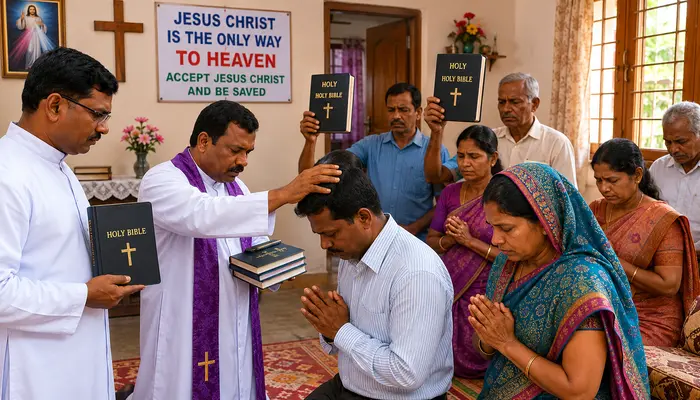
Case Summary
In the Ghazipur town of Fatehpur district of Uttar Pradesh, Hindu villagers, including children, were lured to a prayer meeting and offered inducements for religious conversion by a Christian father-son duo. The incident came to light after a complaint was submitted by Bajrang Dal functionary Dharmendra Singh and local resident Gyanendra Singh, who informed the police that Hindu residents were being encouraged to embrace Christianity during regular prayer meetings held at the house of Suresh Gupta and his son, Sanjay Gupta. Acting on the information, police conducted a raid at the premises on 31 May 2026, and found around twenty individuals, including men, women, and children, attending the gathering. Several attendees informed the authorities that they had been invited by the organisers and had been participating in such meetings for an extended period. According to the complaint, the gatherings had been taking place regularly for many years, with prayer meetings being held every Sunday. Participants from neighbouring villages and localities were said to attend these events. Complainants stated that economically vulnerable and socially disadvantaged Hindu individuals were drawn to the meetings through inducements and assurances connected with faith healing and religious teachings. The organisers, Suresh and Sanjay Gupta, who earned their livelihood through a chaat stall in the town, used these gatherings to influence attendees to adopt Christianity. Bajrang Dal members stated that they had monitored the activities for a considerable period and that the meetings had continued for nearly nine years before the matter came to public attention. During the police action, religious literature, photographs, and other materials associated with Christianity were recovered from the premises. The discovery intensified tensions in the area, leading to the gathering of local residents and activists near the site. Police detained Suresh Gupta, his son Sanjay Gupta, and several other individuals present during the meeting for questioning. Authorities subsequently transported those detained to the police station and initiated an investigation into the nature of the gatherings, the recovered materials, and the circumstances under which people had been attending the meetings. The station house officer stated that statements were being recorded and evidence examined, while further legal action would be determined on the basis of the findings of the investigation.
Why it is Hate Crime ?
The primary category for this case is "Predatory Proselytisation" The sub-category for this case is "Conversion/attempts to convert by inducement". Predatory Proselytisation is not just limited to threat, harassment, force and violence, but it also has contours of stealth. In several cases, the Hindu victim is exploited to convert, with non-Hindus taking advantage of their poverty. In such cases, the Hindu victim who is suffering financially is offered monetary benefits, including lucrative offers for jobs, health treatment, education, etc, to induce the victim into changing his/her religion. In such cases, the religious identity of the victim and the aim to disenfranchise him from his faith form the heart of the crime. Also, taking advantage of and exploiting an individual’s economic vulnerabilities is widely acknowledged as exploitation, forms of which are often penalised by law. Such cases therefore are considered religiously motivated hate crimes since the victim’s religious identity forms the very heart of the crime itself. Another sub-category for this case is "Proselytisation by grooming, brainwashing, manipulation and subtle indoctrination". The tertiary category for this case is "Pattern of targeting Hindus" and "Conversion of minor". Religious brainwashing essentially means the often subtle and forcible indoctrination to induce someone to give up their religious beliefs to accept contrasting regimented ideas. Religious grooming or brainwashing also involves propaganda and manipulation. It involves the systematic effort, driven by religious malice and indoctrination, to persuade “non-believers’ to accept allegiance, command, or doctrine to and of a contrasting faith. Cases of such grooming or brainwashing are far more nuanced than direct threats, coercion, inducement and violence. In such cases, it is often seen that there is repeated, subtle and continual manipulation of the victim to induce disaffection towards their own faith and acceptance of the contrasting faith of the perpetrator. While subtle indoctrination is widely acknowledged as predatory, an element which is often understated in such conversions or the attempts of such conversion is the role of loyalty and trust which might develop between the perpetrator and the victim. Fiduciary relationships are often abused to affect such religious conversion. For example, an educator transmitting religious doctrine of a competing faith to a Hindu student. The Hindu student is likely to accept what the teacher is transmitting owing to existence of the fiduciary relationship. The exploitation of the fiduciary relationship to religiously indoctrinate victims would also be included in this category. Since the underlying animosity towards the victim’s faith forms the basis of predatory proselytization, such cases are considered religiously motivated hate crimes. This case has been added to the Hinduphobia Tracker because a Christian father-son duo was found conducting regular prayer gatherings attended by Hindu villagers, including women and children, where efforts were reportedly made to encourage participants to adopt Christianity. During the police raid, multiple attendees were found at the gathering and Christian religious literature was recovered from the premises, demonstrating that the meetings were being used to propagate Christian beliefs among members of the local Hindu community. Firstly, what was presented as a simple prayer gathering was in reality a covert attempt at religious conversion. These were not genuine community prayers but calculated efforts to exploit the trust of Hindus and manipulate them into abandoning their faith. The organisers deliberately held the meeting at a private residence in secrecy, indicating a deliberate and deceptive strategy designed to avoid public attention and scrutiny. By conducting such gatherings covertly, the Christian perpetrators sought to manipulate vulnerable Hindus, taking advantage of their emotional and social circumstances to push them towards conversion. Furthermore, the perpetrators also carried faith based healing under the guise of prayer meeting. The Changai Sabha format, often described publicly as a faith healing gathering, is a well-recognised tool in organised Christian proselytisation networks. These meetings usually employ songs, testimonies and emotionally charged prayer sessions to influence and induce vulnerable individuals without openly declaring the underlying objective. The absence of transparency is itself central to the method. People attend believing they are seeking comfort, healing or spiritual support, only to be gradually drawn into teachings that undermine their own religious identity and introduce them to the Christian framework presented as the only path to relief. Secondly, offering incentives or making false promises, especially when directed at vulnerable individuals in need, shows that these incentives are not acts of kindness or charity. Instead, they are calculated moves to exploit vulnerable Hindus because of religion. By providing inducements or promising healing in exchange for conversion, the accused were effectively blackmailing those who might have been desperate for assistance or hope. Such instances are seen in many cases where members of Christian missionary groups target socially and economically vulnerable Hindus to further their agenda of religious conversions. This form of coercion strips people of their agency and dignity and results in coerced conversions. These are not random or isolated incidents, but rather cases deeply rooted in religious animosity towards Hindu victims. Thirdly, the Christian perpetrators were also actively attempting to indoctrinate the Hindu victims by using Christian religious texts and literature. Using the scriptures or literature of one faith to deliberately target and manipulate members of another, with the clear intention of religious conversion, represents a direct attack on the Hindu faith. Such actions are designed to violate and undermine the beliefs of Hindu victims and are clear indicators of religious hostility towards Hindus and their religious identity. Such actions further demonstrate that this was not an isolated incident of evangelism, but rather part of a broader, organised operation to further religious conversions. When Christian religious material is used to exploit trust, sow doubt, and misrepresent the beliefs of Hindus to coerce conversion, particularly in a systematic manner, it constitutes a religiously motivated offence. Fourth, the presence of children at the gathering further aggravates the seriousness of the incident. Minors are particularly susceptible to influence and lack the maturity required to fully comprehend the long-term implications of adopting a different religious identity and the Christian perpetrators purposely targeted and exploited this vulnerability of the victim. Since this case exemplifies the use of coercion and manipulation to achieve religious conversion, it is a blatant act of religious hate. The nature of the conversion efforts and the wider impact on the Hindu community all indicate a targeted action against Hindus as a collectivity. When individuals or groups focus their efforts on converting members of a particular religion, in this case, Hindus, then it demonstrates a fundamental disregard for the Hindu faith. Conversion, especially when not based on personal conviction but rather on external persuasion or pressure, is not simply about sharing a different belief system. It is an attempt to undermine the values, traditions, and identity of the Hindu community. In this context, the Christian perpetrators specifically targeted Hindus, which demonstrates a lack of respect for Hinduism and its followers. Such actions are carried out to strip Hindu victims of their faith, making it a religiously motivated crime. The Christian faith, by its very theological foundations, places a strong emphasis on proselytisation. In pursuit of conversion objectives, Christian evangelists often employ unethical means, ranging from psychological pressure and misinformation to inducements such as money or jobs. These tactics are designed not as acts of charity but as tools to engineer religious change under the guise of social upliftment, particularly among vulnerable and underprivileged communities. This systematic attempt to erode the religious foundation of individuals and replace it with allegiance to another faith reflects deep religious malice and animus against the Hindu identity. Because the core motivation of the act stems from hostility toward the victim’s religion, it meets the threshold of a hate crime. Hence, categorised as a hate crime in the database.
Victim Details
Total Victim
20
Deceased
0
Gender
- Male 0
- Female 0
- Third Gender 0
- Unknown 20
Caste
- SC/ST 0
- OBC 0
- General 0
- Unknown 20
Age Group
- Minor 0
- Adult 0
- Senior Citizen 0
- Unknown 20


Case Status
Complaint filed


Perpetrators Details
Perpetrators
Christian Extremists
Perpetrators Range
From 2 To 5
Perpetrators Gender
male
 Sources




