Hindu temple's sanctity defiled; miscreants dump severed cow's head inside its premises a day after Eid al-Adha in West Bengal's Birbhum
 Birbhum district, West Bengal, India
  28 May, 2026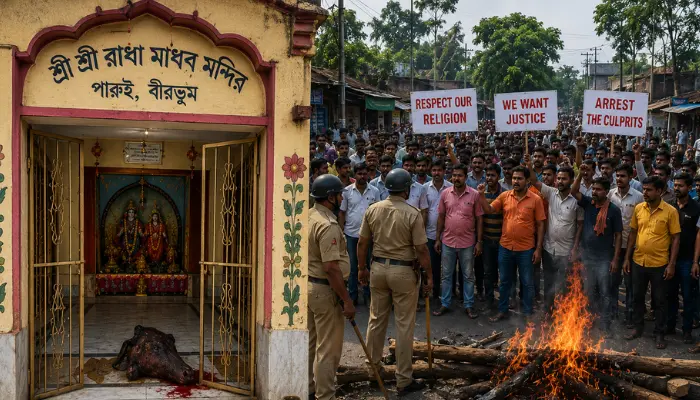
Case Summary
In Parui, located in West Bengal's Birbhum district, the sanctity of the Radha Madhav Temple was defiled when a few unidentified miscreants dumped a severed cow's head inside the temple premises. The incident occurred on 29 May 2026, a day after the Eid al-Adha (Bakrid) celebrations, which were observed from 27 May 2026 to 28 May 2026. After the incident came to light, local Hindu devotees protested, stating that it had hurt their religious sentiments. As the situation quickly escalated, protests, road blockades, and a movement demanding the immediate arrest of the culprits began in the area. Local Hindu residents stated that sometime late on the night of 28 May 2026 or in the early hours of 29 May 2026, unidentified miscreants dumped the severed cow's head within the temple premises. As usual, on the morning of 29 May 2026, devotees who arrived at the temple to offer prayers first noticed the matter. They were shocked to witness such a scene within the temple grounds, and the news quickly spread to the surrounding villages. Within a short time, a large crowd gathered in front of the temple. Local residents were outraged by the incident. They stated that the act had been carried out with the intention of disrupting communal harmony in the area. Many people came out onto the streets in protest and blocked the road for some time. The protesters stated that the incident was not only an insult to a religious place but also an attempt to create divisions within society. They demanded a swift investigation to identify those responsible and called for strict punishment against the perpetrators. Upon receiving information about the incident, officers from Parui Police Station quickly reached the spot. Additional police personnel were also deployed to bring the situation under control. The police first secured the temple premises and later recovered the severed cow's head and removed it from the site. They attempted to calm tensions by speaking with local residents while closely monitoring the law and order situation to ensure that it did not deteriorate further. A written complaint was filed with the Parui Police Station by the temple committee and the aggrieved villagers. The complaint stated that the incident had been carried out with the intention of hurting religious sentiments and creating unrest in the area. The police received the complaint and began an investigation. Investigators examined closed-circuit television footage from the surrounding area and collected information regarding possible suspects. They also investigated whether any organised conspiracy was behind the incident. According to administrative sources, the police began regular patrols in the area to maintain peace and harmony. Local public representatives and prominent members of society also appealed to residents to remain calm. They advised people to exercise patience until the investigation was completed rather than spreading rumours or provocative information. Meanwhile, the incident created an atmosphere of concern throughout the area. Many residents stated that such an occurrence was deeply unfortunate in a locality where communal harmony had been maintained for a long time. The locals demanded that the truth be uncovered through a thorough investigation and that strict legal action be taken against those responsible. The police continued to investigate all aspects of the incident and did not rule out any possibility while the inquiry remained ongoing. The administration expressed hope that a swift investigation would help restore normalcy and ensure that peace prevailed in the area.
Why it is Hate Crime ?
The primary category selected in this case is: Attack on Hindu religious representations. The subcategory selected is: Desecration of Hindu religious symbols. Icons and symbols or a religious representation of a spiritual ideal are widely revered in Hinduism. Iconography is of vital significance in the Hindu milieu. It helps connect people’s spiritual beliefs with the real world. Iconography within the Hindu faith takes several shapes and forms. Murtis are of most significance to Hindus, to which daily rituals, prayers and offerings are done. Besides the murtis, there are several other symbols which have deep significance in the Hindu faith – the Om and Swastika for example. Since these Hindu religious symbols hold paramount importance in Hinduism, any desecration of symbols, icons, murtis, religious representations and manifestations, is driven by animosity towards the faith itself which manifests itself through these murtis, icons and symbols. Therefore, any desecration of these Hindu religious symbols and representations is considered religiously motivated hate crimes under this category. The other subcategory selected is: Defiling religious customs. Sanatan Dharma is not a religion of one book, which is to say that while it has religious scriptures that form the central tenets of the faith, there are several traditions followed through thousands of years, mostly passed from generation to generation orally. There are several such customs and traditions that are followed by various Hindus and Hindu sects. Defiling of these traditions and customs is a breach of an individual or group’s religious practices. Such practices can range from dietary restrictions like not eating non-vegetarian food for a certain period of the year, not eating non-vegetarian food at all, not eating beef since the cow is considered holy in Hinduism, the sanctity of religious customs followed in the house (like many ISCKON devotees), etc. Any malicious action leading to the breach of such traditions or defilement of these traditions owing to animosity towards the faith or for the sake of activism stems not only from the lack of faith in the religion itself but also from disregard for the faith of the devotees who follow the customs/traditions and implicit bias against the faith, the tradition itself. Since these specific traditions are central to the faith of the devotees of that specific sect of Hindus, any non-compliance with these traditional rules would be considered a religiously motivated hate crime. The other subcategory selected is: Attack on Temples. In Hinduism, a temple is the abode of the Deity. The Deity in the Temple is consecrated, thereby, making it a real, breathing entity. Hindus believe that not just the Deity but the temple premises itself are sacred to Hindus since Hindus hold the faith that the entire Temple space is an amalgamation of the divine energy of the deity. Given the central significance of Temples in Hindu Dharma, any attack against a Hindu Temple or its peripheral premises is an attack on the faith itself and is born out of animosity towards the faith, of which, the Temple is a central tenet. Any manner of attack against a Temple and/or its premises would therefore be considered a religiously motivated hate crime. This incident constitutes a serious act of desecration, as it involved the dumping of a severed cow's head inside the premises of the Radha Madhav Temple in Parui, Birbhum district, West Bengal. In Hinduism, temples are sacred spaces of worship, and acts that pollute or defile temple premises are regarded as deeply offensive and sacrilegious. The deliberate placement of a severed cow's head within a Hindu temple represents a direct affront to the sanctity of the religious site and the sentiments of the Hindu community associated with it. The incident occurred shortly after the Eid al-Adha festivities, a period during which animal sacrifice forms part of the religious observances of Muslims. Although the perpetrators have not been identified, the timing of the incident and the nature of the material used to desecrate the temple demonstrate that the act was a deliberate attempt to hurt Hindu religious sentiments. The dumping of a severed cow's head inside a temple cannot reasonably be viewed as an accidental occurrence; rather, it indicates a conscious act directed at a site of particular religious significance to Hindus. While the Islamic practice of animal sacrifice during Eid-ul-Adha, known as Qurbani, is a significant religious observance, the repeated instances of dumping beef during Eid, specifically in or near Hindu temples, demonstrate that these cases are a result of religious animosity towards Hindus and their faith. These actions are committed to deliberately desecrating Hindu temples and provoking communal tensions. In Hinduism, the cow is revered as a sacred symbol of motherhood, nourishment, compassion, and divinity. The slaughter of a cow is regarded by all Hindus as a grave sin and a profound religious taboo. Equally important is the concept of ritual purity associated with Hindu temples, which are considered consecrated spaces dedicated to divine worship. The introduction of cow remains into such a sacred space constitutes a serious violation of these religious principles. Consequently, the act carried a symbolic significance that extended beyond ordinary vandalism and amounted to the deliberate desecration of a place of worship. The incident also triggered widespread outrage among local Hindus, resulting in protests, road blockades, and demands for the immediate arrest of those responsible. Residents stated that the act appeared intended to disrupt communal harmony and create tensions within the locality. The reaction of the local Hindu community underscores the extent to which the incident is an attack on their religious identity and sacred institutions. Historically, the use of cow remains, or acts associated with cow slaughter to insult Hindu religious sentiments, has carried significant symbolic meaning due to the cow's revered status within Hindu tradition. When such acts are directed at temples, they acquire an additional dimension because they involve the desecration of a sacred religious space. In this case, the deliberate dumping of a severed cow's head inside a Hindu temple combined both elements, making the act particularly offensive to the Hindu community. Given that the incident involved the intentional defilement of a Hindu place of worship through the placement of a severed cow's head within the temple premises, and given its apparent purpose of insulting religious sentiments and disturbing communal harmony, the case is being classified as a religiously motivated act targeting Hindu religious beliefs and practices. As such, it warrants inclusion in the Hinduphobia Tracker's hate crime database as a case involving the desecration of a Hindu temple and the deliberate targeting of Hindu religious sentiments.


Case Status
Complaint filed


Perpetrators Details
Perpetrators
Unknown
Perpetrators Range
Unknown
Perpetrators Gender
unknown
 Sources




