Hindu man's livelihood targeted to compel conversion to Islam in Bangladesh
 Dinajpur District, Bangladesh
  29 May, 2026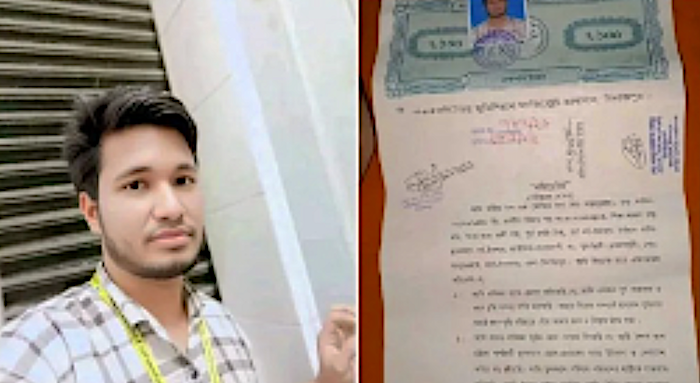
Case Summary
A Hindu man from Dinajpur, Bangladesh, was subjected to sustained pressure and intimidation after refusing to abandon his Hindu faith and convert to Islam. The Hindu victim, Mahendra Nath Roy, faced repeated coercion that eventually forced him to change his religious identity and adopt a new name. The incident took place in Dinajpur district, where Mahendra Nath Roy had been working for a long time at a business establishment. The owner of the establishment pressured him to accept Islam and told him that he would not be allowed to continue his employment unless he converted. Facing economic insecurity and responsibility towards his family, Mahendra Nath Roy eventually converted under pressure and his name was changed to Mahmudullah. Following the conversion, the incident created fear and concern among members of the local Hindu community. Mahendra Nath Roy’s family members stated that he was extremely distressed and that although his name had been changed externally, he was struggling with the situation internally. The incident emerged at a time when Hindu communities across Bangladesh continued to express concerns over different forms of pressure, including land grabbing, attacks on temples, and religious conversion targeting vulnerable Hindu families. Many Hindu families, particularly those facing economic hardship, remained vulnerable to coercion involving livelihood and social pressure. Local Hindu community members stated that such incidents were not isolated cases but part of a wider pattern of pressure faced by minority Hindus. They expressed concern that economic vulnerability was being used to force members of the community into abandoning their religious identity. The local administration stated that it was aware of similar concerns, but no clear action regarding this specific incident had been recorded at the time of reporting. Members of the Hindu community demanded protection and action against those involved in coercive religious conversions. This escalation of violence against Hindus in Bangladesh has unfolded in three distinct phases: first, following the ouster of Sheikh Hasina’s government in August 2024; second, after the death of Sharif Osman Bin Hadi in December 2025; and third, in the immediate aftermath of the 13th National Parliamentary Election 2026. Following the ouster of Sheikh Hasina, multiple reports documented attacks on Hindu homes, temples, and religious institutions, alongside intimidation campaigns, arson, and mob assaults targeting minority neighbourhoods. The Hinduphobia Tracker has recorded 336 such incidents against the Hindu minority, underscoring the scale and persistence of anti-Hindu violence during this period. A further escalation occurred following the death of Sharif Osman Bin Hadi, a Muslim political activist and student leader known for his anti-Hindu and anti-India rhetoric. Hadi had been involved in political unrest after the fall of the Hasina government and was killed in Dhaka on 18th May 2025 during clashes. In the aftermath of his death, Hindu communities were blamed and subsequently targeted in retaliatory violence. Hindu homes were selectively set ablaze in multiple localities, forcing families to flee and leaving many displaced. The attacks appeared patterned rather than sporadic, with Muslim mobs focusing on Hindu neighbourhoods, properties, and religious symbols. Among the victims was Dipu Chandra Das, who was lynched to death and his body was set ablaze by a Muslim mob over false blasphemy allegations. The Hinduphobia Tracker documented 51 incidents of anti-Hindu violence in the period following Hadi’s death alone. Such incidents underscored the vulnerability of the Hindu minority amid rising communal hostility and the weaponisation of religious accusations. Reports further indicated that posters and written materials calling for the extermination of Hindus were displayed in public spaces, signalling an alarming normalisation of genocidal rhetoric. When combined with acts of arson, vandalism, assault, and targeted intimidation, these developments suggested an environment of hostility aimed at terrorising the Hindu community and reinforcing majoritarian dominance. The third phase of violence was unleashed after the 13th National Parliamentary Election 2026. Within days of the announcement of results, Hindu families in districts such as Noakhali, Rangpur, Nilphamari, Sylhet, Thakurgaon, and Dinajpur reported attacks involving arson, looting, assault, and vandalism of temples and homes. In several instances, Hindu homes were targeted, looted, and families were threatened with displacement.
Why it is Hate Crime ?
This case has been added to the tracker under the primary category- Predatory Proselytisation. Within this, the subcategory selected is- Harassment, threats, coercion for conversion. Harassment covers a wide range of behaviours of an offensive nature. It is commonly understood as behaviour that demeans, humiliates, and intimidates a person, including threats and coercion. Harassment and threats, in this case, find their root on discriminatory grounds which has the effect of nullifying a person’s rights or infringing upon his freedom to exercise his right specifically owing to the victim’s religious identity. Verbal and physical threats and psychological or physical harassment are often used against Hindu victims because they choose to practice their professed religion. Religious harassment also includes forced and involuntary conversions by harassment, threats or coercion. Coercion includes intimidatory tactics like force-feeding a Hindu victim beef to convert to another religion, forceful circumcision etc. In several cases documented, non-Hindu perpetrators or those who harbour specific animosity towards Hinduism, harass victims simply based on their religious identity. Such cases often also include harassment to ensure the Hindu victim abandons his/her professed religion and adopts the religion of the perpetrator. Such cases where Hindu victims are harassed to convert to the perpetrator’s religion are rooted in animosity towards the victim’s religious identity and are therefore documented as religiously motivated hate crimes. The other subcategory is- Proselytisation by grooming, brainwashing, manipulation or subtle indoctrination, with the tertiary category being - Family claims grooming. Religious brainwashing essentially means the often subtle and forcible indoctrination to induce someone to give up their religious beliefs to accept contrasting regimented ideas. Religious grooming or brainwashing also involves propaganda and manipulation. It involves the systematic effort, driven by religious malice and indoctrination, to persuade “non-believers’ to accept allegiance, command, or doctrine to and of a contrasting faith. Cases of such grooming or brainwashing are far more nuanced than direct threats, coercion, inducement and violence. In such cases, it is often seen that there is repeated, subtle and continual manipulation of the victim to induce disaffection towards their own faith and acceptance of the contrasting faith of the perpetrator. While subtle indoctrination is widely acknowledged as predatory, an element which is often understated in such conversions or the attempts of such conversion is the role of loyalty and trust which might develop between the perpetrator and the victim. Fiduciary relationships are often abused to affect such religious conversion. For example, an educator transmitting religious doctrine of a competing faith to a Hindu student. The Hindu student is likely to accept what the teacher is transmitting owing to existence of the fiduciary relationship. The exploitation of the fiduciary relationship to religiously indoctrinate victims would also be included in this category. Since the underlying animosity towards the victim’s faith forms the basis of predatory proselytisation, such cases are considered religiously motivated hate crimes. This case has been added to the tracker because a Hindu man, Mahendra Nath Roy, was subjected to sustained pressure that resulted in him abandoning his Hindu identity and converting to Islam. The circumstances surrounding the conversion raised concerns because his change of religion was not the outcome of a natural spiritual decision, but the result of external influence, pressure, and manipulation. The targeting of a Hindu individual from a minority community in Bangladesh, where Hindus have faced continued insecurity, made the religious dimension of the incident central to its classification. The primary religious marker in this case was the targeting of the Hindu victim’s religious identity through pressure to abandon Hinduism and accept Islam. A person’s religious identity forms a central part of their cultural, familial, and spiritual life, particularly for minorities who already exist within a vulnerable social environment. By pressuring Mahendra Nath Roy to change his faith and adopt a new religious identity, the act directly affected his connection to his ancestral beliefs, community, and personal identity. The circumstances indicated an attempt not merely to introduce another faith but to separate the Hindu victim from his existing religious identity. The second religious marker was the use of dependency and vulnerability as a means of influencing conversion. The Hindu victim depended on his employment for his livelihood and family responsibilities, placing him in a position where pressure from those with influence over his circumstances carried significant weight. In such cases, religious conversion cannot be viewed only through the final act of changing faith, but must also consider the conditions that led to that decision. Using economic pressure against a member of a vulnerable religious minority demonstrates how unequal power dynamics can be exploited to influence religious identity. Furthermore, the broader context of anti-Hindu persecution in Bangladesh remains relevant for classification. This incident occurred within an environment where Hindu minorities have faced repeated cases involving intimidation, violence, displacement, attacks on religious institutions, and pressure targeting their religious identity. Within such a climate, cases involving the conversion of vulnerable Hindus require closer examination because social, economic, and communal pressures can operate as tools of coercion even without physical violence. For the purpose of documenting the 2024 to 2026 ethnic cleansing of Hindus in Bangladesh and the subsequent persecution after the political exile of Sheikh Hasina, the death of Sharif Osman Hadi, and the 13th National Parliamentary Election 2026, the Hinduphobia Tracker records such incidents as likely religiously motivated at the point of entry. If any case is later established through credible investigation or court findings to stem from motivations other than religious hostility, it will be revised or removed from the hate crime database. The targeting of Mahendra Nath Roy must be viewed within Bangladesh’s documented anti-Hindu environment, where vulnerable Hindu individuals have increasingly faced threats to their security, property, religious institutions, and religious identity. The pressure placed on him to abandon his faith and assume a new religious identity reflects the wider concerns faced by many Hindu minorities living under conditions where their religious identity can become a source of vulnerability. Given Bangladesh's sustained anti-Hindu persecution environment, this case meets all thresholds for inclusion in the Hinduphobia Tracker's hate crime database. Disclaimer: The Hinduphobia Tracker records incident dates based on when the incident occurred, not when it was published or reported. However, as the exact date of this incident was not specified in the available sources, the article publication date, 30th May 2026, has been used as the indicative incident date. This date has been recorded for documentation purposes only.
Victim Details
Total Victim
1
Deceased
0
Gender
- Male 1
- Female 0
- Third Gender 0
- Unknown 0
Caste
- SC/ST 0
- OBC 0
- General 0
- Unknown 1
Age Group
- Minor 0
- Adult 1
- Senior Citizen 0
- Unknown 0


Case Status
Unknown


Perpetrators Details
Perpetrators
Muslim Extremists
Perpetrators Range
Unknown
Perpetrators Gender
unknown
 Sources




