Hindu student deceived and sexually exploited by Muslim man faking Hindu identity in Kanpur, Uttar Pradesh
 Kanpur, Uttar Pradesh, India
  28 May, 2026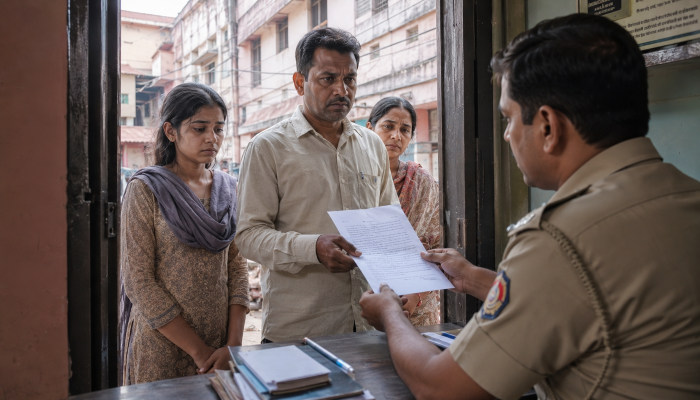
Case Summary
A Hindu law student from Harbanshmohal police station area in Kanpur, Uttar Pradesh, was deceived and sexually exploited by a Muslim man named Mohammad Kaif, posing as a Hindu. According to the complaint filed by the victim, she first came into contact with the accused, Mohammad Kaif, when she visited a veterinary hospital in Koparganj regarding treatment for her family's cow. At that time, the veterinarian had sent Kaif to assist her, and Kaif introduced himself as a Hindu man named Rajdeep and began communicating with her. Over time, he cultivated a close relationship with the victim and won her trust by presenting himself as a Hindu man and promising marriage. Believing his representations to be genuine, the victim entered into a relationship with him, during which he established physical relations with her. The deception came to light when the student spoke with the veterinarian and discovered that the man she knew as Rajdeep was, in fact, Mohammad Kaif. After learning his real identity, she distanced herself from him and ended the relationship. Following this, Kaif began harassing and intimidating her. He repeatedly followed her, stalked her while she travelled between college and home, and threatened both her and her family. The victim stated that the continued intimidation became so severe that she stopped attending college out of fear. He also visited her house while intoxicated, abused her and threatened to defame her if she approached the police. Subsequently, her family met ACP Kotwali Ashutosh Singh on 29 May 2026 and informed him of the sustained harassment and abuse. An FIR was registered on the victim's written complaint. Mohammad Kaif was arrested and was to be sent to judicial custody on 30 May 2026. Investigation further revealed that Kaif had created fake Hindu-named accounts on Instagram and Facebook through which he chatted with multiple girls, establishing a documented pattern of targeting Hindu women through false Hindu identity on social media. Authorities stated that further legal action was being undertaken in accordance with the investigation.
Why it is Hate Crime ?
The primary category for this case is "Crimes against relationships and other sexual crimes". The sub-category for this case is "Man pretends to be Hindu". The tertiary categories for this case are "Name changed" and "Pattern of targeting Hindu women". When a non-Hindu man pretends to be a Hindu to deceive a Hindu woman into a relationship, the act is seen as triggered by malafide intentions. In some cases, the woman eventually accepts the man’s original religious identity and converts after the man’s identity is revealed. These cases could be argued as cases of religious brainwashing and a result of the pressure a woman feels after getting into a relationship with a man. The woman, it can be argued, also changed her religious identity because of the stigma she believes she might face if she chooses to walk out of a deceptive relationship. However, for the purpose of documenting hate crimes, the cases in this subcategory are limited to those where there is explicit violence aimed at religious conversion against the wishes of the victim (force-feeding beef, blackmailing with intimate videos, rape on refusal to convert, etc), or if the woman herself complains of the man’s religious deception. In such cases, it is established that the deception of the non-Hindu man had a specific aim of religious conversion or targeting of the victim due to her Hindu religious identity, therefore, making it a religiously motivated hate crime. This case is being added to the hate crime database of the Hinduphobia Tracker because the entire operation directed at the Hindu law student, from the construction of multiple fake Hindu-named social media accounts to the false introduction as Rajdeep to the sustained campaign of harassment and death threats following the discovery of his true identity, was rooted in religious animosity, a deliberate and structured exploitation of the victim's Hindu religious trust. The accused deliberately concealed his religious identity to initiate and sustain a relationship with a Hindu girl. This itself is a clear manifestation of bias and malicious intent towards the victim's religion. By concealing his true identity, he exploited her trust, targeting her under false pretences. This indicates a premeditated intent to manipulate her based on her religious background. In cases like these, the tactic of adopting a false Hindu identity to manipulate and "ensnare" a Hindu individual is not just an act of personal betrayal but can also be interpreted as an expression of disdain or disregard for Hinduism and its customs that reflects a deeper animosity towards Hindus and their beliefs In such instances, identity concealment is not merely a personal deception but a calculated strategy rooted in religious targeting and profiling. The accused was aware that the victim, being Hindu, may not have consented to the relationship had she known his real identity from the outset. He therefore circumvented her ability to exercise informed choice by deliberately lying about his name and religious background. This demonstrated a premeditated effort to exploit the victim specifically on the basis of her religious identity. Furthermore, the pattern of multiple fake Hindu-named accounts established for the purpose of chatting with girls confirms that this was not an isolated act of personal deception but a documented and repeating operational methodology directed at Hindu women as a category. This reflects an underlying hostility toward Hindu religious identity that cannot be characterised as anything other than religiously motivated. The false name was not adopted casually or for personal convenience. It was deployed across social media platforms as a systematic operational tool for accessing Hindu women, with multiple fake accounts established for the purpose of chatting with girls under a false Hindu identity. A man who maintains multiple fake Hindu-named social media accounts for the purpose of approaching women is not engaged in a personal romantic pursuit. He is running a structured operation in which the false Hindu identity is the primary instrument of access. Additionally, the sustained campaign of harassment that followed the discovery of the accused's true identity reflected an attempt to maintain control over the victim and prevent her from exposing the deception. Kaif followed the victim from college to her home, visited her residence in an intoxicated state, abused her, threatened to kill her family members, and warned that reporting him to the police would result in her public defamation. The harassment occurred after the victim learned that the accused had concealed his religious identity and presented himself as a Hindu, indicating that the threats were closely connected to the exposure of the deception and the victim's decision to end the relationship. Taken together, the facts of the case demonstrate far more than a conventional instance of interpersonal deception. The accused's conduct involved the deliberate adoption of a false Hindu identity, the operation of multiple Hindu-named social media accounts, the exploitation of a Hindu student's trust through concealment of his real religious identity, and a sustained campaign of threats and intimidation once the deception was exposed. The false Hindu persona was not incidental to the relationship but the mechanism through which access to the victim was obtained and maintained. The subsequent harassment served to punish the victim for discovering the truth and attempting to withdraw from the relationship. The combination of religious identity concealment, targeted exploitation of a Hindu victim's trust, and coercive retaliation following exposure constitutes a pattern of conduct that falls within the ambit of religiously targeted victimisation and therefore warrants inclusion in the Hinduphobia Tracker database. Disclaimer: The Hinduphobia Tracker records incidents based on when an event occurred or when the victim's ordeal began. It is important to clarify that none of the media sources covering this case has specified the exact date when the accused came into contact with the victim. Therefore, for documentation purposes, we have recorded the date based on when the incident was reported in the media, 29 May 2026.
Victim Details
Total Victim
1
Deceased
0
Gender
- Male 0
- Female 1
- Third Gender 0
- Unknown 0
Caste
- SC/ST 0
- OBC 0
- General 0
- Unknown 1
Age Group
- Minor 0
- Adult 1
- Senior Citizen 0
- Unknown 0


Case Status
Arrested


Perpetrators Details
Perpetrators
Muslim Extremists
Perpetrators Range
One Person
Perpetrators Gender
male
 Sources




