Hindu villagers targeted for religious conversion by organised Christian missionary network in Rampur, Uttar Pradesh
 Rampur, Uttar Pradesh, India
  30 May, 2026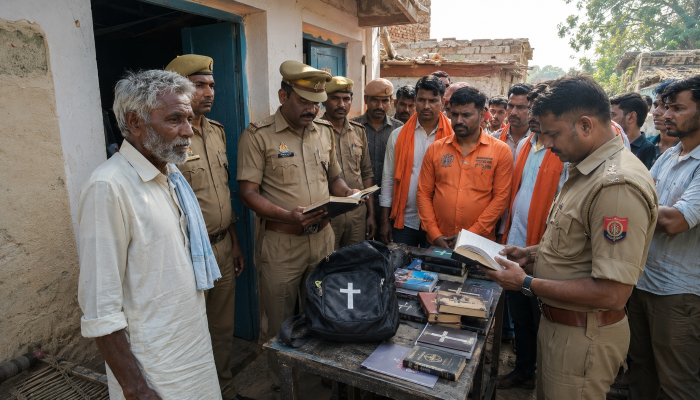
Case Summary
A Christian missionary network was caught conducting a covert conversion operation at the home of a Hindu family in Niswi ka Manjhara village, Patwai police station area, Uttar Pradesh. The network had already converted Sunita, the daughter-in-law of Hindu villager Sher Singh, who had then joined the network and was actively facilitating conversions of other Hindu villagers. As per the details, Sunita took Sher Singh's son, Ashok, away with her approximately one month before the complaint, in good health. Sher Singh stated that the network members lured his son with inducements and converted him to Christianity, and that they administered a chemical substance in water to Ashok, leaving him in a near-death condition. Bajrang Dal members Omveer, Pappu Singh Rajput, Arun Kumar, Ompal Singh, Govindram, Vijaypal Singh Rajput, and Amit Saxena received information that Christian missionaries were present at Sher Singh's house, conducting conversions and reached the scene. Patwai police also arrived and took all individuals to the police station. A black bag bearing the inscription "Prabhu Yeshu ne kaha jagat ki jyoti main hoon" [Lord Jesus said, "I am the light of the world"] was recovered from the network members and contained a Bible and a bottle of liquid. An FIR was registered against eight individuals: Sunita; Jogendra of Gohere, Hasanpur, Patwai; Rajendra and Prabha of Chandpura, Saifni; Naresh Kumar and Tejpal of Nasarpur, Sambhal; Mithilesh of Daravan, Bulandshahr; and Karan Singh. Six were arrested: Rajendra, Naresh Kumar, Tejpal, Karan Singh, Prabha, and Mithilesh. All six were produced before the court and sent to judicial custody. Sunita and Jogendra remained at large at the time of publication. However, on 26 July 2026, the Patwai police arrested the absconding accused, Jogendra, in connection with the case. He was produced before the court after the completion of the necessary legal formalities.
Why it is Hate Crime ?
The primary category for this case is "Predatory Proselytisation". The sub-category for this case is "Conversion/ attempts to convert by inducement" Predatory Proselytisation is not just limited to threat, harassment, force and violence, but it also has contours of stealth. In several cases, the Hindu victim is exploited to convert, with non-Hindus taking advantage of their poverty. In such cases, the Hindu victim who is suffering financially is offered monetary benefits, including lucrative offers for jobs, health treatment, education, etc, to induce the victim into changing his/her religion. In such cases, the religious identity of the victim and the aim to disenfranchise him from his faith form the heart of the crime. Also, taking advantage of and exploiting an individual’s economic vulnerabilities is widely acknowledged as exploitation, forms of which are often penalised by law. Such cases therefore are considered religiously motivated hate crimes since the victim’s religious identity forms the very heart of the crime itself. Another sub-category for this case is "Harassment, threats, coercion for conversion". Harassment covers a wide range of behaviours of an offensive nature. It is commonly understood as behaviour that demeans, humiliates, and intimidates a person, including threats and coercion. Harassment and threats, in this case, find their root on discriminatory grounds which has the effect of nullifying a person’s rights or infringing upon his freedom to exercise his right specifically owing to the victim’s religious identity. Verbal and physical threats and psychological or physical harassment are often used against Hindu victims because they choose to practice their professed religion. Religious harassment also includes forced and involuntary conversions by harassment, threats or coercion. Coercion includes intimidatory tactics like force-feeding a Hindu victim beef to convert to another religion, forceful circumcision etc. In several cases documented, non-Hindu perpetrators or those who harbour specific animosity towards Hinduism, harass victims simply based on their religious identity. Such cases often also include harassment to ensure the Hindu victim abandons his/her professed religion and adopts the religion of the perpetrator. Such cases where Hindu victims are harassed to convert to the perpetrator’s religion are rooted in animosity towards the victim’s religious identity and are therefore documented as religiously motivated hate crimes. One other sub-category that this case qualifies for is "Proselytisation by grooming, brainwashing, manipulation or subtle indoctrination". The tertiary category here for this case is "Pattern of targeting Hindus". Religious brainwashing essentially means the often subtle and forcible indoctrination to induce someone to give up their religious beliefs to accept contrasting regimented ideas. Religious grooming or brainwashing also involves propaganda and manipulation. It involves the systematic effort, driven by religious malice and indoctrination, to persuade “non-believers’ to accept allegiance, command, or doctrine to and of a contrasting faith. Cases of such grooming or brainwashing are far more nuanced than direct threats, coercion, inducement and violence. In such cases, it is often seen that there is repeated, subtle and continual manipulation of the victim to induce disaffection towards their own faith and acceptance of the contrasting faith of the perpetrator. While subtle indoctrination is widely acknowledged as predatory, an element which is often understated in such conversions or the attempts of such conversion is the role of loyalty and trust which might develop between the perpetrator and the victim. Fiduciary relationships are often abused to affect such religious conversion. For example, an educator transmitting religious doctrine of a competing faith to a Hindu student. The Hindu student is likely to accept what the teacher is transmitting owing to existence of the fiduciary relationship. The exploitation of the fiduciary relationship to religiously indoctrinate victims would also be included in this category. Since the underlying animosity towards the victim’s faith forms the basis of predatory proselytisation, such cases are considered religiously motivated hate crimes. This case has been added to the tracker because it involves a deliberate and organised attempt to convert Hindus to Christianity. The facts indicate that the accused were not merely practising their own religion but were actively working to expand it by targeting members of the Hindu community. The operation was conducted within a Hindu household and focused specifically on bringing more Hindus into the Christian fold. A particularly important aspect of this case is that a previously converted member of the Hindu family had become part of the conversion network and was helping facilitate further conversions. This reflects a pattern seen in many organised proselytisation cases, in which converts are encouraged to act as intermediaries to target their own relatives, neighbours, and social circles. The reason is simple: people are more likely to trust someone they already know. Such tactics enable missionary networks to penetrate Hindu communities more effectively and gradually draw more individuals away from their faith. The complaint further indicates that inducements and other forms of influence were used to secure conversions. This is significant because a genuine change of faith must arise from personal conviction and free choice. When vulnerable individuals are approached through inducements, emotional influence, dependency, or other forms of manipulation, the element of genuine consent becomes questionable. The objective shifts from religious belief to religious acquisition. The religious motivation in this case is explicit. The individuals being targeted were Hindus, and the intended outcome was their conversion to Christianity. The accused were not engaging in a theological discussion with willing participants. They were running a conversion operation designed to increase the number of Christian adherents within a Hindu population. Such conduct stems from the belief that Hinduism is insufficient and that Hindus must be brought into another faith, making the activity inherently hostile to the continued existence and practice of the victims' religion. This case, therefore, reflects a systematic effort to weaken Hindu religious identity by targeting Hindu families, exploiting existing social relationships, and using converted individuals to draw more Hindus into the missionary network. For these reasons, it has been classified as a religiously motivated hate crime and added to the tracker.


Case Status
Arrested


Perpetrators Details
Perpetrators
Christian Extremists
Perpetrators Range
From 5 to 10
Perpetrators Gender
both
 Sources




