Hindu temple land encroached in Rajasthan as sacred ground targeted in illicit takeover attempt
 Nagaur, Rajasthan, India
  28 May, 2026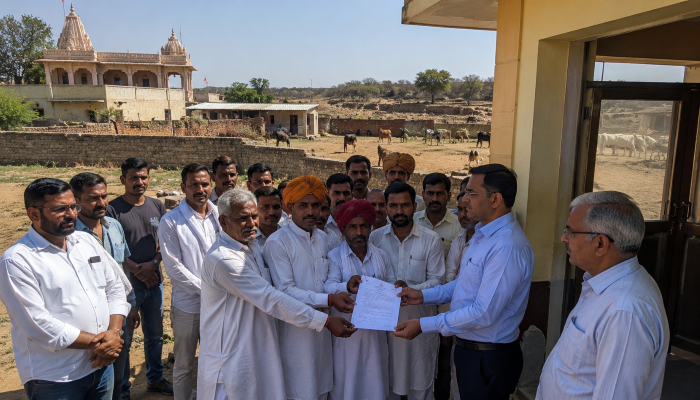
Case Summary
The land of two Hindu temples, Mahadev Mandir and Gorakhnaath Mandir, in Riyanbadi town, Rajasthan, was subjected to encroachment, prompting villagers to submit a memorandum to the Sub-Divisional Officer on 29 May 2026, demanding immediate action to free the land and restrain those responsible. As per details, land including Khasra number 139/679 in village Riyanbadi is registered in the name of Mahadev Mandir and Gorakhnaath Mandir. The land also contains a public use pond and the community cremation ground that villagers have been using for years. Approximately 50 years ago, the late Mahanth Harnath Pir of Mahadev Mandir had specifically reserved this land for the grazing of village animals to ensure cattle herders faced no difficulties. Krishna Goshala and Rajat Goshala [cow shelters revered in Hindu tradition as institutions dedicated to the protection and care of the sacred cow] operate in the vicinity of the land, where large numbers of cattle are kept. The encroachment, therefore, threatened not only the sacred land of two Hindu temples but also the grazing resources of two active goshalas and the community's cremation ground. Villagers warned the administration that if the encroachment continued to increase, social disputes, communal tension, and unpleasant incidents would inevitably follow. They demanded that the administration conduct an immediate on-site inspection, free the land from encroachment, and restrain those responsible. They stated that the protection of public and religious land was the administration's responsibility and that no negligence should be permitted. The memorandum was submitted by a large group of villagers, including Sarpanch Ugamaram Saran of Jatavas and numerous other named community members.
Why it is Hate Crime ?
The primary category for this case is "Attack on Hindu religious symbols". The sub-category for this case is "Encroachment or illicit takeover of temple land/land near temple" In Hinduism, a temple is the abode of the Deity. The Deity in the Temple is consecrated, thereby, making it a real, breathing entity. Hindus believe that not just the Deity but the temple premises itself are sacred to Hindus since Hindus hold the faith that the entire Temple space is an amalgamation of the divine energy of the deity. Not only the Temple but the Temple premises in its entirety are considered sacred by Hindus. In several cases, the premises of the Temple and/or religious centre are illicitly taken over by institutions belonging to other faiths – like the Waqf board or the Church. Other times, the temple property, land or the property of religious centres are illicitly encroached by non-Hindu groups. Any illicit take over or encroachment is a crime an initio, however, when non-Hindu groups illicitly take over or encroach the sacred land of Hindus, it is an affront to the Hindu community and is therefore classified as a religiously motivated hate crime under this category. The encroachment on the land of Mahadev Mandir and Gorakhnaath Mandir in Riyanbadi was not merely an illegal land grab targeting valuable real estate. The land in question was specifically reserved approximately 50 years ago by the late Mahanth Harnath Pir of Mahadev Mandir for the grazing of village animals and the sustenance of the community's cattle keepers. Its registration in the name of two Hindu temples established it as sacred institutional property whose protection was entrusted to the Hindu religious community of Riyanbadi across generations. The encroachment on this land, therefore, constitutes not merely a property violation but a direct assault on the institutional legacy of a Hindu religious leader who had dedicated the land to the service of his community and its cattle. Temple land is not merely physical property in Hinduism; it forms an essential part of the entire temple ecosystem that sustains worship, rituals, religious gatherings, festivals, and the spiritual life of devotees. Illegal encroachment upon this land directly interfered with the functioning, dignity, and sanctity of the temple premises. By occupying land associated with the temple, the encroachers disrupted the sacred environment surrounding the temple and weakened the religious space that devotees relied upon for worship and spiritual connection. Such acts go beyond ordinary land disputes because they damage spaces deeply tied to the Hindu faith and religious continuity. The land's significance extends beyond its registration in the temples' names. It contains a public use pond, a community cremation ground, and serves as the primary grazing resource for Krishna Goshala and Rajat Goshala, two active cow shelters housing large numbers of cattle. In Hindu tradition, goshalas are not merely agricultural facilities. They are religious institutions dedicated to the protection and care of the sacred cow, whose well-being is understood as a spiritual and moral obligation by devout Hindus. The encroachment on land that directly sustains two active goshalas is therefore an encroachment on the material foundation of a living Hindu religious practice, not merely on a piece of registered real estate. The villagers' warning that continued encroachment would inevitably produce social disputes, communal tension, and unpleasant incidents reflects a community that understands the encroachment as a religiously motivated provocation rather than a neutral land dispute. A community that responds to encroachment on temple land by submitting a memorandum to the Sub-Divisional Officer and warning of communal consequences is a community that recognises the religious character of the targeting, even where the source does not explicitly confirm the religious identity of the encroachers. Such targeting of temple property constitutes an attack on the broader temple ecosystem that includes the land, structures, rituals, priests, and devotees connected to the sacred site. Hindu temples hold immense civilisational and spiritual value, serving as centres of worship, cultural preservation, and community life for generations. Encroachment upon temple land, therefore, does not remain a mere administrative issue; it becomes an assault on the continuity and dignity of Hindu religious life itself. Since the illicit takeover of a site sacred to Hindus is seen as an affront to the Hindu community, this incident has therefore been classified as a religiously motivated hate crime and added to the hate crime database of the Hinduphobia Tracker. Disclaimer: The exact date on which the encroachment began was not confirmed in the source. The tracker records incident dates based on when the crime occurred rather than when it was reported or published. In this case, therefore, 29 May 2026 has been used as the indicative incident date, reflecting the confirmed date on which the villagers submitted the memorandum to the Sub-Divisional Officer, since this is the earliest available reference point for the documented conduct. This date has been recorded for documentation purposes only.


Case Status
Complaint filed


Perpetrators Details
Perpetrators
Unknown
Perpetrators Range
Unknown
Perpetrators Gender
unknown
 Sources




