Hindu family left critically injured after brutal attack by Muslim mob in Bangladesh amidst rising attacks on Hindu minorities
 Khulna Division, Bangladesh
  26 May, 2026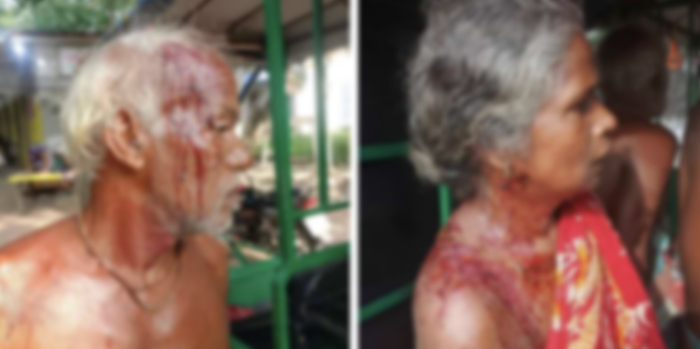
Case Summary
A Hindu family in Shyamnagar Upazila, Satkhira, Bangladesh, came under a violent attack that left multiple members seriously injured. The attack targeted the family of Ranjit Gayen in Jelekhali area of Munshiganj Union. Women were among those wounded, and the violence created fear throughout the local Hindu community. The attack occurred during the morning of 27th May 2026. Members of the Hindu family were subjected to a coordinated assault by a group armed with sharp weapons and sticks. Several members of the household sustained serious injuries and required urgent medical treatment. The incident unfolded against the backdrop of a long running dispute connected to land ownership in the area. The Hindu family had been involved in a prolonged disagreement concerning land. Tensions surrounding the property had persisted for an extended period. On 27th May 2026, the dispute escalated into physical violence when a group led by Abdul Majid Paik arrived and launched an attack on members of the Hindu household. The assailants used sharp weapons and sticks during the assault, causing extensive injuries to the family. The primary targets of the attack were members of Ranjit Gayen's Hindu family. Women from the family were among those injured. Several victims sustained severe wounds during the assault. Local residents intervened following the attack and assisted the injured family members. The wounded victims were transported to Satkhira Medical College Hospital and Shyamnagar Upazila Health Complex for treatment. Medical personnel treated multiple injured members of the family. Several victims were stated to be in critical condition following the violence. The attack generated widespread concern among local residents. Members of the Hindu community expressed fear following the incident. The violence heightened insecurity among Hindu families living in the area and prompted demands for protection and justice. Residents called for immediate administrative intervention and legal action against those responsible for the assault. The injured Hindu family sought security and justice following the attack. Community members urged the authorities to take prompt measures to prevent further violence and ensure the safety of vulnerable Hindu families in the locality. This incident occurred amid a broader period of sustained violence and intimidation directed against Hindus in Bangladesh. The attack on Ranjit Gayen's family formed part of an environment in which Hindu households, properties, temples, and religious institutions have repeatedly faced violence, vandalism, threats, and coercion. The targeting of a Hindu family in the course of a land related dispute has intensified concerns regarding the vulnerability of Hindu minorities in rural areas where property disputes frequently intersect with communal tensions and power imbalances. This escalation of violence against Hindus in Bangladesh has unfolded in three distinct phases: first, following the ouster of Sheikh Hasina's government in August 2024, second, after the death of Sharif Osman Bin Hadi in December 2025, and third, in the immediate aftermath of the 13th National Parliamentary Election 2026. Following the ouster of Sheikh Hasina, multiple reports documented attacks on Hindu homes, temples, and religious institutions, alongside intimidation campaigns, arson, and mob assaults targeting minority neighbourhoods. The Hinduphobia Tracker recorded 336 such incidents against the Hindu minority, underscoring the scale and persistence of anti Hindu violence during this period. A further escalation occurred following the death of Sharif Osman Bin Hadi, a Muslim political activist and student leader known for his anti Hindu and anti India rhetoric. Hadi had been involved in political unrest after the fall of the Hasina government and was killed in Dhaka on 18th December 2025 during clashes. In the aftermath of his death, Hindu communities were blamed and subsequently targeted in retaliatory violence. Hindu homes were selectively set ablaze in multiple localities, forcing families to flee and leaving many displaced. The attacks appeared patterned rather than sporadic, with Muslim mobs focusing on Hindu neighbourhoods, properties, and religious symbols. Among the victims was Dipu Chandra Das, who was lynched to death and whose body was set ablaze by a Muslim mob over false blasphemy allegations. The Hinduphobia Tracker documented 51 incidents of anti Hindu violence in the period following Hadi's death alone. Reports further indicated that posters and written materials calling for the extermination of Hindus were displayed in public spaces, signalling an alarming normalisation of genocidal rhetoric. When combined with acts of arson, vandalism, assault, and targeted intimidation, these developments reflected a climate of hostility directed at the Hindu minority. The third phase of violence was unleashed after the 13th National Parliamentary Election 2026. Within days of the announcement of results, Hindu families in districts such as Noakhali, Rangpur, Nilphamari, Sylhet, Thakurgaon, and Dinajpur reported coordinated attacks involving arson, looting, assault, and vandalism of temples and homes. In several instances, Hindu homes were selectively targeted, looted, and families were threatened with displacement.
Why it is Hate Crime ?
This case is added to the tracker under the primary category - Attack not resulting in death. The subcategory selected is - Attacked for Hindu identity. In several cases, Hindus are attacked merely for their Hindu identity without any perceived provocation. A classic example of this category of religiously motivated hate crime is a murder in 2016. 7 ISIS terrorists were convicted for shooting a school principal in Kanpur because they got ‘triggered’ seeing the Kalava on his wrist and tilak that he had put. In this, the Hindu victim had offered no provocation except for his Hindu religious identity. The motivation for the murder was purely religious, driven by religious supremacy. Such cases where Hindus are targeted merely for their religious identity would be documented as a hate crime under this category. In this case, a Hindu family was subjected to a large scale and coordinated attack in Sharankhola, Bagerhat, Bangladesh, resulting in serious injuries to multiple family members, including elderly women. The assault targeted a Hindu household and was accompanied by widespread vandalism, looting, and destruction of property. The attack occurred during a period in which Hindus across Bangladesh continued to face intimidation, violence, land related targeting, displacement pressures, and communal hostility. Although the available facts do not record an explicit religious slogan or declaration of motive during the attack, the broader context in which it occurred remains highly relevant to understanding its probable nature and intent. While some may argue that the case details do not provide direct evidence of religious motivation, the broader environment of anti Hindu persecution in Bangladesh cannot be separated from the assessment of attacks on Hindu victims. During periods of sustained violence directed against Hindus on the basis of their religious identity, the Hinduphobia Tracker applies a contextual presumption that serious attacks on Hindu families are likely faith targeted, even when perpetrators do not openly articulate a religious motive. In such environments, hostility towards Hindus frequently manifests through mob violence, intimidation, land grabbing attempts, property destruction, and attacks on vulnerable households without perpetrators explicitly stating their intentions. The normalisation of anti Hindu hostility can enable attacks to occur under the cover of land disputes or local tensions while still drawing strength from a wider climate of religious persecution. For the purpose of documenting the 2024 to 2026 ethnic cleansing of Hindus in Bangladesh and the subsequent persecution after the political exile of Sheikh Hasina, the death of Sharif Osman Hadi, and the 13th National Parliamentary Election 2026, the Hinduphobia Tracker records such incidents as likely religiously motivated at the point of entry. If any case is later established through credible investigation or court findings to stem from motivations other than religious hostility, it will be revised or removed from the hate crime database. The nature of this attack demonstrates a level of planning and calculation that extended far beyond a spontaneous confrontation. More than 100 men, including outsiders, descended upon the Hindu family's homestead, vandalised the property, looted valuables, and inflicted serious injuries on multiple members of the household. Elderly women, including 90 year old Belka Rani and 70 year old Dulali Rani, suffered particularly severe injuries. The scale of the mobilisation, the destruction of the family's home, and the targeting of several generations of the same Hindu household indicate a conscious intention to inflict maximum harm. Such conduct mirrors numerous incidents during this period in which Hindu families were subjected to organised violence, intimidation, and displacement pressures amidst Bangladesh's wider anti Hindu persecution environment. This assault must also be viewed within Bangladesh's documented anti Hindu environment, where members of the Hindu minority increasingly faced insecurity in their homes, places of worship, properties, and local communities. Hindu families, particularly those living in areas where they formed a small and vulnerable minority, frequently became targets of intimidation, land grabbing attempts, mob violence, and displacement pressures. The attack on Rabindranath Dhali's family created fear extending far beyond the immediate victims. Such incidents send a message to surrounding Hindu households that their safety, property, and continued presence in the area cannot be taken for granted. The premeditated nature of the attack is particularly significant. More than 100 men, including outsiders, descended upon the Hindu family's homestead, vandalised the property, looted valuables, and inflicted serious injuries upon multiple members of the household, including elderly women. The scale of the mobilisation, the destruction of the family's home, and the targeting of several generations of the same household demonstrate conduct that went far beyond an ordinary dispute. Acts of organised violence against Hindu families during a period marked by escalating anti Hindu hostility cannot be viewed in isolation from the broader persecution facing the community. Rabindranath Dhali's family joins a growing number of Hindu households in Bangladesh that have experienced violence, intimidation, property destruction, and threats amidst an environment characterised by repeated attacks on Hindu homes, temples, businesses, and community members. The cumulative effect of such incidents has been the creation of a climate in which Hindu identity increasingly becomes a source of vulnerability. In that context, large scale attacks on Hindu families acquire a significance that extends beyond ordinary criminal conduct and become part of a broader pattern of communal victimisation. Given Bangladesh's sustained anti-Hindu persecution environment, this case meets all thresholds for inclusion in the Hinduphobia Tracker's hate crime database. Disclaimer: The Hinduphobia Tracker acknowledges that multiple Muslim perpetrators were involved in the coordinated mob attack on the Hindu family. However, as only Abdul Majid Paik was explicitly identified and named in available reports, the perpetrator count has been recorded as 1, while noting that additional unnamed associates were also involved in the assault on the family. The Hinduphobia Tracker also acknowledges that, though only Ranjit Gayen was explicitly identified by name in available reports, multiple members of the Hindu family were injured during this attack, including women, with at least 10 persons sustaining injuries. Therefore, the victim count has been recorded as 11, which includes Ranjit Gayen and 10 others injured in the attack.
Victim Details
Total Victim
11
Deceased
0
Gender
- Male 1
- Female 0
- Third Gender 0
- Unknown 10
Caste
- SC/ST 0
- OBC 0
- General 0
- Unknown 11
Age Group
- Minor 0
- Adult 1
- Senior Citizen 0
- Unknown 10


Case Status
Complaint not filed


Perpetrators Details
Perpetrators
Muslim Extremists
Perpetrators Range
One Person
Perpetrators Gender
male
 Sources




