Hindu temple defiled; severed cow's head placed on donation box within temple premises in Assam
 Karimganj, Assam, India
  28 May, 2026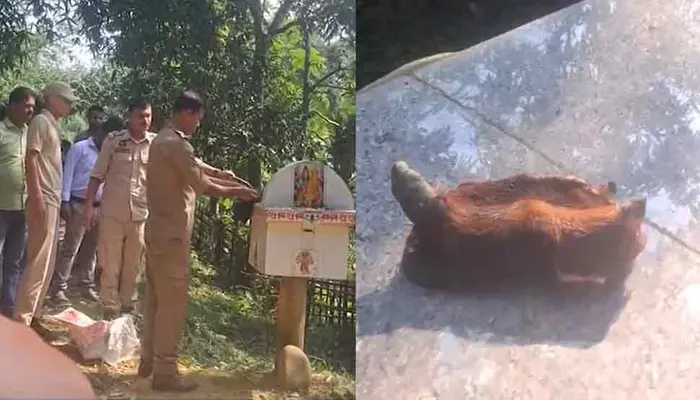
Case Summary
In the Madanpur village under the Ramkrishnanagar subdivision of Sribhumi district (formerly Karimganj), Assam, in a deliberate act of desecration that deeply offended Hindu religious sentiments, a severed cow’s head and other slaughter waste were placed atop the donation box of a Hindu temple. The incident occurred on the morning of 29 May 2026, a day after the Islamic festival of Eid al-Adha (Bakrid). Villagers who arrived at the temple early in the morning found a severed cow's head placed on top of the temple donation box. The object was placed in a prominent position within the temple premises, so that it was visible to the devotees who arrived at the temple. This was viewed by local Hindus as a deliberate act intended to offend Hindu religious sentiments, desecrate a sacred place of worship, and create communal tension in the area. The incident sparked widespread anger among residents, who regarded it as a calculated provocation directed at the Hindu community. News of the discovery spread quickly through the village, drawing local residents and Hindu community members to the site. The donation box, used by devotees for religious offerings, became the focal point of the incident. Villagers informed the police soon after the discovery. Personnel from Ramakrishnanagar Police Station reached the temple at around 10:00 a.m., removed the severed cow's head and other waste materials, and launched an investigation. Additional police personnel were deployed as tensions rose within the area. The incident prompted strong reactions from local Hindu organisations and community leaders, who demanded the identification and arrest of those responsible. Police stated that the matter was being investigated from all angles. At the time of reporting, no perpetrators had been publicly identified and the investigation remained ongoing.
Why it is Hate Crime ?
This case has been added to the tracker under the primary category - Attack on Hindu religious representations. The subcategory selected within this is - Desecration of Hindu religious symbol. Icons and symbols or a religious representation of a spiritual ideal are widely revered in Hinduism. Iconography is of vital significance in the Hindu milieu. It helps connect people’s spiritual beliefs with the real world. Iconography within the Hindu faith takes several shapes and forms. Murtis are of most significance to Hindus, to which daily rituals, prayers and offerings are done. Besides the murtis, there are several other symbols which have deep significance in the Hindu faith – the Om and Swastika for example. Since these Hindu religious symbols hold paramount importance in Hinduism, any desecration of symbols, icons, murtis, religious representations and manifestations, is driven by animosity towards the faith itself which manifests itself through these murtis, icons and symbols. Therefore, any desecration of these Hindu religious symbols and representations is considered religiously motivated hate crimes under this category. The other sub-category selected for this case is - Breaking rules at place of worship. Sanatan Dharma is not a religion of one book, which is to say that while it has religious scriptures that form the central tenets of the faith, there are several traditions followed through thousands of years, mostly passed from generation to generation orally. One of these oral traditions or written traditions is the rules of specific temples. Certain temples have rules which are traditional rules, dependent on the worship of the presiding deities. These rules and traditions have been followed for thousands of years whether they find scriptural mention or not. Such traditions are based on the nature and rules of worship of the presiding deity of that temple. Any non-compliance of these traditions owing to animosity towards the faith or for the sake of activism stems not only from the lack of faith in the presiding deity but also disregard for the faith of the devotees of that deity/temple and implicit bias against the faith, the tradition and the deity itself. Since these specific traditions are central to the faith of the devotees of that specific temple and presiding deity, any non-compliance with these traditional rules would be considered a religiously motivated hate crime. Another sub-category selected for this case is - Defiling religious customs. Sanatan Dharma is not a religion of one book, which is to say that while it has religious scriptures that form the central tenets of the faith, there are several traditions followed through thousands of years, mostly passed from generation to generation orally. There are several such customs and traditions that are followed by various Hindus and Hindu sects. Defiling of these traditions and customs is a breach of an individual or group’s religious practices. Such practices can range from dietary restrictions like not eating non-vegetarian food for a certain period of the year, not eating non-vegetarian food at all, not eating beef since the cow is considered holy in Hinduism, the sanctity of religious customs followed in the house (like many ISCKON devotees), etc. Any malicious action leading to the breach of such traditions or defilement of these traditions owing to animosity towards the faith or for the sake of activism stems not only from the lack of faith in the religion itself but also from disregard for the faith of the devotees who follow the customs/traditions and implicit bias against the faith, the tradition itself. Since these specific traditions are central to the faith of the devotees of that specific sect of Hindus, any non-compliance with these traditional rules would be considered a religiously motivated hate crime. This case qualified as a religiously motivated hate crime because a Hindu place of worship was targeted through the deliberate placement of a severed cow's head on a temple donation box. The act combined the desecration of a sacred Hindu religious symbol with the violation of a Hindu religious site. In Hinduism, the cow holds profound religious, cultural, and spiritual significance and is regarded as sacred by a large section of the Hindu community. The act of placing the severed head of a cow within a temple compound, and specifically atop a donation box used by devotees for religious offerings, transformed an act involving animal remains into a symbolic attack on Hindu religious beliefs and practices. The choice of location ensured that worshippers arriving at the temple would encounter the offensive display, maximising its psychological and emotional impact on the local Hindu community. The act was particularly significant because it involved not only the killing and dismemberment of an animal regarded as sacred, but also its display within a Hindu religious setting. The perpetrators were aware of the sacred status afforded to cows in Hindu belief and chose an object that would maximise shock, distress, and religious offence. The act therefore went beyond ordinary vandalism and amounted to the deliberate degradation of a sacred Hindu symbol in a manner designed to insult Hindu faith and religious sentiment. The conduct amounted to an attack on Hindu religious representations because it targeted a Hindu temple, a sacred space central to Hindu worship and religious identity. By placing a severed cow's head within the temple premises, the perpetrators violated a site of deep religious significance to Hindu devotees. Such acts of desecration are designed to insult, provoke, and humiliate members of the targeted religious community by violating symbols and spaces that they regard as sacred. The use of a severed cow's head, an object that carries particular significance and sensitivity in the Hindu religious context, further heightened the offensive nature of the act. The incident further involved the breaking of the rules governing a place of worship and the defiling of Hindu religious customs. Hindu temples are expected to remain spaces of ritual purity, reverence, and sanctity. The introduction of the remains of a slaughtered cow into a temple environment directly violated these religious expectations. The donation box itself held religious significance as a receptacle for offerings made by devotees as part of their worship. By placing a severed cow's head upon it, the perpetrators contaminated a space associated with prayer, devotion, and religious giving. This act demonstrated complete disregard for the customs and principles that govern Hindu worship. The decision to carry out the act within the temple premises amplified the offence because it ensured that the desecration would occur in a sacred environment central to Hindu religious life. The location was not incidental. It was chosen because the violation of Hindu customs and temple sanctity would cause greater harm to Hindu devotees than if the same act had occurred elsewhere. Taken together, the targeting of a Hindu temple, the desecration of a sacred cow, and the violation of customs governing a place of worship demonstrated a deliberate attack on symbols, beliefs, and spaces that hold special significance within Hinduism. The act derived its impact from the religious identity of the victims and from the sacred status attached to both the temple and the cow. The conduct therefore displayed clear religious hostility directed at Hindu faith, Hindu religious practice, and Hindu community sentiment. Given that this case met the parameters of a religiously motivated hate crime, it was added to the hate crime database of the tracker.


Case Status
Unknown


Perpetrators Details
Perpetrators
Unknown
Perpetrators Range
Unknown
Perpetrators Gender
unknown
 Sources




