Hindu place of worship violated after Muslim man was caught preparing meat inside sacred premises
 Meerut, Uttar Pradesh, India
  27 May, 2026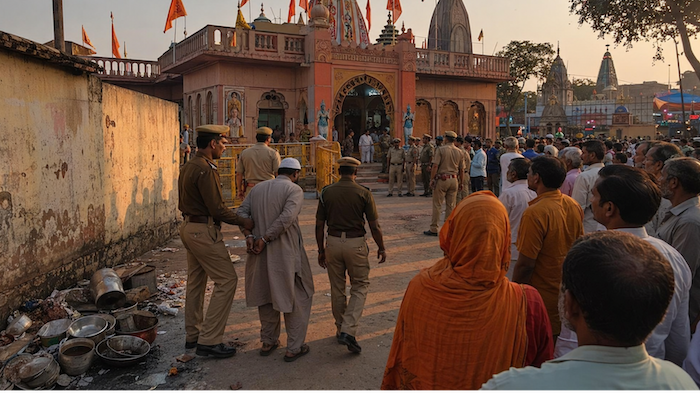
Case Summary
A Hindu place of worship in Meerut, Uttar Pradesh, became the focus of controversy after a Muslim man was found preparing meat within the premises of a Durga temple during the Bakrid period. The incident occurred inside the historic Nauchandi Fair grounds and led to protests by members of the local Hindu community. Police intervened and detained the individual involved. On 28th May 2026, information circulated among local Hindus that meat was being prepared inside the Durga temple situated within the Nauchandi Fair grounds in Meerut. The temple formed part of the fair complex, where several commercial swings had also been installed. One of these swings was operated by Muslim man Gada Khan, a resident of Rajasthan. After receiving information about the incident, members of Hindu organisations, including Narsingh Vahini activists and Kartik workers, reached the temple premises. Information received by community members indicated that a goat had been sacrificed within the temple complex. The matter quickly drew the attention of local Hindus, who gathered at the site. Police officers reached the location and recovered meat from within the temple premises. Gada Khan was taken into custody. Police enquiries found that the meat had been brought into the temple complex from outside and was being prepared for cooking within the premises. The meat was removed and the area was secured. Following the discovery, Hindu activists and local residents staged protests at the temple premises and demanded action. Senior police officers arrived at the scene and engaged with those present to maintain order. Police action followed a complaint submitted by Lalit Sharma, a swing contractor at the fair. City Superintendent of Police Vinayak Gopal Bhosale stated that Gada Khan had been operating a swing within the fairgrounds. Additional officers, including Circle Officer Civil Lines Suchita Singh and Nodal Officer Inspector Jitendra Singh, also reached the location. Gada Khan was detained and legal proceedings were initiated. Authorities stated that he would be produced before the court on 29th May 2026. The investigation remained ongoing.
Why it is Hate Crime ?
This case has been added to the tracker under the primary category - Attack on Hindu religious representations. The subcategory selected within this is - Breaking rules at place of worship. Sanatan Dharma is not a religion of one book, which is to say that while it has religious scriptures that form the central tenets of the faith, there are several traditions followed through thousands of years, mostly passed from generation to generation orally. One of these oral traditions or written traditions is the rules of specific temples. Certain temples have rules which are traditional rules, dependent on the worship of the presiding deities. These rules and traditions have been followed for thousands of years whether they find scriptural mention or not. Such traditions are based on the nature and rules of worship of the presiding deity of that temple. Any non-compliance of these traditions owing to animosity towards the faith or for the sake of activism stems not only from the lack of faith in the presiding deity but also disregard for the faith of the devotees of that deity/temple and implicit bias against the faith, the tradition and the deity itself. Since these specific traditions are central to the faith of the devotees of that specific temple and presiding deity, any non-compliance with these traditional rules would be considered a religiously motivated hate crime. Another sub-category selected for this case is - Defiling religious customs. Sanatan Dharma is not a religion of one book, which is to say that while it has religious scriptures that form the central tenets of the faith, there are several traditions followed through thousands of years, mostly passed from generation to generation orally. There are several such customs and traditions that are followed by various Hindus and Hindu sects. Defiling of these traditions and customs is a breach of an individual or group’s religious practices. Such practices can range from dietary restrictions like not eating non-vegetarian food for a certain period of the year, not eating non-vegetarian food at all, not eating beef since the cow is considered holy in Hinduism, the sanctity of religious customs followed in the house (like many ISCKON devotees), etc. Any malicious action leading to the breach of such traditions or defilement of these traditions owing to animosity towards the faith or for the sake of activism stems not only from the lack of faith in the religion itself but also from disregard for the faith of the devotees who follow the customs/traditions and implicit bias against the faith, the tradition itself. Since these specific traditions are central to the faith of the devotees of that specific sect of Hindus, any non-compliance with these traditional rules would be considered a religiously motivated hate crime. This case qualified as a religiously motivated hate crime because the conduct centred on the desecration of a Hindu religious space and the violation of practices that hold deep religious significance for Hindu devotees. The incident did not occur in a neutral public setting. It took place within the premises of a Durga temple, a sacred site dedicated to Hindu worship. The deliberate choice to bring and prepare meat within a Hindu temple during the Bakrid period demonstrated a disregard for Hindu religious sensitivities and targeted a space that derived its significance specifically from the faith of the Hindu community. The conduct targeted a Durga temple, a sacred site central to Hindu worship and religious identity. By bringing and preparing meat within the temple premises, the perpetrator interfered with a space devoted to Hindu devotion and spiritual practice. The deliberate choice of a Hindu temple rather than a neutral location demonstrated an intent to target a site of particular religious significance to Hindus and undermine its sanctity. One religious marker was the breaking of rules associated with a place of worship. Hindu temples operate within a framework of religious customs and expectations that emphasise ritual purity and reverence. The preparation of meat within a Durga temple directly violated these norms and conflicted with the standards of conduct expected inside a sacred Hindu space. This was not simply a matter of food being present in a public area. The issue was that meat was being prepared within the boundaries of a temple dedicated to Hindu worship, where devotees expected religious traditions and sacred customs to be respected. The decision to carry out such an act inside a temple demonstrated a disregard for the religious rules governing Hindu places of worship. The conduct showed indifference towards Hindu beliefs and targeted a sacred space in a manner that was incompatible with its religious purpose. The other religious marker was the defiling of Hindu religious customs. Hindu devotees attach deep spiritual significance to the sanctity of temples and to the observance of customs associated with worship. The introduction and preparation of meat within a Durga temple conflicted with those customs and undermined the religious environment that devotees sought to preserve. The act was religiously significant because it involved conduct that many Hindus would regard as fundamentally incompatible with the sanctity of a temple dedicated to a Hindu deity. By choosing to engage in such activity within the temple premises, the perpetrator disregarded the customs and values that governed the space. The act therefore did not merely violate local expectations but directly challenged the religious norms observed by Hindu worshippers, causing harm that derived from the temple's sacred status and its importance to the Hindu community. Taken together, the choice of a Hindu temple as the location, the violation of the religious norms governing a place of worship, and the disregard shown towards customs central to Hindu devotional practice demonstrated that the incident was not religiously neutral. The conduct targeted a sacred Hindu space in a manner that maximised offence to Hindu devotees and interfered with the sanctity attached to Hindu worship. The religious significance of the location was central to both the impact of the act and the choice of target. Given that this case met the parameters of a religiously motivated hate crime, it was added to the hate crime database of the tracker.


Case Status
Arrested


Perpetrators Details
Perpetrators
Muslim Extremists
Perpetrators Range
One Person
Perpetrators Gender
male
 Sources




