Hindu families coerced to convert through inducements and denigration of Hinduism; threatened with death for not complying
 Udham Singh Nagar, Uttarakhand, India
  9 May, 2026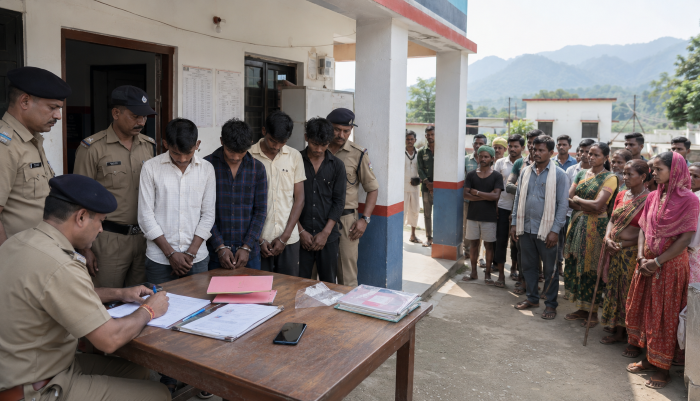
Case Summary
A Christian conversion network operating in Khatima and Nanakamatta areas, Udham Singh Nagar district, Uttarakhand, was systematically targeting economically vulnerable Hindu families, Tharu community members, and Scheduled Caste individuals with financial inducements of Rs 6,000 per month and a lump sum of Rs 2 lakh to convert to Christianity. Those who refused were threatened with violence against themselves and their children. Four members of the network were arrested following complaints filed by two Hindu victims. As per details, the network had been operating for a sustained period, approaching poor Hindu families and exploiting their financial difficulties and illnesses as entry points for conversion. The network promised Rs 6,000 per month and a lump sum of Rs 2 lakh as inducements to convert to Christianity. It further assured prospective converts that adopting Christianity would cure their illnesses, resolve family problems, and eliminate financial difficulties. Prayer meetings were organised at which denigrating and misleading statements about Hinduism were made, Christian books were distributed, and participants were psychologically prepared for conversion. Those who refused or threatened to inform others were warned of serious consequences. On 10 May 2026, Khatima resident Rampal filed a complaint at Khatima Kotwali stating that Jay Singh Rana, Draupadi Rana, and Pastor Sunil George were continuously targeting Tharu-majority villages and poor Scheduled Caste families for conversion. On 23 May 2026, a Hindu woman filed a complaint stating that her husband, Sandeep Singh Rana, Kamaljit Singh, and Dan Singh Rana were pressuring her to forcibly adopt Christianity, abusing her upon refusal, and threatening to kill her and harm her children. SSP Udham Singh Nagar, Ajay Ganapati, confirmed that special police teams were constituted under the supervision of SP Rudrapur and the Circle Officer, Khatima. Raids and search operations led to the arrest of Dan Singh Rana, Jay Singh Rana, Draupadi Rana, and Pastor Sunil George alias Sunil George Masih. A mobile phone recovered from Dan Singh Rana contained significant evidence, including photographs and videos of prayer meetings, material related to conversion through baptism, screenshots of financial transactions, documents setting conversion targets, and audio recordings. A conversation related to calling the complainant's husband about the children's Aadhaar cards and other documents was also found on the mobile. Four cases were registered. The arrested individuals were being produced before the court, and further investigation was underway. Additional named suspects were being searched for at the time of publication.
Why it is Hate Crime ?
The primary category for this case is "Predatory Proselytisation". The sub-category for this case is "Conversion/attempts to convert by inducement". Predatory Proselytisation is not just limited to threat, harassment, force and violence, but it also has contours of stealth. In several cases, the Hindu victim is exploited to convert, with non-Hindus taking advantage of their poverty. In such cases, the Hindu victim who is suffering financially is offered monetary benefits, including lucrative offers for jobs, health treatment, education, etc, to induce the victim into changing his/her religion. In such cases, the religious identity of the victim and the aim to disenfranchise him from his faith form the heart of the crime. Also, taking advantage of and exploiting an individual’s economic vulnerabilities is widely acknowledged as exploitation, forms of which are often penalised by law. Such cases therefore are considered religiously motivated hate crimes since the victim’s religious identity forms the very heart of the crime itself. Another sub-category for this case is "Harassment, threats, coercion for conversion". Harassment covers a wide range of behaviours of an offensive nature. It is commonly understood as behaviour that demeans, humiliates, and intimidates a person, including threats and coercion. Harassment and threats, in this case, find their root on discriminatory grounds which has the effect of nullifying a person’s rights or infringing upon his freedom to exercise his right specifically owing to the victim’s religious identity. Verbal and physical threats and psychological or physical harassment are often used against Hindu victims because they choose to practice their professed religion. Religious harassment also includes forced and involuntary conversions by harassment, threats or coercion. Coercion includes intimidatory tactics like force-feeding a Hindu victim beef to convert to another religion, forceful circumcision etc. In several cases documented, non-Hindu perpetrators or those who harbour specific animosity towards Hinduism, harass victims simply based on their religious identity. Such cases often also include harassment to ensure the Hindu victim abandons his/her professed religion and adopts the religion of the perpetrator. Such cases where Hindu victims are harassed to convert to the perpetrator’s religion are rooted in animosity towards the victim’s religious identity and are therefore documented as religiously motivated hate crimes. One other sub-category for this case is "Attempting to convert/converting by denigrating Hinduism". In several cases, Hindus are converted or an attempt is made to convert Hindus by denigrating their faith, Hinduism. In such cases, the Hindus associate with the non-Hindu perpetrators often by choice and then, the attempt to convert them by insulting their faith, showing the faith down etc begins. An example of this would be a non-Hindu gathering where the Hindus are attending the gathering of their own free will. However, once they attend the gathering, there is an explicit attempt to convert them by abusing their faith and hailing the faith of the perpetrator. The denigration of the Hindu faith is often based on misrepresentation of the Hindu faith, its doctrine and scriptures and insult to espoused traditions if not blatant lies about Hindu beliefs and ways. Such conversions or attempts at conversions are driven by animosity towards the Hindu faith and are therefore documented as religiously motivated hate crimes. The conversion network operating in Khatima and Nanakamatta was not a collection of individual missionaries making informal religious appeals. It was a structured and resourced organisation with documented conversion targets, financial transaction records, a defined methodology, and a geographic focus on the most economically and socially vulnerable Hindu communities in the area. The mobile phone recovered from Dan Singh Rana contained photographs and videos of prayer meetings, baptism-related conversion material, screenshots of financial transactions, documents setting conversion targets, and audio recordings. An organisation that sets conversion targets and maintains financial transaction records is not conducting a spiritual ministry. It is running a conversion operation with measurable objectives and institutional accountability for results. The targeting methodology reflects a deliberate exploitation of multiple dimensions of vulnerability simultaneously. The network did not approach economically stable Hindu families. It specifically identified the Tharu community, Scheduled Caste families, and those experiencing illness and financial difficulty as its primary targets. For each category of vulnerability, a corresponding inducement was deployed: Rs 6,000 per month and a lump sum of Rs 2 lakh for financial vulnerability, promises of medical healing for health vulnerability, and promises of resolution of family problems for social vulnerability. The simultaneous deployment of multiple inducements calibrated to specific vulnerabilities reflects an operational sophistication that goes beyond individual missionary activity and reflects an institutionally designed conversion programme. The denigration of Hinduism at prayer meetings is a significant and deliberate religious marker. The network did not merely present Christianity as an attractive alternative. It made misleading and insulting statements about Hinduism specifically to undermine the participants' attachment to their faith before the conversion demands were made. The denigration of the victim's existing faith is not incidental to the conversion methodology. It is integral to it. By attacking the religious identity the target currently holds, the network sought to create a psychological vacuum that the financial inducements and Christian material could then fill. This reflects a conversion methodology that treats Hindu religious identity as an obstacle to be dismantled rather than a faith to be respected. The death threats directed at those who refused conversion and the threats to harm their children establish the coercive enforcement mechanism of the network. The network did not merely offer inducements and accept refusals gracefully. It deployed threats of lethal violence against individuals and their children when the inducements failed to secure compliance. The combination of financial inducement as the entry point and death threats as the retention mechanism reflects a conversion operation in which vulnerable Hindu individuals were offered a transaction and threatened with violence if they declined it. This is not religious outreach. It is organised religious coercion. Given that this case met the parameters of a religiously motivated hate crime, the network's conduct reflected more than the exercise of religious freedom or charitable activity. By systematically targeting the most economically and socially vulnerable Hindu communities in Khatima and Nanakamatta with financial inducements, denigrating Hinduism at organised prayer meetings to undermine Hindu religious identity, psychologically preparing targets for conversion through sustained indoctrination, and threatening death and harm to children when inducements failed, the network demonstrated a deliberate and institutionally organised campaign to remove Hindu individuals from their faith through the exploitation of their most acute vulnerabilities. The Hindu families of Udham Singh Nagar were targeted specifically because they were Hindu and because their poverty, illness, and social vulnerability made them accessible to a conversion methodology that treated their faith as a commercial transaction to be completed through inducement or enforced through violence. This reflects an underlying hostility toward Hindu religious identity that cannot be characterised as anything other than religiously motivated. Given that this case met the parameters of a religiously motivated hate crime, it was added to the hate crime database of the tracker.


Case Status
Arrested


Perpetrators Details
Perpetrators
Christian Extremists
Perpetrators Range
From 5 to 10
Perpetrators Gender
male
 Sources




