500 Hindu residents pressured to convert to Christianity under pretext of 'curing illnesses' in Naigaon, Maharashtra
 Palghar, Maharashtra, India
  24 May, 2026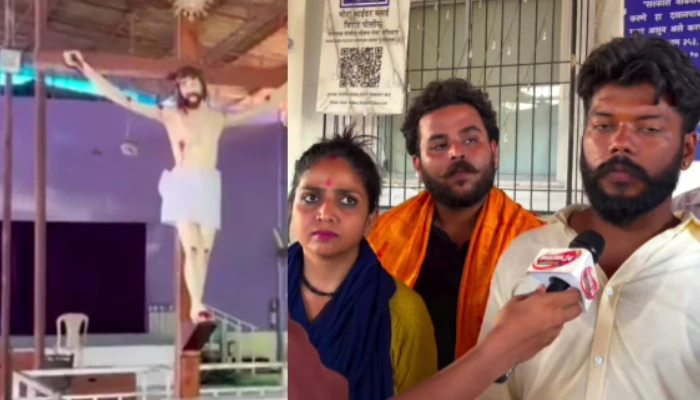
Case Summary
In the Majipada locality of Naigaon, situated in Palghar district of Maharashtra, a large-scale attempt was made to convert Hindus to Christianity through missionary activities. Around 400–500 Hindus were targeted by missionaries who lured them to attend prayer meetings and told them that converting to Christianity would help cure their illnesses. Hindu female participants were also told that attending the prayer meetings would help them conceive children. According to media reports, the Christian missionaries were running a prayer gathering called the "Ashish Prathana Sabha". It was organised from a temporary structure that had been built through illegal encroachment. On the day of the incident, the Christian missionaries had gathered nearly 400–500 people, comprising both men and women, where Hindus were subjected to efforts to convert them to Christianity during the prayer meetings. Hindu organisations reached the spot and protested against the activities. However, police personnel present at the location were assisting the Christian perpetrators in leaving the premises instead of supporting the Hindu victims. Hindu activists stated that vulnerable individuals were told that their illnesses, including cysts and stomach ailments, would be cured through conversion. Hindu women who were struggling to conceive were also told that attending the prayer meetings would help them become pregnant. A Hindu male participant stated that he had been suffering from a serious illness and frequently vomited blood. He said that he had been persuaded to attend the prayer meetings on the promise that his illness would be cured, after which he believed that his condition had improved. He further stated that a female pastor named Vandana Kamble conducted the prayers. Hindu activists stated that such activities had been taking place for the past four years (2022). They further said that several complaints had previously been submitted to the police, but no action had been taken. Regarding the present incident, workers of Bajrang Dal submitted a complaint to the police, following which an investigation was initiated. The police stated that within 15 days, the illegally encroached structure where the prayer meetings were being conducted would be demolished and that further legal action would be taken against those responsible.
Why it is Hate Crime ?
This case has been added to the tracker under the primary category- Predatory Proselytisation. The subcategory selected is- Proselytisation by grooming, brainwashing, manipulation or subtle indoctrination. The subcategory selected is- Pattern of targeting Hindus. Religious brainwashing essentially means the often subtle and forcible indoctrination to induce someone to give up their religious beliefs to accept contrasting regimented ideas. Religious grooming or brainwashing also involves propaganda and manipulation. It involves the systematic effort, driven by religious malice and indoctrination, to persuade “non-believers’ to accept allegiance, command, or doctrine to and of a contrasting faith. Cases of such grooming or brainwashing are far more nuanced than direct threats, coercion, inducement and violence. In such cases, it is often seen that there is repeated, subtle and continual manipulation of the victim to induce disaffection towards their own faith and acceptance of the contrasting faith of the perpetrator. While subtle indoctrination is widely acknowledged as predatory, an element which is often understated in such conversions or the attempts of such conversion is the role of loyalty and trust which might develop between the perpetrator and the victim. Fiduciary relationships are often abused to affect such religious conversion. For example, an educator transmitting religious doctrine of a competing faith to a Hindu student. The Hindu student is likely to accept what the teacher is transmitting owing to existence of the fiduciary relationship. The exploitation of the fiduciary relationship to religiously indoctrinate victims would also be included in this category. Since the underlying animosity towards the victim’s faith forms the basis of predatory proselytization, such cases are considered religiously motivated hate crimes. The other subcategory selected is- Conversion/attempts to convert by inducement. Predatory Proselytisation is not just limited to threat, harassment, force and violence, but it also has contours of stealth. In several cases, the Hindu victim is exploited to convert, with non-Hindus taking advantage of their poverty. In such cases, the Hindu victim who is suffering financially is offered monetary benefits, including lucrative offers for jobs, health treatment, education, etc, to induce the victim into changing his/her religion. In such cases, the religious identity of the victim and the aim to disenfranchise him from his faith form the heart of the crime. Also, taking advantage of and exploiting an individual’s economic vulnerabilities is widely acknowledged as exploitation, forms of which are often penalised by law. Such cases therefore are considered religiously motivated hate crimes since the victim’s religious identity forms the very heart of the crime itself. This case is a clear example of a religiously motivated hate crime because Hindus were specifically targeted for Christian proselytisation under the pretext of attending prayer meetings. Around 400–500 Hindus were gathered and persuaded to attend Christian prayer meetings, where they were told that converting to Christianity would cure illnesses and solve personal hardships. Hindu women who were struggling to conceive were also promised that attending the prayer meetings would help them become pregnant. The nature of the conversion efforts and the wider impact on the Hindu community all indicate a targeted action against Hindus as a collectivity. When individuals or groups focus their efforts on converting members of a particular religion, in this case, Hindus, then it demonstrates a fundamental disregard for the Hindu faith. Conversion, especially when not based on personal conviction but rather on external persuasion or pressure, is not simply about sharing a different belief system. It is an attempt to undermine the values, traditions, and identity of the Hindu community. In this context, the Christian perpetrators specifically targeted Hindus, which suggests a lack of respect for Hinduism and its followers. Such actions are carried out to strip Hindu victims of their faith, making it a religiously motivated crime. Hindus were deliberately targeted by the accused under the guise of attending prayer meetings. A prayer meeting is ordinarily understood to be a gathering for worship and spiritual reflection. However, in this case, the prayer meetings were used as a means to attract vulnerable Hindus, including women, by promising solutions to deeply personal concerns, including difficulties in conceiving children. Rather than serving solely as a place of worship, the gatherings became a platform through which Christian religious teachings were promoted with the objective of encouraging conversion. The deliberate targeting of Hindu women on the basis of their vulnerabilities, coupled with the focus on converting members of a specific religious community, highlights the religiously motivated character of this hate crime. The perpetrators also targeted vulnerable Hindus through manipulation and inducement tactics designed to encourage religious conversion. Hindu individuals suffering from illnesses were told that their health problems would be cured if they converted to Christianity and participated in the prayer meetings. Similarly, Hindu women who were unable to conceive children were informed that attending the gatherings and embracing Christianity would help them become pregnant. These promises were directed at individuals facing significant personal hardships and vulnerabilities. By exploiting fears, anxieties, and deeply personal struggles, the accused sought to create a sense of dependence on the conversion process as a solution to their problems. Such conduct demonstrates an attempt to influence Hindus to abandon their existing faith by appealing to their vulnerabilities rather than allowing them to make a genuinely free and informed religious choice. The deliberate targeting of vulnerable Hindus for conversion in this manner underscores the religiously motivated nature of the incident. The promises of curing illnesses and enabling conception also functioned as inducements. These assurances were presented as benefits that could be obtained through participation in the prayer meetings and eventual conversion to Christianity. Rather than addressing the victims' suffering through genuine medical or social support, the inducements were linked to religious conversion. By attaching promises of relief, healing, and personal fulfilment to the adoption of a different faith, the accused attempted to influence religious decisions through external incentives. Such inducement-based conversion efforts undermine the principle that religious belief should arise from personal conviction and free choice. Consequently, the conduct is an infringement upon the religious autonomy of the Hindu victims and an attempt to persuade them to abandon their existing faith identity. Such instances of forced or coercive conversion violate an individual's religious autonomy and dignity. Every person possesses the right to freely practise, retain, or change their religion without pressure, manipulation, or inducement. When vulnerable Hindu individuals are targeted on account of their religious identity and encouraged to renounce their faith through promises of material, physical, or personal benefits, their freedom of conscience is compromised. The actions described in this case were directed specifically towards Hindus and sought to persuade them to discard their existing religious beliefs in favour of the Christian faith. Such conduct showcases disregard for the victims' religious identity and their right to maintain their faith without external pressure, thereby contributing to the religiously motivated character of the incident. According to statements made by Hindu activists, such conversion-related activities had been taking place in the area for nearly four years. They further stated that several complaints had previously been submitted to the authorities, yet the prayer meetings and conversion efforts continued. The present incident, in which around 400–500 Hindus were gathered and exposed to conversion attempts, is part of a continuing pattern rather than an isolated occurrence. The repeated targeting of Hindus through prayer meetings, coupled with promises of healing from illnesses and assistance with conception, demonstrated a sustained effort to influence members of a specific religious community to abandon their faith and adopt Christianity. The scale of the operation and its continuation over several years highlighted the organised nature of the activities. The fact that hundreds of Hindus were gathered for these activities indicates that the conversion efforts were not directed at random individuals but at a particular religious community. The sustained and organised targeting of Hindus over an extended period underscores the religiously motivated character of the incident and suggests a deliberate attempt to expand conversion activities and change the religious demographics of that locality. These instances of targeted proselytisation activities stem from inherent hostility towards the victims' professed faith since Abrahamic faiths believe that any non-adherent to their faith is subject to being dehumanised till they convert, making it a religiously motivated crime against Hindus. Therefore, this case is being added to the hate crime database of the Hinduphobia Tracker. Disclaimer: Media reports stated that around 400-500 Hindus, comprising both men and women, were gathered at the prayer meeting in Majipada, Naigaon, Palghar district, Maharashtra, where conversion efforts were taking place. However, no gender-wise breakdown of the participants was provided in the available sources. For documentation clarity, the Hinduphobia Tracker has recorded the upper estimate of 500 victims and has applied a proportional demographic estimate based on India’s Census 2011 and National Family Health Survey-5 (2019–21) population data. Accordingly, the 500 participants are estimated as 250 men (50%) and 250 women (50%), reflecting an equal gender distribution in the absence of specific demographic information. The exact date of the incident at the Ashish Prarthana Sabha prayer meeting in Majipada, Naigaon, Palghar district, Maharashtra, was not specified in the available sources. The media reports concerning the incident were published on 25 May 2026. The Hinduphobia Tracker records incident dates based on when the crime occurred rather than when it was reported in the media. However, since the exact date of the incident was not clarified in the available reports, 25 May 2026 has been selected as the indicative incident date for documentation purposes only. The total number of perpetrators involved in the conversion activities was not specified in the available sources. While multiple missionaries and organisers were mentioned, only one individual, a female pastor named Vandana Kamble, was specifically identified by name. Therefore, the perpetrator count has been recorded as one, referring solely to Vandana Kamble. This represents a conservative estimate based on the information presently available and has been recorded for documentation purposes only.
Victim Details
Total Victim
500
Deceased
0
Gender
- Male 250
- Female 250
- Third Gender 0
- Unknown 0
Caste
- SC/ST 0
- OBC 0
- General 0
- Unknown 500
Age Group
- Minor 0
- Adult 0
- Senior Citizen 0
- Unknown 500


Case Status
Complaint filed


Perpetrators Details
Perpetrators
Christian Extremists
Perpetrators Range
One Person
Perpetrators Gender
female
 Sources




