Hindu sentiments outraged after polythene bag filled with meat dumped outside a Hindu home on Eid al-Adha in Ujjain
 Ujjain, Madhya Pradesh, India
  27 May, 2026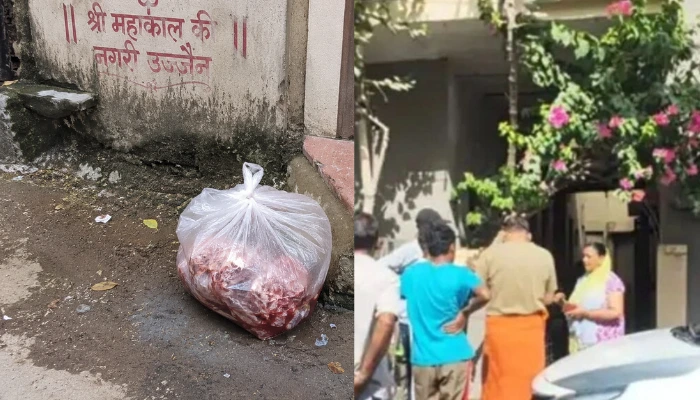
Case Summary
In Ujjain, Madhya Pradesh, Hindu sentiments were outraged after pieces of meat were found dumped outside the home of a Hindu family. The incident occurred on Thursday morning (28 May 2026), the day of Eid al-Adha (Bakrid). According to media reports, locals called for action, describing it as an attempt to harass Hindus on the occasion of Eid. Snehlata Gupta, a resident of Gandhinagar, said that she had cleaned the area outside her house as usual that morning. When she returned a short while later, she saw pieces of meat lying in a polythene bag near the gate. Upon seeing this, she immediately alerted her neighbours. A crowd of people quickly gathered at the scene, and the police were informed. Upon receiving the information, the police arrived at the scene and brought the situation under control. The police recorded statements from nearby residents and began examining CCTV footage from the area. Hindu locals stated that some miscreants had carried out the act deliberately to create religious tensions and disturb the law-and-order situation. Meanwhile, Town Inspector Vivek Kanodia said that the matter was under investigation. He raised suspicion that the pieces of meat could have reached the location through a bird or animal. The police continued to investigate the matter while increasing surveillance in the area.
Why it is Hate Crime ?
The primary category selected in this case is- Attack not resulting in death. The subcategory selected is- Attacked for Hindu identity. In several cases, Hindus are attacked merely for their Hindu identity without any perceived provocation. A classic example of this category of religiously motivated hate crime is a murder in 2016. 7 ISIS terrorists were convicted for shooting a school principal in Kanpur because they got ‘triggered’ seeing the Kalava on his wrist and tilak that he had put. In this, the Hindu victim had offered no provocation except for his Hindu religious identity. The motivation for the murder was purely religious, driven by religious supremacy. Such cases where Hindus are targeted merely for their religious identity would be documented as a hate crime under this category. This incident is a clear case of a hate crime because a polythene bag containing pieces of meat was dumped outside the home of a Hindu family in Ujjain on the day of Eid al-Adha (Bakrid), a festival during which animal sacrifice (Qurbani) is a widely practised religious tradition within the Muslim community. Local Hindus also stated that the act was carried out with the intention of troubling and provoking Hindus on the occasion of Eid. The timing of the incident, the nature of the material involved, and the selection of a Hindu household together demonstrate that the act was intended to offend religious sentiments and target the family because of their faith. It is important to note that during Eid al-Adha, animal sacrifice, or Qurbani, is a common religious practice. In this context, the dumping of a polythene bag filled with meat outside a Hindu home takes on a particular significance. Many Hindus regard meat as impure, especially in religious and devotional contexts, and consider contact with such material to be a form of ritual defilement. The fact that a Hindu household was singled out suggests a deliberate act directed at a family because of its religious identity. Such conduct can be interpreted as an attempt to cause distress, hurt religious sentiments, and create a sense of intimidation during a major Islamic festival. The circumstances of the incident naturally showcase that the act was intended to provoke outrage and inflame communal tensions. Acts involving the placement of religiously sensitive items outside places associated with a particular faith often carry symbolic meaning and are used to insult or intimidate members of that community. The act of meat being placed outside the Hindu family's home amounts to a deliberate attempt to desecrate a space regarded as sacred by its occupants and to cause maximum emotional and religious offence. For this reason, this case fits the characteristics of a hate-motivated act. The police suggested that the meat may have reached the location through a bird or animal. However, it is important to consider that if this explanation were true, one would ordinarily expect the meat and the packaging to have been torn and scattered around. Instead, the pieces of meat were found contained within a polythene bag outside the gate of a Hindu family's home. The fact that the meat was found in a polythene bag and deposited at a specific location strongly indicates deliberate human intervention rather than an accidental occurrence involving an animal or bird. This points towards a conscious act of placing the meat outside the residence. While the investigation was ongoing, these circumstances strongly demonstrated that the act was directed at the Hindu family because of their religious identity, further reinforcing the view that the incident bore the characteristics of a hate-motivated crime intended to hurt Hindu sentiments and provoke communal outrage. The police's suggestion that a bird or animal may have been responsible for the meat reaching the location showcases an attempt to minimise and whitewash the seriousness of the incident rather than examining the possibility of deliberate religious targeting. By advancing an explanation that is inconsistent with the reported circumstances, the authorities were overlooking the religious dimensions of the case. Such responses downplaying acts bear clear indicators of religious hostility. Additionally, the police, in many such cases, where the motive behind the crime is obvious but not explicitly mentioned, deny that the crime committed was in any way motivated by a religious bias or say that there was ‘no communal angle’ to the crime. Several factors are generally at play here. Many a time, the police downplay incidents of low-level communal crime because it is their jurisdiction that comes under question. The police also often say that there was ‘no communal angle’ to a crime when there was one because they wish to ensure that, owing to the crime already committed, there is no further flare-up in the area. However, only a police statement, for instance, cannot be enough to determine whether there is a communal angle present in the crime that has been committed. In fact, to determine whether the crime is communal in nature or not, we need to give emphasis to the ground realities. For example, in the case of Rinku Sharma, the Bajrang Dal activist who was mercilessly stabbed in his house in front of his family members in Delhi’s Mangolpuri area in the year 2021, the leftist media and the leftist ecosystem had tried to peddle that there was no communal angle to the crime. Even the police denied that the crime was communal in nature. However, Opindia, a news portal, spoke to several people who were on the ground with the family of Rinku Sharma, and they were told that the communal tension in the area was palpable. The family of Rinku Sharma stated that the Muslims of the area held a grudge against Rinku ever since he celebrated the Ram Mandir verdict Like the case of Rinku Sharma, those cases where even if the police have denied a communal angle or the leftist media have gone on an overdrive to peddle the ‘no communal angle’ trope, the ground reality, like the victim’s family or relative's testimonies, make it clear that there was an obvious religious bias that led to the crime, will be documented in this tracker. Going by the same logic, since local residents, along with the victim Hindu family, stated that the act was carried out to target and harass Hindus in the area, the incident is being recorded as a hate crime. Therefore, it is being included in the hate crime database of the Hinduphobia Tracker. Disclaimer: In this case, although an entire Hindu family was affected as the incident occurred outside their home, the total number of family members was not specified in the available information. Only Snehlata Gupta was specifically identified by name. Therefore, the victim count has been recorded as one, referring solely to Snehlata Gupta.
Victim Details
Total Victim
1
Deceased
0
Gender
- Male 0
- Female 1
- Third Gender 0
- Unknown 0
Caste
- SC/ST 0
- OBC 0
- General 1
- Unknown 0
Age Group
- Minor 0
- Adult 1
- Senior Citizen 0
- Unknown 0


Case Status
Unknown


Perpetrators Details
Perpetrators
Unknown
Perpetrators Range
Unknown
Perpetrators Gender
unknown
 Sources




