Hindu couple brutally attacked by Muslims for playing Hanuman Chalisa in 'Muslim area' of Dehradun
 Dehradun, Uttarakhand, India
  21 March, 2026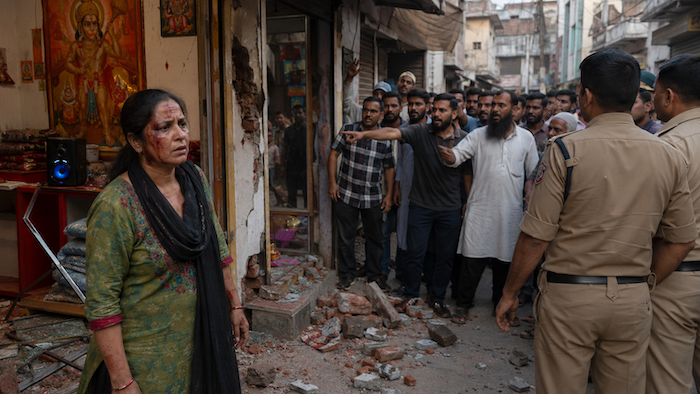
Case Summary
A Hindu woman running a boutique in Dehradun, Uttarakhand, faced sustained harassment, intimidation, and violence after playing Hanuman Chalisa and Hindu devotional songs at her shop. For weeks, she was pressured by neighbouring Muslim shopkeepers to stop playing Hindu prayers. The dispute escalated into threats, physical assault, and a violent attack that left her injured. The Hindu victim, identified as Hema, operated a boutique in the Mandakini Vihar area under Raipur police station limits in Dehradun. According to the events described by the victim and her family, tensions began approximately one and a half months before the attack. During this period, Muslim neighbours repeatedly objected to the playing of Hanuman Chalisa, bhajans, and other Hindu devotional content at her shop and claimed it to be 'their area', alias 'Muslim area'. The Hindu woman stated that members of two Muslim families regularly approached her and instructed her to stop reciting Hanuman Chalisa and singing bhajans. They expressed hostility towards the devotional practices and repeatedly pressured her to discontinue them. As the pressure continued, the Hindu victim reduced the volume of the bhajans in an effort to avoid confrontation. Despite this, the objections continued. When concerns were raised with the family members of those involved, the Hindu woman was told that there was no reason for her to continue playing bhajans if they were disturbing others. The dispute gradually expanded beyond objections to volume and became centred on the Hindu woman’s continued practice of openly playing Hindu devotional content within her business premises. The victim stated that she was repeatedly subjected to mental harassment and intimidation. During this period, members of the Muslim families continued approaching her shop and attempted to pressure her into changing her behaviour. The Hindu woman stated that she was told multiple times that either she or her husband would be made to comply with their demands. She described these encounters as repeated efforts to control how she conducted herself and what religious practices she followed inside her own workplace. By 6th May 2026, the situation escalated further. The Hindu woman was unwell and remained at her shop while her husband was away in Uttarkashi for work. During his absence, members of the Muslim family again approached her. The victim stated that she was confronted and pressured regarding the playing of Hanuman Chalisa and other devotional content. The interactions continued throughout the day and were accompanied by repeated visits and communications involving members of the neighbouring Muslim family. Later that day, after her husband returned, further confrontations took place. The Hindu woman and her husband stated that one of the Muslim women involved became aggressive and declared that she would "teach" them how to live. The dispute rapidly intensified. The Hindu victim stated that she was threatened, verbally abused, and surrounded by members of the neighbouring Muslim family. As tensions escalated, additional individuals arrived at the location. According to the Hindu woman and her husband, several Muslim individuals gathered near the boutique after being informed about the confrontation. The Hindu family stated that the gathering occurred shortly before the violence began. The attack then turned physical. The Hindu woman stated that members of the Muslim family, including relatives who had arrived at the scene, assaulted her and targeted her with bricks and stones. During the attack, she was struck with a brick and lost consciousness. She sustained injuries as a result of the assault. The violence continued until others intervened and came to her assistance. The Hindu family stated that the confrontation arose directly from objections to the playing of Hanuman Chalisa, bhajans, and other expressions of Hindu religious practice. They described a prolonged pattern of pressure, intimidation, and hostility directed at the Hindu woman because she continued engaging in Hindu devotional activities at her shop despite repeated demands that she stop. Following the attack, the matter was reported to the police. A case was registered at Raipur police station against multiple individuals, including Saniya Khan, Ishaan Khan, Sayeed Ahmed, and Rifakat Ali. Proceedings were initiated under the relevant legal provisions, and an investigation was commenced. The police subsequently began examining the circumstances surrounding the harassment, threats, and assault reported by the Hindu victim and her family.
Why it is Hate Crime ?
This case has been added to the tracker under the primary category - Attack not resulting in death. Within this, the subcategory selected for this case is - Attacked for Hindu identity. In several cases, Hindus are attacked merely for their Hindu identity without any perceived provocation. A classic example of this category of religiously motivated hate crime is a murder in 2016. 7 ISIS terrorists were convicted for shooting a school principal in Kanpur because they got ‘triggered’ seeing the Kalava on his wrist and tilak that he had put. In this, the Hindu victim had offered no provocation except for his Hindu religious identity. The motivation for the murder was purely religious, driven by religious supremacy. Such cases where Hindus are targeted merely for their religious identity would be documented as a hate crime under this category. The other sub-category selected for this case is - Attacked for crossing 'Muslim area'. One of the reasons that Hindus get attacked unprovoked specifically by Islamists is for crossing ‘Muslim areas’. Essentially, Muslim mobs often attack Hindus crossing or present in certain areas which have a majority Muslim population. It has often been cited as one of the reasons to blame Hindus for attacks against themselves, signalling that Hindus displaying religious symbols, taking our religious processions or crossing any area which is dominated by Muslim residents is a provocation in and of itself. These areas are mostly ghettoized areas where mobs mobilize quickly to attack Hindus for a variety of reasons like playing music during a religious procession, crossing a mosque, wearing a tilak or any other religious symbol in a Muslim-dominated area, praying at a local temple in that area etc. There have been cases where the few local Hindus of that area have been attacked on their way to the Temple for prayers as well, simply because the area is considered a Muslim-dominated area. Several times, it is entirely possible that the immediate trigger for the violence against Hindus was non-religious in nature, however, the violence became religiously motivated in nature because the area was Muslim dominated and the residents on the whole harboured animosity towards Hindus, evidenced from the actions of the mob, the slogans, and the nature of the attack. Such crimes are motivated by the religious identity of the victims and are therefore classified as hate crimes under this category. This case qualified as a religiously motivated hate crime because the attack on the Hindu woman was intrinsically linked to her visible Hindu identity and her practice of Hindu religious customs. The hostility began not because of any personal dispute but because she openly played Hanuman Chalisa, bhajans, and devotional music associated with her faith. Even after she reduced the volume in an effort to avoid conflict, the harassment continued, demonstrating that the objection was not genuinely about noise but about the very presence and expression of Hindu religious practices. The Muslim perpetrators repeatedly targeted her for engaging in acts of Hindu worship that formed a normal part of her daily life, showing clear intolerance towards the public expression of Hindu faith. The religious nature of the targeting became even more apparent through the sustained efforts to pressure the Hindu woman into abandoning these practices. She was repeatedly told to stop playing Hanuman Chalisa and singing bhajans, while comments were made questioning why such devotional practices should continue at all. This reflected an attempt to suppress Hindu religious expression and discourage the victim from openly practising her faith. The hostility was directed not merely at the individual but at the religious activities that identified her as Hindu. By targeting devotional recitations, prayers, and expressions of faith, the perpetrators effectively targeted a core aspect of the victim’s religious identity. The violence that followed further reinforced the religious motivation behind the attack. The Hindu woman was threatened, confronted, pelted with stones and bricks, and physically assaulted after refusing to abandon her religious practices. The fact that the hostility arose merely because Hanuman Chalisa was being played is a critical factor in understanding the nature of the incident. Hanuman Chalisa is a revered Hindu devotional hymn, and the act of assaulting Hindu individuals solely for playing or listening to it demonstrates hostility not towards any unlawful act, but towards a visible expression of Hindu faith itself. When violence is directed at individuals merely for engaging in a peaceful religious practice, it reflects religious intolerance and animosity towards that community's beliefs and identity. During the confrontation, statements were made that she would be “taught how to live”, a phrase carrying particular significance in the context of ongoing objections to her Hindu worship. The statement was not simply a threat of violence but conveyed an intention to impose behavioural expectations upon a Hindu woman whose way of life, religious practices, and devotional activities had already been singled out for hostility. The attack, therefore, functioned as both physical punishment and intimidation directed at a Hindu woman who refused to alter her religious conduct. By seeking to stop the playing of Hanuman Chalisa through threats and violence, the perpetrators effectively attempted to suppress the open expression of Hindu faith, demonstrating a clear element of religious hostility and making the attack far more than an ordinary neighbourhood dispute. The incident also carried clear markers of religiously motivated territorial exclusion. The repeated assertions that the locality was effectively a Muslim area where Hindu devotional practices were unwelcome reflected a mindset of religious supremacy in which members of one faith attempted to dictate the acceptable religious behaviour of those belonging to another. Notably, Muslims often consider areas near mosques, dargahs, or localities where their community forms a majority as "Muslim areas." This reveals a disturbing sense of Islamic supremacy on the part of the attackers, who viewed the area near the Muslim-owned shop as an exclusive zone where non-Muslims, particularly Hindus, were unwelcome. The objection was not confined to a particular action but extended to the broader presence of Hindu religious expression within the locality. By seeking to silence Hindu prayers and devotional music, the perpetrators implicitly treated the area as a space where Hindu religious identity should be restricted or concealed. This demonstrated an effort to control how Hindus lived within the neighbourhood and to establish informal religious dominance over public and social life. The message conveyed to the Hindu family was that their ability to openly practise their faith depended upon the approval of members of the Muslim community. The assault on the Hindu victims was motivated by this exclusionary and supremacist mindset, with the perpetrators believing they had the right to determine who could freely express their faith within what they regarded as “their area.” Such conduct sought to diminish the Hindu family’s sense of belonging, security, and equal standing within the locality by making ordinary expressions of Hindu faith a source of confrontation and danger. The pressure to stop Hindu devotional practices, combined with threats, violence, and attempts to dictate acceptable behaviour, reflected an attitude rooted in exclusion, intolerance, and religious animosity. Such actions illustrate a dangerous attempt to assert religious dominance over public spaces and make this case a clear example of a crime motivated by hostility towards the Hindu community and its religious identity. Taken together, the targeting of Hindu prayers and bhajans, the continued harassment even after accommodation was made, the threats that the victim would be taught how to live, the stone-pelting and assault, and the attempts to treat the locality as a space where Hindu religious expression could be curtailed established clear indicators of religiously motivated hostility directed at the victim because she openly practised and expressed her Hindu faith. Therefore, this case is being added to the hate crime database of the tracker. Disclaimer: The harassment and intimidation faced by the Hindu woman had been ongoing for approximately one and a half months before the physical attack. However, the exact date on which the harassment first began was not specified in the available sources. As the tracker records incident dates based on when the underlying offence occurred rather than when it was reported, and no precise commencement date was available, 22 March 2026 has been recorded as the indicative incident date. This date has been calculated based on the information that the harassment had been ongoing for approximately one and a half months prior to the publication of the report on 7 May 2026, and has been included in the tracker for documentation purposes only. The perpetrator count has been recorded as four in the tracker because these were the individuals specifically identified by name in the available sources. However, the victim's statements indicated that additional unnamed individuals were also involved in the harassment, intimidation, and assault. The tracker, therefore, records the four named perpetrators while acknowledging the participation of other unidentified persons whose identities were not disclosed in the source material.
Victim Details
Total Victim
2
Deceased
0
Gender
- Male 1
- Female 1
- Third Gender 0
- Unknown 0
Caste
- SC/ST 0
- OBC 0
- General 0
- Unknown 2
Age Group
- Minor 0
- Adult 2
- Senior Citizen 0
- Unknown 0


Case Status
Complaint filed


Perpetrators Details
Perpetrators
Muslim Extremists
Perpetrators Range
From 2 To 5
Perpetrators Gender
both
 Sources




