Hindu temple land in Pushkar targeted for illegal encroachment; priest and his sons brutally attacked for opposing it
 Ajmer, Rajasthan, India
  24 May, 2026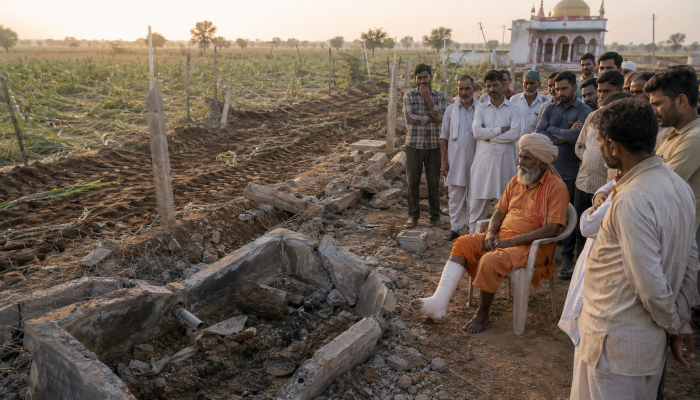
Case Summary
The land of Thakur Ji Mandir in Rewat (Kadail) village near Pushkar in Ajmer district, Rajasthan, was targeted for attempted encroachment late at night on 25 May 2026. A group of approximately 30 to 40 individuals arrived with a JCB (excavator) and a tractor and broke the temple land’s fencing, gate, and cattle water trough, and destroyed the standing crops on the temple’s agricultural land. When the temple priest and his sons arrived to protest the encroachment, they were chased and attacked with an iron rod, causing injuries. As per details, temple priest Girdhari Das Vaishnav was awakened at approximately midnight by a phone call from Mahavir Singh, a labourer working on the temple’s agricultural land, informing him that 30 to 40 people had arrived with a JCB and tractor and were breaking the temple land’s fencing, gate, and cattle water trough. The priest arrived at the scene with his son and protested the encroachment. The attackers chased the priest and his son with sticks, iron rods, and other weapons. One individual struck the priest with an iron rod, causing serious injury to his leg. The priest and his son fled to save their lives and informed the police. The fencing of adjacent fields belonging to Shankar Singh and Manish Soni was also broken by the JCB during the incident. Police arrived at the scene, but the attackers had fled. On the morning of 26 May 2026, large numbers of villagers and the priest’s family reached Pushkar Police Station under the leadership of former District Council member Mahendra Singh Majhewala, demanding immediate arrests. Villagers warned that if action was not taken within 24 hours, a protest demonstration would be held at the Ajmer Collectorate. Police registered a case against furniture trader Ishwar Dhariwal of Ajmer and approximately 40 others and initiated an investigation.
Why it is Hate Crime ?
The primary category for this case is "Attack on Hindu religious representations". The sub-category for this case is "Encroachment or illicit takeover of temple land/land near temple". In Hinduism, a temple is the abode of the Deity. The Deity in the Temple is consecrated, thereby, making it a real, breathing entity. Hindus believe that not just the Deity but the temple premises itself are sacred to Hindus since Hindus hold the faith that the entire Temple space is an amalgamation of the divine energy of the deity. Not only the Temple but the Temple premises in its entirety are considered sacred by Hindus. In several cases, the premises of the Temple and/or religious centre are illicitly taken over by institutions belonging to other faiths – like the Waqf board or the Church. Other times, the temple property, land or the property of religious centres are illicitly encroached by non-Hindu groups. Any illicit take over or encroachment is a crime an initio, however, when non-Hindu groups illicitly take over or encroach the sacred land of Hindus, it is an affront to the Hindu community and is therefore classified as a religiously motivated hate crime under this category. Another sub-category for this case is "Attack on temples". In Hinduism, a temple is the abode of the Deity. The Deity in the Temple is consecrated, thereby, making it a real, breathing entity. Hindus believe that not just the Deity but the temple premises itself are sacred to Hindus since Hindus hold the faith that the entire Temple space is an amalgamation of the divine energy of the deity. Given the central significance of Temples in Hindu Dharma, any attack against a Hindu Temple or its peripheral premises is an attack on the faith itself and is born out of animosity towards the faith, of which, the Temple is a central tenet. Any manner of attack against a Temple and/or its premises would therefore be considered a religiously motivated hate crime. The second primary category selected in this case is- Attack not resulting in death. The subcategory selected is- Attacked for opposing radicals or trying to save victim. In several cases, Hindus are attacked for opposing religiously motivated crimes being committed against a fellow Hindu or simply for voicing an opinion opposing radical elements, who either have in the past or continue to persecute Hindus. In such cases, the initial attack against the victim, against which the Hindu was trying to defend the victim, would also need to be classified as a religiously motivated hate crime. Since the initial crime itself was religiously motivated and the subsequent crime of attempting to save the victim or speaking against the radical elements ends up inviting a violent attack, it would also be classified as a religiously motivated hate crime under this category. This case is a clear example of a hate crime because a Hindu temple’s land was targeted for encroachment, and the temple’s fencing, gate, and other property were damaged during the process. The perpetrators not only attempted to take control of land belonging to the temple but also destroyed infrastructure associated with the religious premises. When the temple priest and his sons arrived to oppose the encroachment and protect the temple property, they were chased and violently attacked, resulting in injuries. The combination of the attempted encroachment on temple land, the destruction of temple property, and the assault on those defending it gives this incident a clear religious dimension and makes it a case of a hate crime targeting a Hindu religious institution and its custodians. A Hindu temple is not merely a physical structure but a sacred religious space that holds immense spiritual, cultural, and social significance for the Hindu community. The land attached to a temple is also regarded as an integral part of the religious institution, as it is often dedicated to the deity, used for religious activities, maintenance of worship, charitable functions, and the sustenance of the temple and its priests. Consequently, temple land is not viewed simply as ordinary property but as part of a sacred space associated with the deity and the religious life of the community. Any attempt to seize, damage, or unlawfully occupy such land is not merely an encroachment on property but an attack on a site of religious significance. Hence, the targeting of the temple, the destruction of its fencing and gate, and the attempt to take control of land belonging to the temple amount to a clear case of a religiously motivated hate crime. The temple and its land are sacred to Hindus, and vandalism and encroachment directed against them undermine the sanctity of a revered religious institution. The deliberate damage to temple property and the effort to occupy temple land demonstrate hostility towards a Hindu place of worship and its associated religious assets. Such acts go beyond an ordinary property dispute because they involve the desecration and violation of a space that holds deep religious significance for the Hindu community, thereby giving the incident a clear hate-based character. When the temple priest and his sons went to oppose this desecration and protect the temple property, the perpetrators launched a violent assault against them. This demonstrates how individuals attempting to safeguard Hindu religious spaces from encroachment, vandalism, and damage can themselves become targets of violence. The attack was not limited to the attempted takeover of the temple land; it also extended to those who sought to defend the sanctity and integrity of the religious site. This further strengthens the religious dimension of the incident and demonstrates hostility towards both the sacred space and those responsible for its protection, making it a hate crime rooted in religious animosity. Given that this case involves the targeting of a Hindu religious institution, damage to property associated with a temple, an attempt to encroach upon land regarded as part of the sacred premises, and a violent assault on individuals who opposed these actions, it meets the parameters of a hate crime. Therefore, the case is being added to the hate crime database of the Hinduphobia Tracker. Disclaimer: In this case, although the temple priest and his sons were attacked, the total number of sons who were subjected to the assault has not been specified in the available information. Therefore, for documentation purposes, the victim count has been recorded as one, based on the explicitly identified victim, namely the temple priest. This should be treated as a conservative estimate for documentation purposes only and does not necessarily reflect the actual number of individuals affected by the attack.
Victim Details
Total Victim
1
Deceased
0
Gender
- Male 1
- Female 0
- Third Gender 0
- Unknown 0
Caste
- SC/ST 0
- OBC 0
- General 1
- Unknown 0
Age Group
- Minor 0
- Adult 1
- Senior Citizen 0
- Unknown 0


Case Status
Complaint registered


Perpetrators Details
Perpetrators
Others
Perpetrators Range
From 10 to 100
Perpetrators Gender
male
 Sources




