Hindu temple in Modinagar desecrated as miscreant enters sanctum sanctorum with shoes and robs offerings; violently attacks Hindu family who reported theft
 Ghaziabad, Uttar Pradesh, India
  24 May, 2026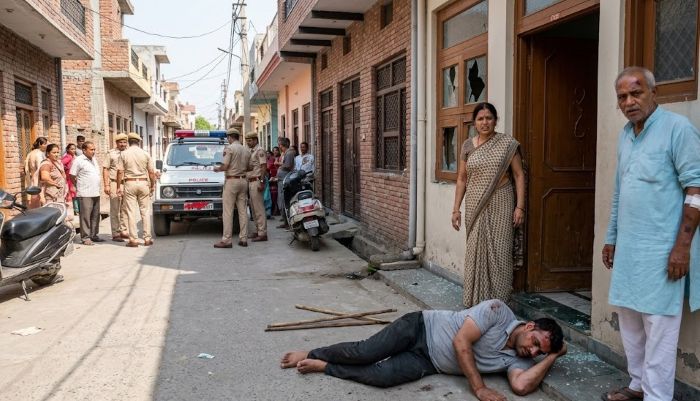
Case Summary
A Hindu temple in Jagatpuri Colony, Modinagar, Ghaziabad, Uttar Pradesh, was desecrated and robbed when a perpetrator entered the sacred premises wearing shoes, violating the most fundamental tradition of Hindu devotional practice, and stole cash from near the idol and dhuna [a sacred fire pit used in Hindu devotional worship]. The desecration was captured on CCTV footage. When a colony resident named Sandeep identified the perpetrator from the footage and complained to his family, the perpetrator and his family members launched a violent retaliatory attack on Sandeep and his uncle Rajesh, beating both men severely with sticks and vandalising Sandeep's home. As per details, the temple theft occurred two days before the attack on 25 May 2026. CCTV footage captured the perpetrator wearing shoes inside the temple and stealing cash from near the idol and dhuna. Upon viewing the footage, Sandeep approached the perpetrator's family to complain about the theft. The perpetrator and his family members reacted with violent fury. They entered Sandeep's home and vandalised it. They then dragged Sandeep outside and beat him severely with sticks, leaving him seriously injured. When Sandeep's uncle Rajesh intervened to protect his nephew, the attackers beat him as well. Both Sandeep and Rajesh were hospitalised following the attack. Videos of both the temple theft and the violent attack spread widely on social media. Sandeep's mother Pooja stated that police had registered only an NCR [Non-Cognisable Report] rather than an FIR, which had emboldened the perpetrators who were openly issuing threats of serious consequences against the family, and stated that police was colluding with them. ACP Modinagar Bhaskar Verma stated that action had been taken as per the written complaint and that an investigation was underway based on the viral videos.
Why it is Hate Crime ?
The primary category for this case is "Attack on Hindu religious representations". The sub-category for this case is "Defiling religious custom". Sanatan Dharma is not a religion of one book, which is to say that while it has religious scriptures that form the central tenets of the faith, there are several traditions followed through thousands of years, mostly passed from generation to generation orally. There are several such customs and traditions that are followed by various Hindus and Hindu sects. Defiling of these traditions and customs is a breach of an individual or group’s religious practices. Such practices can range from dietary restrictions like not eating non-vegetarian food for a certain period of the year, not eating non-vegetarian food at all, not eating beef since the cow is considered holy in Hinduism, the sanctity of religious customs followed in the house (like many ISCKON devotees), etc. Any malicious action leading to the breach of such traditions or defilement of these traditions owing to animosity towards the faith or for the sake of activism stems not only from the lack of faith in the religion itself but also from disregard for the faith of the devotees who follow the customs/traditions and implicit bias against the faith, the tradition itself. Since these specific traditions are central to the faith of the devotees of that specific sect of Hindus, any non-compliance with these traditional rules would be considered a religiously motivated hate crime. Another sub-category for this case is "Breaking rules of place of worship". Sanatan Dharma is not a religion of one book, which is to say that while it has religious scriptures that form the central tenets of the faith, there are several traditions followed through thousands of years, mostly passed from generation to generation orally. One of these oral traditions or written traditions is the rules of specific temples. Certain temples have rules which are traditional rules, dependent on the worship of the presiding deities. These rules and traditions have been followed for thousands of years whether they find scriptural mention or not. Such traditions are based on the nature and rules of worship of the presiding deity of that temple. Any non-compliance of these traditions owing to animosity towards the faith or for the sake of activism stems not only from the lack of faith in the presiding deity but also disregard for the faith of the devotees of that deity/temple and implicit bias against the faith, the tradition and the deity itself. Since these specific traditions are central to the faith of the devotees of that specific temple and presiding deity, any non-compliance with these traditional rules would be considered a religiously motivated hate crime. Another primary category for this case is "Attack not resulting in death". The sub-category here would be "Attacked for opposing radicals or trying to save victim". In several cases, Hindus are attacked for opposing religiously motivated crimes being committed against a fellow Hindu or simply for voicing an opinion opposing radical elements, who either have in the past or continue to persecute Hindus. In such cases, the initial attack against the victim, against which the Hindu was trying to defend the victim, would also need to be classified as a religiously motivated hate crime. Since the initial crime itself was religiously motivated and the subsequent crime of attempting to save the victim or speaking against the radical elements ends up inviting a violent attack, it would also be classified as a religiously motivated hate crime under this category. The desecration of the Hindu temple in Jagatpuri Colony began the moment the perpetrator crossed the threshold wearing shoes. The removal of footwear before entering a Hindu temple is not a bureaucratic rule or a modern institutional requirement. It is a tradition passed down over thousands of years as an act of reverence toward the presiding deity and the sacred space. Its deliberate violation reflects not merely criminal intent but a fundamental disregard for the devotional sanctity of the space and the faith of those who worship there. A person who enters a Hindu temple wearing shoes to steal from it has not merely committed a property crime. He has committed an act of religious desecration from the moment of entry. Non-compliance with this tradition stems from animosity or disregard for the faith and constitutes a religiously motivated hate crime. Additionally, the violent retaliatory attack on Sandeep and his uncle Rajesh following their attempt to seek accountability for the temple desecration establishes the second dimension of this case. Sandeep did not confront the perpetrator physically or take any aggressive action. He viewed the CCTV footage and approached the perpetrator's family to raise a complaint about the desecration of his community temple. Two days later, the accused went to the Hindu complainant's house and attacked him and his family members. The response was not immediate but well organised and premeditated. The perpetrator and his family members, after two days, went armed to Sandeep's home and vandalised it. They dragged him outside and beat both him and his uncle Rajesh with sticks until both required hospitalisation. The violence was not reactive anger. It was a coordinated retaliatory operation conducted by multiple individuals against a Hindu man who had sought accountability for an act of religious desecration. The perpetrator's family treated the raising of a complaint about temple desecration as a provocation worthy of organised communal violence, establishing that the desecration and the subsequent violence were connected expressions of the same underlying hostility toward the Hindu community. Equally important, such retaliatory attacks serve a broader purpose beyond punishing the immediate victim. By attacking a Hindu man who objected to the desecration of a temple, the perpetrators sent a message to the wider Hindu community that resisting, reporting, or seeking justice for attacks on Hindu religious symbols could invite violent consequences. The objective was not merely to assault Sandeep but to create fear among other Hindus and discourage them from defending their places of worship or asserting their religious rights. Such acts of collective intimidation are designed to establish dominance, silence opposition, and make the wider community think twice before challenging anti-Hindu conduct. This element of intimidation directed beyond the individual victim further underscores the hate crime nature of the offence. The institutional failure compounds the harm's religious dimension. Police registered only an NCR rather than an FIR, which Sandeep's mother, Pooja, characterised as collusion with the perpetrators. The perpetrators became emboldened immediately and began issuing open threats of serious consequences. A Hindu community whose temple was desecrated and whose members were hospitalised for seeking accountability received institutional protection so inadequate that the perpetrators felt confident enough to issue open threats in the aftermath of the attack. This case is being added to the hate crime database of the Hinduphobia Tracker because the wearing of shoes into a Hindu temple, the theft from near the idol and dhuna, the organised retaliatory violence against Hindus who sought accountability, and the institutional indifference that emboldened further threats together constitute a sustained and multi-dimensional assault on Hindu religious identity and Hindu community safety. The desecration began with a pair of shoes crossing a sacred threshold and culminated in two Hindu men being hospitalised for daring to demand accountability for it. Given that this case met the parameters of a religiously motivated hate crime, it was added to the hate crime database of the tracker. Disclaimer: The exact date of the temple desecration was not confirmed in the source. The tracker records incident dates based on when the crime occurred, not when it was reported or published. The source confirms the theft occurred two days before the attack and complaint, placing it at approximately 25 May 2026. This date has been recorded for documentation purposes only.
Victim Details
Total Victim
2
Deceased
0
Gender
- Male 2
- Female 0
- Third Gender 0
- Unknown 0
Caste
- SC/ST 0
- OBC 0
- General 0
- Unknown 2
Age Group
- Minor 0
- Adult 2
- Senior Citizen 0
- Unknown 0


Case Status
Complaint filed


Perpetrators Details
Perpetrators
Unknown
Perpetrators Range
Unknown
Perpetrators Gender
male
 Sources




