“Only goons wear tilak”: Sacred Hindu symbol treated like crime and children as criminals for displaying their faith
 Dehradun, Uttarakhand, India
  25 May, 2026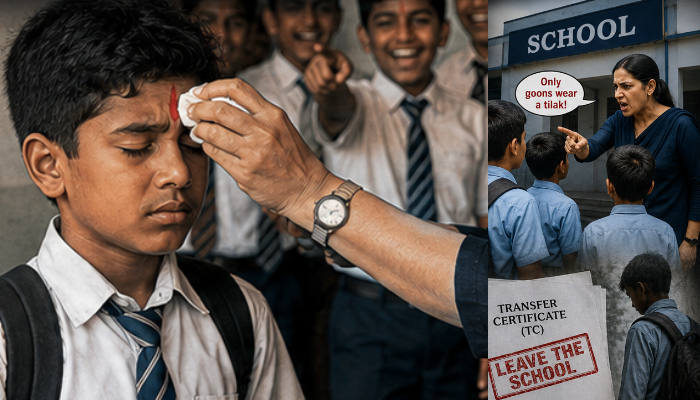
Case Summary
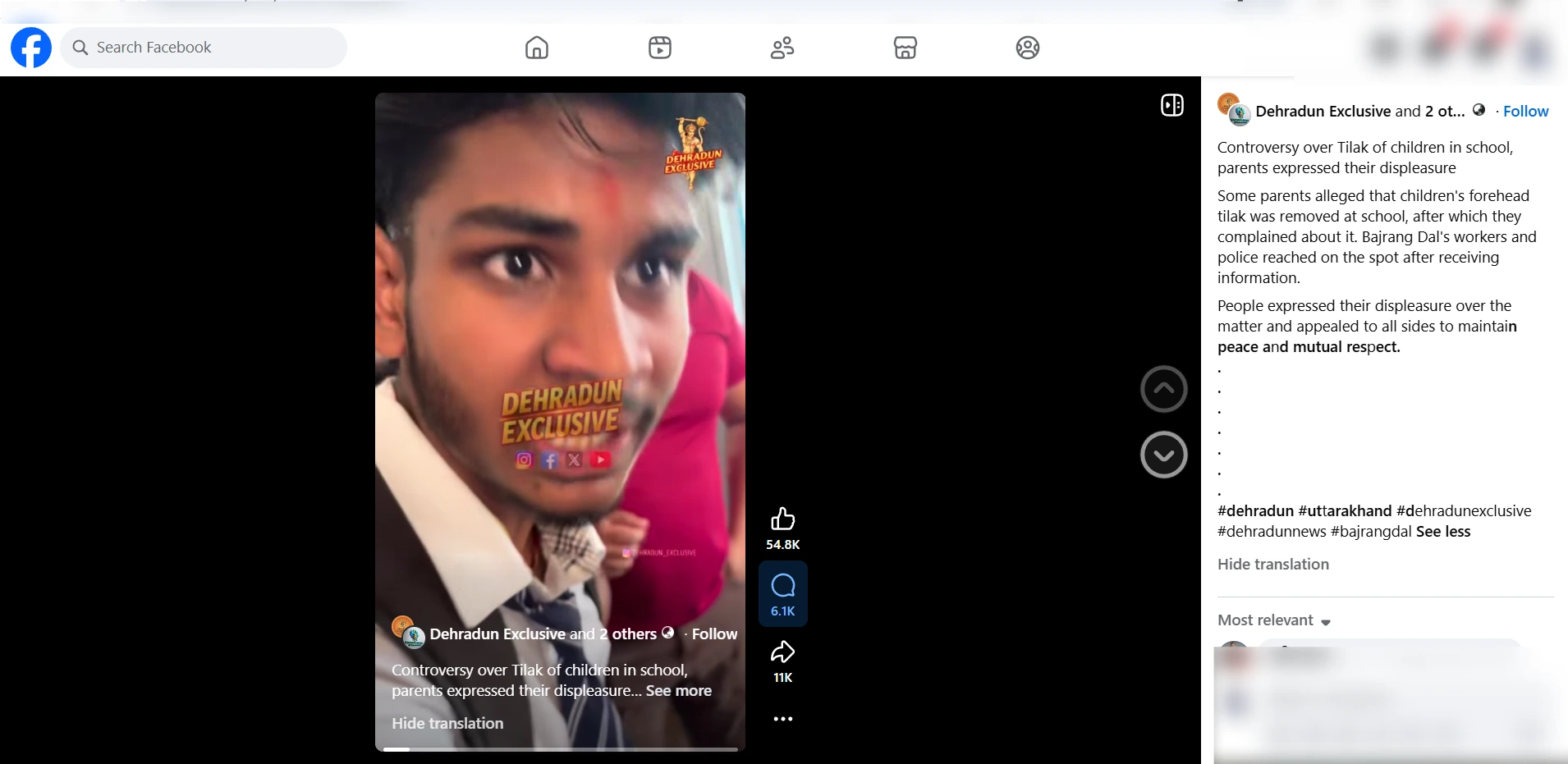
At a school in Dehradun, Uttarakhand, minor Hindu students were restricted from wearing tilaks, a sacred Hindu symbol worn on the forehead as an expression of faith and religious identity. Teachers and other school authorities forcibly wiped off the students' tilaks and mocked them with remarks such as, "Only goons wear a tilak." The students stated that they were routinely humiliated, harassed and threatened with expulsion if they refused to comply with the school's demands. The incident came to light on 27 May 2026, when two Hindu students were stopped while entering the school and ordered to remove their tilaks. When they refused, they were issued Transfer Certificates and told to leave the school. Distressed by the treatment they had faced, the students approached Bajrang Dal activists and recounted their ordeal. Following this, Bajrang Dal activists reached the school and confronted the principal and several teachers, nearly fifteen in total, who had been involved in targeting the students. A video of the incident soon went viral on social media, triggering widespread outrage. In the video, one Hindu student stated that he and his friends had been instructed to remove their tilaks and that when they refused, teachers mocked their faith by saying, "Only goons wear a tilak." Another student revealed that, a day earlier, on 26 May 2026, the tilaks of three to four Hindu students had been forcibly wiped off by school authorities. The students further explained that this was not an isolated incident. According to them, Hindu students who wore tilaks were routinely singled out, made to stand separately, humiliated in front of others and compelled to remove the sacred symbol. Several students stated that such treatment had become a regular occurrence within the school. The video also showed numerous Hindu students approaching Bajrang Dal workers and describing how their tilaks were wiped off every day and how they were repeatedly mocked for wearing them. According to the students, school authorities would tell them: "This is a school, not a religious place where you will be Hindu, Muslim, Christian or Sikh. Remove the tilak or leave the school." When Bajrang Dal workers confronted the teachers, they denied that any such incidents had occurred. The teachers also stated that the school had an equal number of Hindu and Muslim students. One female teacher mockingly remarked, "What will happen by wearing a tilak?" Meanwhile, other teachers and the principal also denied that there were any restrictions on wearing tilaks. However, more than twenty Hindu students came forward on camera and stated that their tilaks were forcibly wiped off on a daily basis. In protest against the school's actions, Bajrang Dal workers applied tilaks to the foreheads of several Hindu students. As tensions escalated, the police arrived at the school to maintain order. The students shared their experiences with the police and described the treatment they had endured. According to the students, even after the matter came to light, school authorities continued to pressure and threaten them, accusing them of acting against the school. They stated that they were instructed to return with their parents, apologise, remove their tilaks, or leave the school altogether. Some students further said that teachers mocked their faith by remarking, "If you want to practise Hinduism so much, then go and chant the Hanuman Chalisa as well." The Hindu students appealed to Bajrang Dal for help, stating that they had been targeted, humiliated, threatened and punished simply for expressing their Hindu faith and identity. Following the incident, Bajrang Dal workers urged the Uttarakhand state government to take action against such schools that harass Hindu students, suppress their religious expression and disrespect their religious identity.
Case Images
Why it is Hate Crime ?
This case has been added to the tracker under the first primary category: Restrictions/Ban on Hindu Practices. The subcategory selected is: Restriction on Expression of Hindu Identity. An example of the state-affected prejudicial and targeted orders against the Hindu community would be a government denying the right of a Hindu or a group of Hindus to hold a religious procession owing to the animosity of non-Hindu groups. Denial of the religious right of the Hindus to assuage the non-Hindu group which harbours animosity to a point where it could lead to violence against Hindus is not only a failure of law and order but is a prejudicial order against Hindus, denying them their fundamental rights to express their religious identity. An example of a hate crime against Hindus by a non-Hindu would be a non-Hindu institution forcing its Hindu employees to abandon religious symbols that a Hindu would wear as an expression of faith owing to inherent prejudice against the faith professed by the victim or a non-Hindu group of people restricting a Hindu group from constructing a place of worship simply because the demography of the area in which the temple is being built is dominated by non-Hindus. Such actions are driven by religious animosity and/or prejudice against Hindus and their faith and would therefore be categorized as a hate crime. The second primary category selected in this case is: Attack on Hindu Religious Representations. The subcategory selected is: Desecration of Hindu Religious Symbol. Icons and symbols or a religious representation of a spiritual ideal are widely revered in Hinduism. Iconography is of vital significance in the Hindu milieu. It helps connect people’s spiritual beliefs with the real world. Iconography within the Hindu faith takes several shapes and forms. Murtis are of most significance to Hindus, to which daily rituals, prayers and offerings are done. Besides the murtis, there are several other symbols which have deep significance in the Hindu faith – the Om and Swastika for example. Since these Hindu religious symbols hold paramount importance in Hinduism, any desecration of symbols, icons, murtis, religious representations and manifestations, is driven by animosity towards the faith itself which manifests itself through these murtis, icons and symbols. Therefore, any desecration of these Hindu religious symbols and representations is considered religiously motivated hate crimes under this category. The third primary category selected is: Hate Speech Against Hindus. The subcategory selected is: Anti-Hindu Slurs, Mocking Faith. Anti-Hindu slurs and the deliberate mocking of the Hindu faith owing to religious animosity involve the usage of derogatory terms, stereotypes, or offensive references to religious practices, symbols, or figures. One of the common anti-Hindu slurs used against Hindus is “cow-worshipper” and “cow piss drinker”. The intention of using this term is to demean and mock Hindus as a group and their religious beliefs since Hindus consider the cow holy. Additionally, some symbols and the slurs attached to them have a historical context that exacerbates the insult, hate, stereotyping, dehumanisation and oppression against Hindus. Cow worship has been used for centuries to denigrate Hindus, insult their faith and oppress Hindus specifically as a religious group. There has been overwhelming documentation about how cow slaughter has been used to persecute Hindus with cow meat being thrown in temples and places of worship. There has also been overwhelming documentation where cow meat (beef) has been force-fed to Hindus to either forcefully convert them to Islam or denigrate their faith. Apart from cow worship, the Swastika – which holds deep religious significance for the Hindus – has also been misinterpreted and distorted to use as a slur against Hindus. Similarly, the worship of the Shivling has been used by supremacist ideologies and religions to denigrate Hindus owing to religious animosity. Such slurs and denigration stem out of inherent animosity and hate towards Hindus and their faith, therefore, it is categorised as hate speech targeted at Hindus specifically owing to their religious identity. The fourth primary category selected is: Predatory Proselytisation. The subcategory selected is: Proselytisation by Grooming, Brainwashing, Manipulation, or Subtle Indoctrination. Religious brainwashing essentially means the often subtle and forcible indoctrination to induce someone to give up their religious beliefs to accept contrasting regimented ideas. Religious grooming or brainwashing also involves propaganda and manipulation. It involves the systematic effort, driven by religious malice and indoctrination, to persuade “non-believers’ to accept allegiance, command, or doctrine to and of a contrasting faith. Cases of such grooming or brainwashing are far more nuanced than direct threats, coercion, inducement and violence. In such cases, it is often seen that there is repeated, subtle and continual manipulation of the victim to induce disaffection towards their own faith and acceptance of the contrasting faith of the perpetrator. While subtle indoctrination is widely acknowledged as predatory, an element which is often understated in such conversions or the attempts of such conversion is the role of loyalty and trust which might develop between the perpetrator and the victim. Fiduciary relationships are often abused to affect such religious conversion. For example, an educator transmitting religious doctrine of a competing faith to a Hindu student. The Hindu student is likely to accept what the teacher is transmitting owing to existence of the fiduciary relationship. The exploitation of the fiduciary relationship to religiously indoctrinate victims would also be included in this category. Since the underlying animosity towards the victim’s faith forms the basis of predatory proselytization, such cases are considered religiously motivated hate crimes. In this case, minor Hindu students at a school in Dehradun, Uttarakhand, were subjected to religious discrimination and humiliation for wearing a tilak, a sacred Hindu symbol worn on the forehead as an expression of the Hindu faith and religious identity. According to the students, the teachers and school authorities forcibly wiped off their tilaks, mocked them by saying that "only goons wear a tilak", and threatened them with disciplinary action, including being asked to take Transfer Certificates and leave the school if they continued wearing tilaks. The students further stated that such treatment was not an isolated occurrence but a recurring practice directed specifically at Hindu students. The repeated targeting of Hindu students for displaying a visible symbol of their faith demonstrates that the conduct was directed at them because of their religious identity. This case, therefore, meets multiple parameters of a religiously motivated hate incident. The Hindu students were singled out solely because of their religious identity and expression. The students were not accused of misconduct, indiscipline, disruption of classes, or any other violation that would justify punitive action. Their only "offence" was wearing a tilak, an important symbol of Hindu faith and devotion. If the school genuinely maintained a neutral policy regarding religious symbols, the matter could have been addressed respectfully through established procedures and applied uniformly to students of all faiths. Instead, the Hindu students were singled out, publicly humiliated, and subjected to derogatory remarks about their religious practice. The selective targeting of Hindu students for displaying a Hindu symbol demonstrates that the action was directed not merely at a mark on the forehead but at the students' religious identity. Such conduct transforms a routine disciplinary issue into a case of religious discrimination because the students became targets specifically due to the visible expression of their Hindu faith. The tilak holds profound religious and cultural significance in Hinduism. It is not merely a decorative mark but a sacred symbol associated with devotion, spirituality, blessings, and religious identity. Across numerous Hindu traditions, tilaks are applied during prayer, worship, festivals, pilgrimages, and other religious observances as an outward expression of faith and reverence. For Hindus, wearing a tilak is a deeply personal act of devotion and a visible affirmation of their religious beliefs. It serves as a marker of spiritual commitment and connection with Hindu traditions that have been practised for centuries. Consequently, any attempt to forcibly remove a tilak cannot be viewed as the removal of a simple cosmetic mark; it directly interferes with a religious practice and a symbol that carries deep meaning for the believer. The significance of the tilak within Hinduism makes the targeting of those who wear it particularly harmful and offensive to the religious sentiments of Hindu students and their families. The restriction imposed on Hindu students for wearing tilaks further demonstrates hostility towards Hindu religious identity and expression. A tilak is a peaceful and widely recognised expression of Hindu faith, yet in this case, Hindu students were subjected to harassment, humiliation and punishment merely for displaying this aspect of their religious identity. The fact that a simple expression of Hindu faith by minor students provoked repeated targeting and disciplinary threats underscores the discriminatory nature of the treatment they faced. Rather than accommodating or respecting the students' religious beliefs, school authorities sought to suppress and remove a visible manifestation of their faith. Such actions have the effect of erasing or discouraging the public expression of Hindu identity within an educational institution and communicate to Hindu students that openly practising their faith may invite punishment or humiliation. This is deeply disrespectful towards Hindu beliefs and practices and constitutes an attack on the dignity, identity and religious expression of Hindu students. By making Hindu children feel that they must conceal or abandon a harmless religious practice in order to avoid harassment, the authorities created an environment that was hostile towards the open expression of Hindu identity. Consequently, forcibly wiping off a tilak against a Hindu student's wishes amounts to the deliberate removal and desecration of a sacred religious symbol. By physically erasing the tilaks of Hindu students, school authorities did not merely remove a mark; they interfered with and disrespected a religious expression that carries deep spiritual significance for the students and their families. The physical act of wiping off the tilak is particularly significant because it transformed verbal disapproval into direct action against a visible manifestation of Hindu faith. The students were not merely asked to comply with a rule; according to their accounts, the symbol itself was forcibly erased from their foreheads. Such conduct communicates that Hindu religious expression is unwelcome and must be removed from public view. The deliberate removal of a sacred symbol, coupled with mocking remarks and threats of punishment, demonstrates a pattern of conduct directed against Hindu religious identity and contributes to the classification of the incident as a religiously motivated hate incident. The fact that the students were told that "only goons wear a tilak" further strengthens the religiously motivated nature of the incident. This statement did not merely prohibit a symbol; it actively stigmatised and demeaned it. The remark associated a sacred Hindu religious symbol with criminality and undesirable behaviour, thereby insulting not only the students who wore the tilak but also the broader Hindu community for whom the symbol holds deep religious significance. Such language transforms the incident from a dispute over school rules into an act of religious ridicule and mockery. By attaching a negative stereotype to a sacred Hindu symbol, the statement fostered an atmosphere in which Hindu beliefs and practices were treated with contempt rather than respect. This constitutes a form of anti-Hindu hostility because the insult was directed specifically at a religious symbol and those who chose to wear it. The statements attributed to the school authorities, namely that students should not come to school as "Hindu, Muslim, Sikh or Christian" but only as students, and that those unwilling to remove their tilaks should leave the school, further demonstrate hostility towards the open expression of religious identity. While educational institutions may seek to promote unity and equality among students, such principles cannot be used to selectively suppress a harmless religious practice. In this case, the message conveyed to the Hindu students was that they could remain in the school only if they concealed a visible aspect of their religious identity. The choice presented to them was not between discipline and indiscipline, but between abandoning a manifestation of their faith or facing exclusion from the institution. Such conduct creates an environment in which Hindu students are made to feel that their religious identity is unwelcome and that acceptance is conditional upon suppressing their beliefs. This transforms what should be a place of learning into a setting where Hindu children are pressured to distance themselves from their religious identity in order to avoid punishment or expulsion, demonstrating clear intolerance towards the expression of Hindu faith. The remarks made by a teacher questioning, "What will happen by wearing a tilak?", further reinforce the dismissive and hostile attitude displayed towards Hindu religious practices. The significance of a religious symbol is not determined by the tangible benefit it produces but by the spiritual, cultural and devotional meaning it holds for believers. For millions of Hindus, the tilak is a sacred expression of faith, devotion and religious identity. By mockingly questioning its value, the teacher trivialised and belittled a practice that holds deep significance for Hindu devotees. Such remarks did not reflect a position of religious neutrality; rather, they conveyed contempt for a symbol that is revered within Hinduism. When a figure of authority openly ridicules a sacred religious practice in front of students, it not only humiliates those who follow that faith but also legitimises prejudice against them. The dismissive treatment of the tilak, combined with its forcible removal and the punishment of those who wore it, points towards a broader pattern of hostility directed at Hindu religious expression and identity. The accounts given by multiple Hindu students that they were routinely forced to remove their tilaks and that their tilaks were forcibly wiped off on a daily basis further demonstrate that this was not an isolated incident but a recurring pattern of conduct directed specifically at Hindu religious expression. The repeated removal of tilaks amounts to more than mere disciplinary enforcement; it constitutes the deliberate targeting and desecration of a sacred Hindu religious symbol. The tilak is a visible manifestation of Hindu faith and identity, and forcing Hindu students to erase it from their foreheads sends a clear message that expressions of Hindu belief are unwelcome within the institution. The humiliation inflicted upon the students by making them stand in line, publicly removing their tilaks, and ridiculing them for wearing them transformed a personal act of devotion into a source of shame and punishment. Such actions specifically targeted the students because they chose to visibly express their Hindu identity and therefore constitute discrimination directed at them on the basis of their religion and religious expression. The remarks made by school authorities after the police became involved further reinforce the hostile attitude displayed towards Hindu beliefs and practices. According to the students, they were told that if they wished to practise Hinduism so much, they should "go and chant the Hanuman Chalisa as well". The Hanuman Chalisa is one of the most revered devotional hymns in Hinduism and is recited by millions of Hindus as an act of worship and devotion to Lord Hanuman. In this context, the statement was not presented as a respectful acknowledgement of the students' faith but as a sarcastic and derisive remark intended to mock their religious beliefs and practices. By using a sacred Hindu prayer as a subject of ridicule, the statement trivialised a deeply revered aspect of Hindu devotion and conveyed contempt towards the students' faith. Such comments contribute to an atmosphere in which Hindu religious practices are not treated with respect but are instead used as objects of mockery and humiliation, further underscoring the religiously motivated nature of the conduct described by the students. It is also important to recognise the broader impact that repeated harassment, ridicule and suppression of Hindu religious practices can have on minor Hindu students. When children are consistently mocked, punished or humiliated for expressing their faith, they may begin to associate their Hindu identity with social stigma, exclusion and negative consequences. Over time, this can create pressure to abandon visible expressions of their faith simply to avoid further harassment. Such an environment does not encourage genuine freedom of conscience; rather, it discourages Hindu students from openly identifying with their religion and gradually alienates them from their religious and cultural heritage, making them a potential target for conversion to other faiths. This concern becomes even more significant when the victims are minors. Children, by virtue of their age and stage of development, are particularly vulnerable to social pressure, authority figures and institutional influence. They often lack the maturity and independence necessary to fully evaluate such pressures or resist them. Consequently, persistent hostility towards a child's Hindu identity leads to the child distancing themselves from their faith, not as a result of an informed and voluntary choice, but because of the fear of continued humiliation, punishment or exclusion. Such conditions make vulnerable Hindu children more susceptible to embracing alternative religious identities and belief systems, not through genuine conviction but through sustained psychological pressure and alienation from their own faith. In this sense, the repeated suppression of Hindu practices and symbols functions as a subtle form of indoctrination that weakens a child's attachment to Hinduism and increases their vulnerability to religious influence from outside their community. The targeting of minor Hindu students in this manner therefore has profound implications for their religious freedom, identity and ability to exercise genuine freedom of conscience. In this case, it is also important to mention that in 2022, a massive controversy erupted in Karnataka, which took a national form, after Muslim women insisted that they should be allowed to wear burqas and hijabs in their schools and classrooms. At that time, the argument given by several politicians, social commentators, Hindu activists and even the judiciary was that schools have the right to enforce uniform rules, since wearing uniforms brings harmony and equality in the classroom, and therefore, schools not allowing girls to wear hijab in the classroom is not religious discrimination, but merely an enforcement of widely accepted uniform norms. The argument was also that overt religious symbols like the Hijab can be restricted under the school's policy of uniformity. Some pseudo-seculars and anti-Hindu leftists argue that a similar line of reasoning should be applied in this case and that schools have the authority to regulate student appearance in order to maintain uniformity and discipline. However, it is important to note that a tilak is a benign religious symbol that neither disrupts classroom activities nor interferes with the educational environment. For Hindu students, wearing a tilak is a peaceful expression of faith and religious identity. More importantly, the issue in this case extends far beyond any purported uniform policy. According to the students, their tilaks were forcibly wiped off, they were mocked by being told that "only goons wear a tilak", publicly humiliated in front of other students, and threatened with being issued Transfer Certificates and forced to leave the school if they continued wearing tilaks. Such conduct cannot be equated with the neutral enforcement of school regulations. Rather, it demonstrates hostility towards Hindu religious practice and the students who adhered to it. The repeated targeting of Hindu students for wearing a sacred Hindu symbol, coupled with derogatory remarks and punitive actions, raises serious concerns about the motivations behind such enforcement. The actions of the school authorities amount to religious discrimination and are consistent with the framework of a hate incident, where Hindu students were penalised solely for adhering to and expressing their Hindu religious identity. Overall, the cumulative facts of this case demonstrate a pattern of hostility directed at Hindu students because of their faith, religious identity, and religious expression. The forcible removal of tilaks, repeated humiliation, derogatory remarks, threats of exclusion, mockery of Hindu devotional practices, and sustained targeting of Hindu students collectively point towards conduct that was directed not at misconduct but at Hindu identity itself. Since this case meets multiple parameters of a religiously motivated hate incident, it is being added to the hate crime database of the Hinduphobia Tracker. Disclaimer: The Hinduphobia Tracker records incident dates based on when a victim's ordeal begins rather than when the incident is reported by the media. In the present case, the incident came to public attention through social media posts and local media coverage on 27 May 2026. However, information provided by the affected students indicates that the harassment, forcible removal of tilaks, and targeting of Hindu students had been occurring prior to that date as part of an ongoing pattern. One student specifically stated that on 26 May 2026, the tilaks of three to four Hindu students were forcibly wiped off by school authorities. Since the exact date on which this pattern of harassment first began remains unclear from the available information, 26 May 2026 is being recorded as the indicative incident date for documentation purposes only. This date should not be interpreted as the confirmed date on which the harassment commenced, but rather as the earliest date presently available from the evidence in the public domain. In this case, although multiple Hindu students were affected, the currently available video shows nearly twenty Hindu students coming forward and sharing their experiences on camera, with all identifiable victims visible in the footage being male children; additionally, according to students, tilaks were removed from 3–4 students on 26 May 2026. Accordingly, the documented victim count has been recorded as 24 Hindu students (20 male children and 4 whose details remain unspecified). However, the available information also indicates that female Hindu students were also affected by the same practices, and since the exact number of female victims cannot be independently verified from the available evidence, they have not been included in the documented count. Although multiple perpetrators were involved in the incident, only fifteen teachers and one principal were specifically identified in the available video footage. Accordingly, the perpetrator count has been recorded as 16 individuals based on those who could be identified from the evidence currently available. It remains possible that additional school staff members were involved; however, they have not been included in the count due to the absence of clear identification. Both the victim count and perpetrator count should be regarded as conservative estimates based on the evidence presently available. The actual number of affected Hindu students and the total number of individuals involved may be higher than the figures recorded. The documented counts reflect only those victims and perpetrators who could be reasonably identified from the available videos and information at the time of documentation.
Victim Details
Total Victim
24
Deceased
0
Gender
- Male 20
- Female 0
- Third Gender 0
- Unknown 4
Caste
- SC/ST 0
- OBC 0
- General 0
- Unknown 24
Age Group
- Minor 24
- Adult 0
- Senior Citizen 0
- Unknown 0


Case Status
Unknown


Perpetrators Details
Perpetrators
Others
Perpetrators Range
From 10 to 100
Perpetrators Gender
both
 Sources




