Hindu worship site targeted, temple boundary wall demolished amidst ongoing persecution of Hindus in Bangladesh
 Nilphamari District, Bangladesh
  26 May, 2026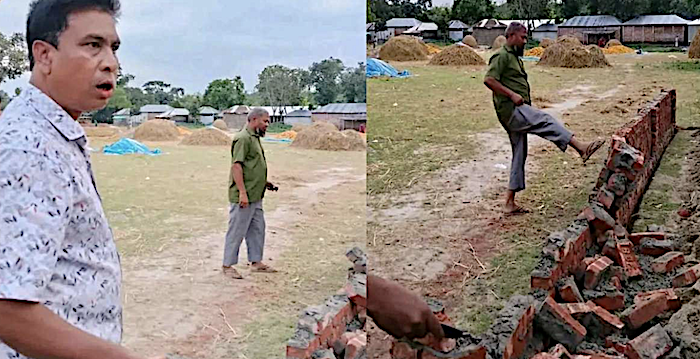
Case Summary
A historic Hindu temple in Nilphamari’s Kishoreganj upazila became the centre of fear and tension after the boundary wall of the Sri Sri Annapurna Temple was publicly demolished. The incident took place in Borovita Union of Kishoreganj upazila, where local Hindus said the destruction of the temple boundary deeply shocked the Hindu community. The incident triggered anxiety among Hindu residents already living under growing insecurity in Bangladesh’s hostile anti Hindu environment. The Sri Sri Annapurna Temple had long stood as a significant religious and cultural centre for local Hindus in the area. Every year, a traditional fair had been organised around the temple, making it an important part of the locality’s Hindu religious identity and cultural heritage. Renovation work and construction of a protective boundary wall around the temple premises had recently been undertaken to improve the security of the temple complex and preserve the religious site. Soon after the construction work began, individuals connected to the local land office arrived at the site and demolished a section of the temple’s newly constructed boundary wall without any prior consultation or community discussion. The demolition specifically targeted the boundary surrounding the Hindu religious premises. The destruction of the wall created immediate fear and unrest among local Hindus, who viewed the incident as a direct attack on the sanctity and security of the temple. Local Hindu residents stated that the temple was not merely a place of worship but also a symbol of the area’s religious history, communal heritage, and long standing Hindu presence. The destruction of the temple boundary caused deep distress within the Hindu community, particularly because the structure had been built to secure the temple premises amid rising insecurity faced by Hindu religious institutions in Bangladesh. The incident also intensified concerns regarding the vulnerability of Hindu temples and the inability of minority communities to safeguard their religious spaces from interference and destruction. Several elderly residents of the locality stated that the temple had historically remained a place around which people of different communities maintained peaceful relations for many years. However, the sudden demolition of the temple boundary without discussion or notice created widespread anger, fear, and uncertainty among local Hindus. Community members feared that the targeting of the temple boundary represented an attempt to weaken the physical protection and territorial security of the Hindu religious site. The destruction of the temple boundary occurred amid a broader pattern of attacks on Hindu temples, homes, and religious institutions across Bangladesh following the political turmoil that unfolded after the removal of Sheikh Hasina’s government in August 2024. During this period, Hindu minorities across Bangladesh experienced repeated incidents of temple vandalism, land encroachment, intimidation, looting, mob violence, and attacks on religious infrastructure. The Hinduphobia Tracker documented hundreds of incidents targeting Hindus, demonstrating the increasingly precarious condition of Hindu religious and cultural spaces in the country. A further escalation in anti Hindu hostility emerged after the death of Sharif Osman Bin Hadi in December 2025. Hindu communities across multiple districts faced retaliatory violence, arson attacks, destruction of homes and temples, and organised intimidation campaigns. Hindu religious symbols and institutions increasingly became focal points of hostility, creating an atmosphere in which attacks on Hindu religious properties became normalised. The demolition of the boundary wall surrounding the Sri Sri Annapurna Temple took place within this wider environment of escalating pressure on Hindu religious institutions and shrinking security for minority communities. The anti Hindu climate intensified further after the 13th National Parliamentary Election 2026, when multiple districts across Bangladesh witnessed coordinated attacks on Hindu homes, temples, and neighbourhoods. Hindu families faced threats, looting, vandalism, forced displacement pressures, and destruction of religious property. Within this broader pattern, the targeting of the boundary wall surrounding a historic Hindu temple carried heightened significance because the attack focused directly on the territorial protection and physical security of a Hindu religious institution situated within a Muslim majority country where Hindus remained a vulnerable minority community.
Why it is Hate Crime ?
This case was added to the tracker under the primary category is - Attack on Hindu religious representations. Within this, the sub-category selected is - Attack on temples. In Hinduism, a temple is the abode of the Deity. The Deity in the Temple is consecrated, thereby, making it a real, breathing entity. Hindus believe that not just the Deity but the temple premises itself are sacred to Hindus since Hindus hold the faith that the entire Temple space is an amalgamation of the divine energy of the deity. Given the central significance of Temples in Hindu Dharma, any attack against a Hindu Temple or its peripheral premises is an attack on the faith itself and is born out of animosity towards the faith, of which, the Temple is a central tenet. Any manner of attack against a Temple and/or its premises would therefore be considered a religiously motivated hate crime. In this case, the historic Sri Sri Annapurna Temple in Kishoreganj Upazila of Nilphamari district, Bangladesh, was directly targeted when individuals linked to the local land office demolished a section of the temple’s newly constructed boundary wall without prior notice or discussion. The destruction of the temple boundary created fear, outrage, and insecurity among local Hindus, who viewed the action as an attack on a longstanding Hindu religious institution and a deliberate attempt to undermine the sanctity and security of a Hindu place of worship. While the incident was presented through the framework of land administration activity, the broader anti Hindu environment in Bangladesh remains essential for understanding the religious nature of the targeting. During periods of sustained persecution against Hindus, attacks on temples, religious infrastructure, and Hindu sacred spaces frequently occur through administrative pressure, encroachment disputes, demolition drives, and selective interference with Hindu religious property. In such an environment, the destruction of a temple boundary wall cannot be separated from the wider pattern of intimidation directed at Hindu religious life and identity. For the purpose of documenting the 2024 to 2026 ethnic cleansing of Hindus in Bangladesh and the subsequent persecution after the political exile of Sheikh Hasina, the death of Sharif Osman Hadi, and the 13th National Parliamentary Election 2026, the Hinduphobia Tracker records such incidents as likely religiously motivated at the point of entry. If any case is later established through credible investigation or court findings to stem from motivations other than religious hostility, it will be revised or removed from the hate crime database. The targeting of the Sri Sri Annapurna Temple carried clear religious significance because the structure was not an ordinary property boundary but part of the physical protection and preservation of a Hindu temple that had existed for generations and functioned as a central religious and cultural landmark for local Hindus. The wall was being constructed specifically to secure and preserve the temple premises and ensure the safety of worshippers and religious gatherings associated with the temple’s traditional annual fair. The deliberate demolition of that protective structure immediately after its construction demonstrated a conscious choice to interfere with a Hindu religious institution at a time when Hindu places of worship across Bangladesh were already facing heightened insecurity and hostility. This incident must also be understood within the broader pattern of targeting Hindu temples and religious symbols during the ongoing anti Hindu persecution environment in Bangladesh. Hindu temples carry immense spiritual and communal significance for the Hindu minority, particularly in regions where Hindus live as vulnerable demographic minorities surrounded by dominant non Hindu populations. Attacking or dismantling visible religious structures such as temple boundaries sends a broader message of domination and insecurity to the Hindu community beyond the immediate physical damage itself. By focusing specifically on the temple boundary instead of surrounding non religious structures, the perpetrators chose a target that carried unmistakable religious significance for Hindus and maximised communal fear within the local Hindu population. The demolition further reflected a calculated assertion of control over Hindu religious space. Local Hindus stated that the temple had long symbolised the religious heritage, history, and cultural continuity of the area. The destruction of the boundary wall therefore impacted not only property but also the Hindu community’s sense of safety, permanence, and ability to practise religion freely. In Bangladesh’s present climate of escalating anti Hindu hostility, even administrative or land related actions directed specifically at Hindu temples acquire heightened religious significance because Hindu religious institutions increasingly face pressure, intimidation, encroachment, and selective targeting. The decision to interfere with the temple premises despite its recognised religious importance reinforced fears among local Hindus that their religious spaces remained vulnerable and unprotected. This attack on the Sri Sri Annapurna Temple must be viewed within Bangladesh’s documented anti Hindu ecosystem, where temples, idols, religious processions, cremation grounds, and Hindu owned religious properties increasingly face acts of vandalism, encroachment, desecration, and intimidation. The demolition of the temple boundary wall reflected more than a routine property dispute. It targeted a visible representation of Hindu religious identity within a Muslim majority environment where Hindu minorities were already facing escalating violence, insecurity, and social marginalisation. The Hindu community surrounding the temple joined countless other Hindu communities across Bangladesh whose religious institutions had become focal points of intimidation during the ongoing persecution period. Against this backdrop, the demolition of part of the Sri Sri Annapurna Temple boundary wall in Nilphamari acquired heightened significance as part of the broader pattern of attacks and pressure directed at Hindu religious institutions in Bangladesh. The incident deepened insecurity among local Hindus and reinforced fears regarding the vulnerability of Hindu places of worship amidst the continuing climate of anti-Hindu hostility. Given Bangladesh's sustained anti-Hindu persecution environment, this case meets all thresholds for inclusion in the Hinduphobia Tracker's hate crime database. Disclaimer: The exact date of the demolition was not specified in the available sources. The Hinduphobia Tracker records incident dates based on when the crime occurred rather than when it was published or circulated in the media. Since the publication date of 27th May 2026 was the only confirmed date available, it was used as the indicative incident date in the tracker for documentation purposes only.


Case Status
Unknown


Perpetrators Details
Perpetrators
State and Establishment
Perpetrators Range
Unknown
Perpetrators Gender
unknown
 Sources




